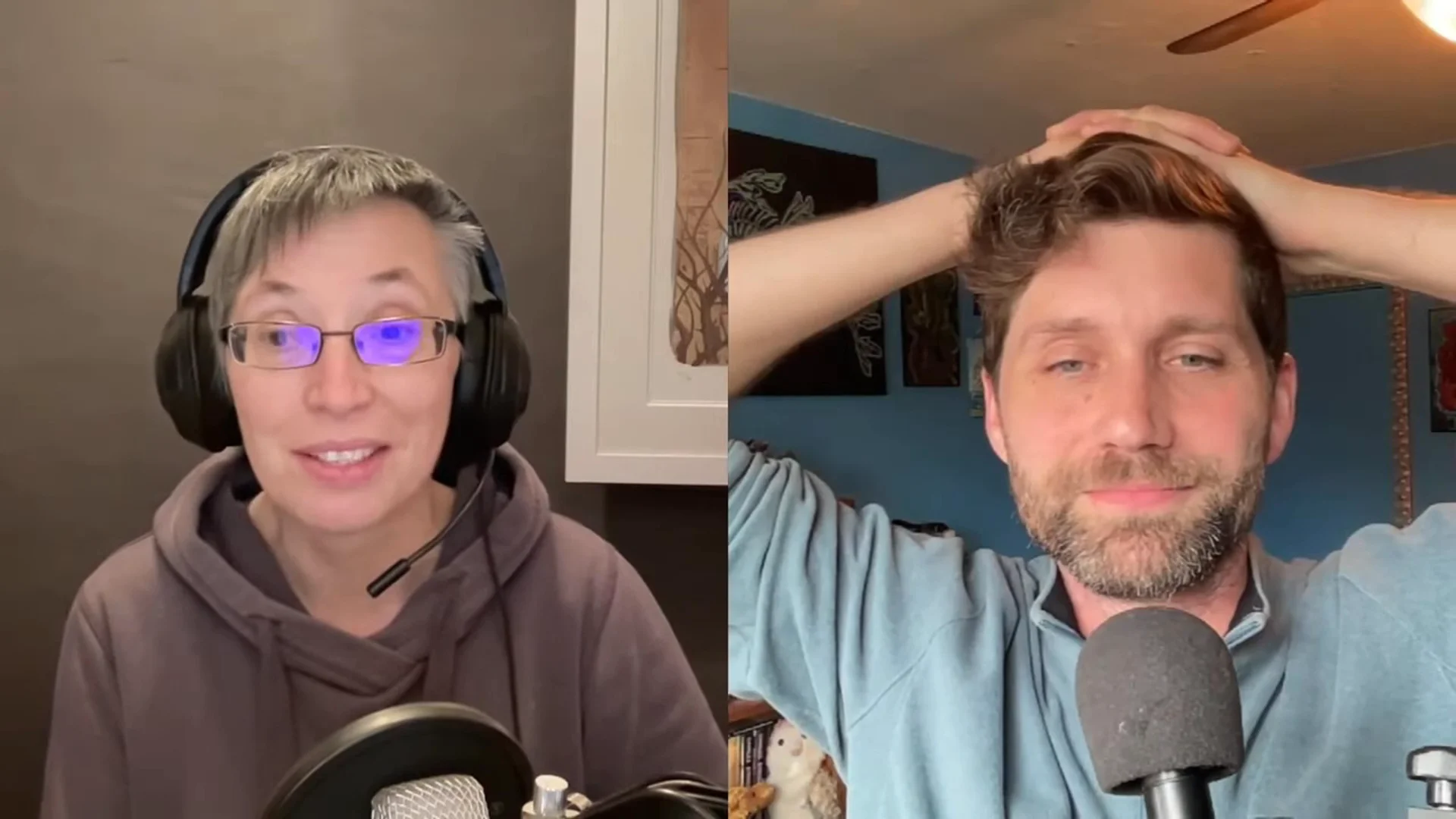
No. 31 of 44 · 11 December 2025 · 1 h 53 min Manda Scott Giving Wisdom to Power and Power to Wisdom Watch the conversation On YouTube Everything said in it, in the order it was said: 239 turns, 140 of them Manda Scott's. Press one to hear it from its second. 0:00 Manda Scott What we're doing at the moment is constraining ourselves within the boundaries of a narrative that tells us there is no alternative to the death cult of predatory capitalism. That this is human nature, to always r want to get to the top of the tree, that the dark triad is the epitome of human behavior when we know from every bit of cognitive neuroscience that actually we are pro-social beings, most of us. It's just that a percentage of us are psychopaths. And we happen to have created a system that elevates the psychopaths. And yeah, they are miracles of evolution just as much. And they have, as we've pointed out several times there, their own deep traumas, and we can have compassion for them. But it's probably not very clever to put them at the wheel of the bus that is driving over the cliff. It would be really cool to give them a stretcher at the back and go, hey, look, we'll help you with your traumas. Someone else is driving the bus. And I am back to I think the goal of clean water, clean air, I would like to drink water that is not has not got forever chemicals in it.0:56 Manda Scott I would like to breathe air that's not going to kill me. I'd like to eat food that is not full of microplastics that I have no idea what happens when I've got a credit card to worth a microplastics in my brain, but it's not going to be good. And I don't want my kids to have that. Clean air, clean water, clean soil strikes me as really basic. Clean connections within myself, all parts of myself, me and you, me and every other part of the web of life. That's really clear. If we all decided to commit to that tomorrow, I don't think there's many people on the planet who go, no, that's a really bad idea. We want toxic air, toxic water, toxic soil, and toxic connections between all of us. We keep going. They're doing it because they don't know that there's an option and they can't see how to get there. Which is the nature of writing throughtopian novels. It ends up cyber political because part of what we are as a culture is cyber political, and we've got to use the tools that we've got to create the off-ramp that enough people can see and want.1:48 Manda Scott Motivation, agency, direction, empowerment. I see a direction I want to go. Clean water, clean air, clean soil, clean connections. And I know what's mine to do to get there. And I feel that it's worth it. And I feel that I can do it. People do things that are incredibly hard. People climb Everest. It's not a cakewalk, but they do it because they can see a route to the top.2:23 Michael Garfield Greetings, future fossils. Welcome to episode 28 of Humans on the Loop, a podcast that explores our place and time, our relationship with technology, and the rest of the more-than-human world, the role of the imagination and of reflection and introspection in shaping the futures that we want, or at least drawing them toward us through time and inhabiting them fully. And that is why I am so delighted today to share this conversation I had embarrassingly long ago with author, podcaster, and wizard Manda Scott, whose book Any Human Power I found to be truly singular, as a text that provides clear vision and even some plausible instructions for how we might navigate the complexity of our volatile, uncertain, chaotic, and ambiguous era into something that allows us to fully express as stewards of our society and of our biosphere. Any human power is especially interesting to me because it is told from the perspective of a dead woman. And we get to see not only the sort of cyber political thriller angle of a generational conflict between old and new orders, between the death cult, as she puts it, and uh flocking collective intelligence of human beings devoted to greater responsibility and care, but also because it is a deeply esoteric text that explores the world of dreams, life after death, magic, land, spirituality in a sense that I frankly don't really ever see in novels of this kind.4:30 Michael Garfield And I like that because, as anyone who's been listening to me for a while knows, that's the same kind of thing I'm trying to do with this show is to constantly point past the legible, point past the frameworks of our language, past consensus reality and the known into the excess and the mystery of the reality we truly inhabit, you know, past the virtuality and into the weird, you know, the the relationships that we have with spirit and this remainder that always exists beyond the city walls of civilization, transcendent intelligence, the great unknown, and the continuous presence of these things, even in our mundane, disenchanted, anxious modern world. This is the reality that, as Philip K. Dick put it, refuses to go away when you stop believing in it, and I believe must become a part of the foreground, the explicit, the figured in any futures that we might actually all deem livable. I mean, they're not going away, and the true complexity of our lives demands that we account for them, even if we can't actually fully account for them in terms of like bookkeeping and quantification.6:05 Michael Garfield The thread that I found so wholesome in any human power is that there is always a beyond, that it speaks to us. That even the most prosaic dimensions of our lives, online gaming, politics, interpersonal strife, these things are surrounded by, infused with, always next to, that deep weirdness and wonder that the ancient and the future are braided together in a kind of Celtic knot, that time is not what we think it is, that life is not necessarily what we might conceptualize it to be. But really embraces and holds the full spectrum of human experience, the civilized world, and the wildness that I think are starting to flow back into one another as the cracks of our models start to open, as our era of profound alienation starts to reveal itself for what it was, a kind of grayscale delusion, a throttling back. And it is in that sense that another one of the persistent themes of this show appears in Manda's work very vividly, in terms of a reconsideration of value and a reappraisal of the place of wisdom and its relationship to power in this century.8:13 Michael Garfield I found Manda and her podcast Accidental Gods after I had already framed Humans on the Loop as a show about what she calls bringing wisdom to power and power to wisdom. And I found in her as an author and a conversation partner and as a human being, someone with whom I found it easy to approach these enormous and existentially important issues with a kind of transatlantic stereoscopic depth. I have enormous respect for Amanda about the clarity of value and purpose that she brings to her work, the recognition that we do live in an age of madness and that that madness must come to an end. And yet we need quote unquote new ways of hospicing this sickness in perspective and of midwifing, ways of being more adequate to the open-ended, inherently awesome, tragic, wondrous, soluble challenges of life. I think it takes a developed understanding like hers to be able to translate all of this into language as simple and compelling, humorous and compassionate as hers, and to recognize the potential for our moment in history as a truly thrilling and inspiring story, to stand both in and outside of time, as her narrator does in Any Human Power, to allow it to break our hearts and yet to stay with it.10:00 Michael Garfield Humans on the Loop is at least in large part a show about the power of the imagination, but not just imagination as a form of power. It's about dreaming better together. And for that reason, I'm glad to offer this conversation to you today. There are 16 more of these unpublished conversations available right now in their raw, unedited form to founding members of Humans on the Loop, as well as over half a dozen essays in draft I'm currently chipping away at when I can. So if you like this and you want to support my work, please consider becoming a patron at MichaelGarfield.substack.com or patreon.com slash Michael Garfield, whichever you prefer. We host monthly member hangouts. The next one is this weekend. I've got a ton of essays and new conversations with neuroscientist Andrew Gallimore, author Tyson Yunka Porta of the Deacon University Indigenous Knowledge Systems Lab coming up. And all of this work is to the side of everything else I'm doing. This is a show I keep going out of the sheer love of these questions and this work.11:16 Michael Garfield And without your support, I would slink away into the necessity of other work that would foreclose upon the possibilities of this weirdness continuing. So I want to give a huge thanks, tis the season, to all of the folks who are contributing every month, including new supporters, Yule Mackey, Ina Bornkincel Cheslewski, Clay D98, Robbie Slape, and Gen Exegesis. Everyone who's contributing in the Discord, a handful of substantial anonymous private donors, and of course my wife, without whom I would be constantly beset with requests for snacks and piggyback rides. The last thing I'll say before we dive into this episode is that I am excited to announce that Emma Stamm and I, members of the Weirdosphere faculty, are hosting a series of daytime colloquia in conjunction with the weird academia events happening at IU Bloomington at the end of January. Weird Studies Podcast and the Center for Possible Minds at IU are joining forces to do a series of really, really cool evening programming. And uh Emma and I are creating a space during the daytime for scholars interested in matters of high strangeness to meet and network and have fascinating conversations.12:55 Michael Garfield And if you think you might be in town for this and you'd like to get involved, please email us at elfthoughts at gmail.com. So with that, thank you for your time, your attention, maybe also your ratings and reviews, and enjoy this conversation with the wonderful Amanda Scott. Yes, I had a wonderful call yesterday with Richard Bartlett. I thought we were going to be talking about community building and ended up talking about how both of us like to code psychedelic experiences with music of our own creation.13:59 Manda Scott Right.14:00 Michael Garfield Nice. And how he and I both want to, and I had no idea he was even a musician. How he and I both want to either actually are inspired by this sense of despair that people have. Like I'm not an artist, I'm not a musician thing, and be like, no, no, no, no, you can still make music.14:18 Manda Scott Yeah, yeah. Okay.14:19 Michael Garfield We have the technology. And so you can code your own life in this way, and that's a big part of actually what I wanted to speak with you about. But anyway.14:30 Manda Scott I'm trying to remember how I know Richard Bartlett.14:33 Michael Garfield Which Richard Bartlett he he got a podcast. Have I seen him on podcast or I don't know how you might know him. He d he does not bell. I just googled exactly. That's he's at the top.14:49 Manda Scott I wonder I think I would be on. And been hanging around. Oh no, I'm not even connected. Right, I'm gonna connect him now. Well, he's in Italy.15:08 Michael Garfield Well, he's in Barcelona now.15:09 Manda Scott Oh, is he? Oh, okay. Cool image. Well, thank you. You've already linked me up to somebody in news. So yeah.15:14 Michael Garfield We're done. Good game.15:16 Manda Scott Done what we need to do today. Yeah.15:18 Michael Garfield Yes. Yeah. Anything before we dive in?15:21 Manda Scott I'll only just if we're doing co-links. I spent two and a half hours recording a podcast yesterday. We split it in the middle with Daniel Firth Griffith. Are you familiar with him? No. I think he's very into I'll put his put him in chat. He's gone beyond regenerative farming to what he calls kin-centric rewelding. So he's living on 400 acres of the uh east side of the Appalachians, Appalachians, and he's he's got cows, sheep, goats, horses, and he as insofar as he can, lets them just be. And then when he needs to harvest one, he basically shoots it long distance with a rifle and butchers it on the spot and he teaches people how to do this. Um and it's an entirely different I think it's for me, it's the closest I've seen someone get to consciously stepping into what I think we need in terms of really being part of the web of life and asking what do you want of me of the land rather than trying to impose onto it. And he's a really interesting bloke.16:16 Manda Scott I think you get on well. So I put his link in the sh in the show notes. Um it might not be your thing at all, but I'm still still in the the zing of that.16:25 Michael Garfield Yeah. Zing like a sniper.16:28 Manda Scott He's not like I mean he's such a nice person. He's gor he's really genuinely gorgeous.16:33 Michael Garfield I'm reminded of Chris Ryan.16:36 Manda Scott Yeah, Civilized to Death.16:38 Michael Garfield I had him on, and we talked about Civilized to Death, and he was asking this question of, you know, would you rather live in the Calcutta Zoo or the San Diego Zoo? Because we've domesticated ourselves. And it's like, actually, I think I would rather be entirely unaware that I am in a zoo. And in that sense, maybe therein we find the answer to Fermi's paradox, right? Why don't we find civilized extraterrestrials? Because they care about us and they only shoot us in the head when they're so we don't see them, they just go from a long distance.17:12 Manda Scott Yeah, possibly. Yes. Or yeah, or maybe they're just watching the experiment play out and don't want to get in the way.17:18 Michael Garfield Yeah. Yeah. So how's your I I'm just tabbing the last few pages of things I want to talk about in your book, of which you have many, but any human power. How is the year of the wood snake for you so far?17:34 Manda Scott Or do you inspired by yeah, well, I mean heck, and and all the astrological stuff that's going on. I mean, it's very interesting. I don't live in your country, so I'm not actually living under technofeudal fascism in real time. So watching it is probably safer than being in it. I just read a post. I don't know how this is true. Breaking. California Secretary of State Shirley Weber just gave the green light for a campaign to gather signature vote signatures for vote on California leaving the US and becoming an independent country per Newsweek. Which is what I have friends in California and I absolutely in the governor's office now when Trump won or when the vote was given to Trump, let's say, on 5th November, I said so you guys going for secession? Because I would be doing it now while I've got two months with a friendly president who's not gonna sick the army onto you. And they went, oh no, you can't do that. No, no, no, no. Secession bad. No, mmm, yeah, okay.18:26 Manda Scott Anyway, there we go. So how am I? I feel that the system needed to break, and it wasn't gonna break unless it was broken by the right, because if the left started to break it, the military would have moved. Yeah, if Carbon or Sanders, let's say, who were not left, left or progressive particular, they were still neoliberals, they just weighed priplex a bit more than the others, had decided to dismantle the system, the military would have been in by that afternoon. Two hours later, gone. And this is the military, so they're not gonna get in the way. And so we're watching the the old neoliberal notional democracy. It was never a democracy, it was only ever a kacyocracy or kleptocracy at best, designed to filter power to the top. It's it was the epitome of the trauma culture, and it's breaking apart in real time. And there's the old thing about you know the cracks are where the light gets in. How do we become the light? Because they can't yeah, technofeudalism is not a thing.19:19 Manda Scott You can't they they want linear control of a hyper-complex system and that doesn't work. And pretending that it can work doesn't make it work, so it's it's not gonna work. And therefore, in the not working, can we lay the foundations for a future that would actually see humanity thriving as part of the web of life? So that's where I am. It feels uh horrifying, and I think a lot of people are gonna die very badly, because that's the nature of fascism. They they create we want subservience and we will terrify you into it. Um and we'll offer you the you know you will be safe if you will be obedient, and the safety is illusory, and the obedience is total, and I don't think that's gonna happen. So I it feels like watching a train wreck, but the train needed not to be running where it was running, so that's where I'm at. It feels like the web of life is really, really, really present at the moment and offering everything. Does that make sense?20:15 Manda Scott And does it accord with who you are?20:17 Michael Garfield Yeah, I would say I like the term that I picked up from Jim O'Shaughnessy who described himself as a crisis personality. Meaning that if you have enough trauma in childhood, then you need a little drama in your adult life to feel like you fit in.20:38 Manda Scott Okay. And do you think that most of us are there in this culture?20:42 Michael Garfield Yeah.20:43 Manda Scott Okay.20:43 Michael Garfield Yeah, there was a you know, this great joke that you told in this book somewhere about the uh the going into Z trying to to come to an agreement about something, and they said, Well, we need to talk to somebody who's gonna got a PhD in in neuroscience and and a master's in economics and uh and all the rest of it.21:06 Manda Scott And yeah, one who puts her hand up and goes, Waiter, we need you over here.21:10 Michael Garfield Yeah, we need the millennial waiter. Yeah, I feel like there's a pun there. It's like the I've been the millennial waiter, not literally in restaurants, but waiting around for this to happen for a while. And even though it wasn't what I uh expected your book to be about, I don't know what I thought it would be about. I appreciate how much Corvidesque swooping you do between the domains of magic and mysticism and dream work and cyber warfare and politics, and like it's very gritty, and I think it's like for people who are not accustomed to that kind of dimensional whiplash, okay, you know, I think it might be a challenging read, but I found it endearing because it seemed like one of the few books I've encountered that has made an effort to cover the full swath. Thank you. And then that's where it is, right?22:19 Manda Scott Thank you.22:20 Michael Garfield It's like um when more people are quoting Carl Sagan's Demon Haunted World now about the the breakdown of critical thinking in society and how it's gonna leave people clutching their crystals and consulting astrology. And then I had Josh DiCoglio on a while ago, and Josh made the point that Carl Sagan less famously got into a conversation with his taxi driver about ghosts and never bothered to just ask the taxi driver, never approached it with like pure unadulterated empiricism. Right, and so superstition comes in many forms, and uh anyway, I would like to set uh a point of departure for us in your own story before I start leafing through this.23:16 Manda Scott Wow, you have got a lot of tabs there, mate.23:18 Michael Garfield Okay, yes, citing you and then prompting you with citations of your own thing. It's like a feedback process where I get you to be the uh marginalia on your own.23:31 Manda Scott On my own writing. That's very recursive. Thank you.23:34 Michael Garfield But yeah, for those five people in the audience who are not already listening to Accidental Gods and reading your stuff, where do you come from and what made you who you are?23:45 Manda Scott Thank you. I suspect there may be more than five out there. So hello people. I grew up in Scotland. I trained as a veterin surgeon. On the way through, when I was very young, nine, ten, I read two or three books that really changed my life. One was The Last of the Mohicans, because the BBC had just done a most astonishing black and white variant of that, that was brilliant and beautiful in the days when the BBC was a good place. And I read The Eagle of the Ninth, which was a horribly colonial Roman story of a but of a young boy who goes north of the walls, so from England into Scotland, to try and hunt down the eagle that his father had lost, and therefore great, great shame to lose the eagle from your legion. Basically the legion's disbanded if the eagle's gone. And he finally ends up at the tribe of the seal people, and they their priests are called the priests of the horned moon god, and they definitely have the eagle, but they've got it hidden in a long barrow, and there's a goat skin curtain, and you never get to see what's happening behind the goat skin curtain.24:46 Manda Scott And I was nine or so when I read that, and then my dad took me to the Brock's, which are big um prehistoric dwellings in Scotland, Shetland, Orkney, bits of other places, definitely three and a half thousand-ish years old, and I was listening, I could hear these people, I couldn't hear what they were saying, but I knew they were there. And so that sealed a desperate desire to know how to connect with these. These are my people. They are the people of this land, and they are talking to the gods of this land, and I need to talk to these. And that shaped all of the rest of my life, and is finding how I could talk to the gods of this land in a way that made sense. And that carried me through a veterinary degree and then on into being a novelist and now then doing a master's in regenerative economics, which came out of nowhere. Um, but was definitely I teach humanic practice now. I wrote a whole book series of books called the Buddhika Dreaming Novels, which were Interpretations of who we were before the the Roman nightmare arrived, the kind of cultural annihilation of our indigenous people.25:48 Manda Scott And I wrote them believing that we were waking up from the post-Roman nightmare. And that if we understood who we'd been before Rome Rome came, more of us would shed the shackles of the predatory death cult of capitalism, which is is Roman in its origins for us on in the islands of Britain. It didn't quite work out like that, but it got me teaching the shamanic work, the contemporary shamanic work that is my life. And 25 years on, everything that I do is shaped by asking the gods of the land what they want me to do. And now I would interpret the gods of the land as the web of life of which we are each conscious nodes, self-aware to a greater or lesser extent, but a lot of the other conscious nodes are not human. And for me, our job, endeavouring to be the best ancestors we can possibly be, to live a leave a future that seven generations down the line they'll look back at us with pride and gratitude. The only way I get to that is connecting to the web of life, to the gods of the land, and offering myself in service to life without presupposing what that might entail.26:54 Manda Scott So there was a point when it entailed writing any human power, and I assumed, coming to the end of that, that I needed to write the sequel, and that was nine months ago, and I haven't written the sequel because other stuff is there to be done that is m obviously much more important and arrives in every time I sit down thinking, okay, I'll just write no, do something different. So that's where I am. Did that make sense?27:14 Michael Garfield Yeah, I talk to a lot of people who place an object in their story that I would identify as the inflection point or the traumatic event or the crucible or something, something that that gives people a strategy and a longing, and they place it in their own lives, and you placed it very, very deep in the past, in a sense of there's already a scope in your story that is about the moment of discovery of this bigger thing. So just calling to that. So I have you here in part because I want to talk with you about the nature of agency and agency as inherently constrained. That I think something you and I both acknowledge about the death cult, as it were, is that it believes in some promise of true convenience or true like choice without externality or without responsibility or a freedom from the fetters of our embodiment. And I had one of the most profound dreams of my life was in 2007 when I this is very in keeping with some of the scenes in this book.28:49 Michael Garfield I met my friends between lives, and they were all coming together to report on what they had experienced in their last human incarnation. And I told them, Oh my god, I don't think I can do it again. Like everyone had just gotten off a roller coaster, and they're like, Let's get back in line. And I was like, You guys, I can't, I can't do this. This is like way too intense to have a body, and was so overwhelmed emotionally. And you talk about this in here about your narrator, not a spoiler at all, is a dead woman, and the intensity of feeling that she experiences learning to navigate the spaces beyond her life as she tries to remain in touch with her family and to continue to help them. The intensity of feeling in this dream was so profound that I fainted or fell over and landed on what I thought was a bed, but it was just like business-length carpet that had come up off the floor of this dream space into the shape of a bed, okay, and I still like whacked it and hit myself.30:09 Michael Garfield And I was like, even in dreams, even like even in death, we're not gonna get away from constraint, and you know that seems important. So the first piece I want to prompt you with is your narrator says, panic consumed me, but Uri, her teacher, had given me rules enough to navigate. In the void, intention and the power of our need are everything. Oblivion comes when one of these falters. Oblivion comes, in fact, on the heels of panic. At core, there are only two emotions. One is fear, the other is love. The two cannot exist in the heart at the same time.30:55 Manda Scott So I had been taught, and so did I believe, and still do.30:58 Michael Garfield I think about this a lot with respect to the choices that we are making with our technologies broadly defined, and how bad people seem to be right now at realizing when they are making a choice from love versus a choice from fear, and how much of the conversation around the most powerful technologies of our time are about the enhancement of leverage, and that is what I've come to call the logic of the crab like to evolve into a crab to like become a risk mitigation optimization function. Where it lists the logic of the fish, which is very beautifully espoused in your book, which is being vulnerable and learning to school, being flexible and mercurial and to move together.32:00 Manda Scott Becoming a murmuration of crows, actually. Exactly.32:04 Michael Garfield So I'm gonna stop and I'm gonna let you riff at length about all of that.32:09 Manda Scott Wow. So much there. So I want to ground this in my perspective on things that has evolved a bit since I wrote the book. The nature of the publishing cycle is such that the book comes out after you've written it. I am now framing things a lot with Francis Weller's narrative of initiation culture versus trauma culture. That all of human history, 64 million years since the last mass extinction and the evolution of humanity, the evolution since we were hydrogen boiling in the sun, the evolution since we were the Big Bang, has brought us to here. Each of us is a total miracle of existence. Our ancestors for thousands of generations lived long enough to bear children, who lived long enough to bear children. The odds against us being here are astronomically high. And we have the potential. Each of us is born, I believe, with the birthright, of being an integral part of the web of life. And where are we that? That's what an initiation culture is. Francis Weller says initiation cultures are epitomized by episodic, intermittent, contained encounters with death.33:13 Manda Scott That the individuals are pushed to the edges of themselves, and they exist in a mindset and a mind state where help exists if we can learn how to ask for it and we can internalize it and we can enact it. We can have the agency and the empowerment to connect to the web, ask for the help, and live it. And in doing so, become a reciprocal agent within the web. There's that sense of reciprocity and relationship and yes, responsibility, but it's a shared responsibility with something so much bigger than myself. And somewhere along the line, pre-the Roman invasion of Britain, pre-Rome arising from being seven little villages stuck on hilltops, before the Greeks, before Egypt, before Phoenicia, before all the rest, when we the the origin of Western-style agriculture, which is enslavement of the land and enslavement of the more than human life, we split off from that. You cannot enslave the more than human world if you understand yourself to be an integral part of it. That's just not a thing. So our style of agriculture speaks to the schism.34:15 Manda Scott And all we've been doing since what Francis Weller calls the trauma culture, is trying to fill the void of separation. That our heart minds yearn for connection and don't know how to do it, and we have a narrative that tells us it's not even possible. The whole citadel mind of Tanya Lorman, the whole bonkers, inane, insane restrictions of our world that tells us that we are little individuals. And as you said, the death cult sells us these stories of fulfillment when the core wounding is the wounding of separation that it can never fulfill. The richest man of the planet is sending rockets to Mars and is still on ketamine every other week for depression. It's there are no amount of boxes from Amazon that will ever fill that void. And yet the corollary to the death cult is that getting to the top of the tree, which is the only place where there is possible fulfillment, is what each of us is here for, and it doesn't matter how much destruction of human and more than human life we create on the way.35:16 Manda Scott That's what's got us to where we are. And in that place, for me, connection to the web of life is love. It's raw compassion. The whole of the web is raw compassion. And that doesn't mean there isn't death, but then part of any human power was endeavoring to explore the concept that death is another rite of passage. It's not a bad thing. It's not something to fear. And we get to the Buddhist concept of pain is inevitable, suffering is optional. And that isn't to say there isn't enormous suffering happening. Or enormous pain, there is. And yet, that doesn't stop us having absolute gratitude for this sacred nature of being alive, to fall in love, utterly fall in love with the process of being alive. And my understanding of everything from cognitive neuroscience to spirituality to mysticism is that if I am wholly in love with the process of being alive and my connections to the web, I am not afraid. I had a dream last night where I was in a big conference space with some extremely smart young men, roughly your age, who were all desperately trying to work out how to end suffering.36:22 Manda Scott And they were doing it with total old paradigm mindsets which are based on fear and linear thinking and complicated rather than complex thinking. They were not thinking in systems, they were thinking in straight lines. And in the dream, I was trying very gently and very carefully to go, you are some of the brightest people I've ever met. We are better than this. Please can we look at the ways that are not totally linear to help us emerge from this moment? Because I genuinely don't think the linearity of your thinking is going to help. And in the dream they didn't get it, but they didn't definitely not get it. They just didn't get it at the time to be continued. Does that address does that speak to what you were thinking of?37:03 Michael Garfield Yeah. I want to proceed like a river, like layers of sedimentary deposition on.37:11 Manda Scott And flowing around the boulders.37:12 Michael Garfield Yeah, this core idea, and we'll wind around it a little bit, and maybe we'll find ourselves in an eddy researching some things.37:21 Manda Scott Emergent process of conversation.37:23 Michael Garfield Yeah, yeah. I'd like to hear you talk about, as you say, the importance of the clarity of intent, but that again, this difference between the linear thinking which wants to put the equation on a t-shirt, and of course, you can't put the universe on a t-shirt, or can you? Maybe a holographic t-shirt. The issue is that that decontextualization tends to winnow down into something that is within the horizon of its own sense-making, highly agentic. You talk about Elon Musk, and I spend a lot of time on this project thinking about how strange it is that the most powerful people in the world are effectively just tools for these enormous systems of coercive power that they seem to be utterly unaware of. And it's like, I don't want to trivialize this, but it so many of the tech gurus that are reshaping the American technofeudalist landscape have screaming neon daddy issues.38:40 Manda Scott Oh, yes.38:40 Michael Garfield Yes. And you know, so this question of the clarity of intent and this question of love and relatedness to the rest of life, there's a few pieces in here. So it's like, yeah, the more efficient and agentic you become, strangely, the it seems like it's an an illusion.39:02 Manda Scott Because you're only agency.39:03 Michael Garfield So then you end up spending all your money on insurance. Sure, or Rucus Tomars, which you know are not going to get there.39:08 Manda Scott It's they're only agentic and efficient within a very narrow frame. Nobody outside our culture would consider these guys to be either powerful or agentic. We have given them collectively, and our history, you know, the post-Roman nightmare elevates the dark triad of psychopathy, narcissism, machiavellianism, and some people put in sadism and then it becomes a dark quadrangle quadrant. It's we have said that what they do is power. And you're right. I mean, up to a point, Marjorie Kelly wrote a brilliant book, and she said basically we took out every hedge fund manager in the world, the superorganism would continue. But I think if we stepped back a little bit, if every single one of us woke up tomorrow and said, What I want in my life is clean water, clean air, clean soil, and clean, clear connections between all parts of myself, between me and other people, between me and the web of life, the superorganism would be gone by tonight. It it just wouldn't exist anymore because those things clean water, clean air, clean soil, clean relating, cannot ex happen with the superorganism existing.40:13 Manda Scott And so each of us has a value set that allows this to continue. And yes, I think they are as much swept up in it as anybody else, but I'm not sure I think there's a degree now of I think some other people near the top understand how energy works. They're just doing things with it that I wouldn't say are necessarily in service to life. Certainly if I think now the the system is not broken. The system is doing exactly what the system was designed to do, which is to perpetuate the system. The system is not fit for purpose if that purpose is the continuation of complex life on Earth in this iteration. Another 64 million years after the sixth mass extinction, there might be some more. But if we want complex life to continue now, the way these guys are acting is not compatible with that. Because it's not compatible with clean air, clean water, clean soil, and clean connections between ourselves, each other, and the web of life. So how we choose to give our energy and allow value and power to accrue is critical.41:14 Manda Scott And we get back to our intention is the focus of attention. And where we put our attention, how we focus our intention, I think is the single most powerful thing any human being can do. And our we're in an attention harvesting, strip mining social ecosystem that is perhaps not deliberately designed, but is effective at completely destroying our capacity to focus our attention on an intention that heads us towards compatibility with the continuation of complex life. Stepping off that hamster wheel becomes quite urgent, I think.41:49 Michael Garfield So it's funny because I was gonna say paying due respect to the complexity of the situation, there isn't an obvious single generalizable place to cut to interrupt this, that it's gonna show up differently in different places and in different lives. But getting off the hamster wheel is like, well, right now, like here.42:10 Manda Scott Off-ramp, we need the off-ramps, we need to build off-ramps for each other in a way, don't we?42:14 Michael Garfield Yeah, I want to lead through a bit of sympathy for I mean, I don't know about you, but I accept that I am still undoing the sins of my fathers, and that there is work in me to recognize and reconcile some of these things, and that it's not like it takes one to know one.42:39 Manda Scott Are we on the daddy issues now? That we all have daddy issues? That we all have daddy is.42:48 Michael Garfield Triggered people are easy to control, so we're gonna put a stop to the limbic hijacks. That's a huge piece of why I started this project, was because the frame around artificial intelligence where people are trying to prevent existential risk seemed so obviously hilariously wrong. It does kind of you're using a technology called reinforcement learning where it works just like chaos magic. You are inscribing sigils into hardware and software, sending them out into the opacity beyond some dimensional transformation to be amplified and reflected back to you. And what you're saying is no terminators, and it's like looking at the one example. If anyone has listened to sigil making 101 with Gordon White or Mitch Horowitz or anyone, literally any magical practitioner will say, you have to ask for what you want, not what you don't want. You know, don't tell the AI no terminators, please.44:02 Manda Scott Yes, yes, because what it's not gonna hear is terminators, please. Yeah, they don't hear the no.44:07 Michael Garfield And it's like so there's that, then there's the parenting thing, which is that this is true of the kids as well, and it's extraordinarily challenging with my son and my daughter to just be a completely integral beacon of alignment to the desired outcome rather than be like, don't do that.44:30 Manda Scott Yeah, yeah, it's hard.44:32 Michael Garfield But but so anyway, this thing about dreaming, there's something about all of that, and uh the no that is part of this civilization being a kind of ratcheting enterprise of deciding all the things we don't want until all of them are outside the city walls trying to get back in. Yeah, yeah, and then there's the yes or like the both and acceptance of the world and all of its messiness and complexity, and the strength that comes through embracing that. And you quote Dom Helder Kamara, who was in turn quoted in post-capitalist philanthropy by Al Nur Alata and Lynn Murphy. When we are dreaming alone, it is only a dream. When we are dreaming with others, it is the beginning of a reality. And then earlier in the book, you say the dream of your being must be nourished by the dream of the earth. This is how you gain strength as a tree. So this is the sediment layer. The next sediment layer is to emphasize our considerations of agency as not exclusively our own.45:43 Michael Garfield And the more Clarity we can find with that, the more strength like that's the actual agency.45:51 Manda Scott Yes, absolutely. Yes. And thank you for picking that up from the book.45:55 Michael Garfield Go for it.45:56 Manda Scott Yeah. So I think this is crucial. Our culture, we are domesticated from childhood. I think we were born expecting to come into an initiation culture. And the shock of childhood, a lot of the trauma of our early childhood, is the realization that's not the case. I was reading, I think it was Predages of Collapse, Ginny Cervant McClaus, and she'd been in India in one of the very low-caste areas, where basically people from the day they're born, the nature of their birth defines the rest of their life. But she said she walked amongst the village and not a single baby was crying at any point. She never heard a baby cry once because they were passed around from person to person to person to person. They were never put down. They knew themselves to be held and loved and cherished. And we're born expecting this. And that's not what happens. Our bizarre concept of a domestic unit being two people and a bunch of kids is guaranteed not to be functional. We you know it takes a village to raise a child.46:55 Manda Scott This is a horrible cliche, but that's because it happens to be true. And these untouchables were in abject poverty, but the children were emotionally whole and we break. And we and yet our generation has to heal. I and by our generation, I mean anyone who's alive on the earth at this moment, we have to do the healing work. We have to. Thomas Hubble is really good on the concept that a trouble response inside us is a moment frozen in time. So it's that moment of realization of I'm on my own. I'm not actually an integral part of a mesh that cherishes me. Because my parents didn't know how to love and their parents didn't know how to love. And going back 200 generations till since the Romans crucified people who didn't do what they said, nobody knew how to love anyone. And that's nobody's fault. And getting hooked up on blame cycles is not useful. But how do I heal? How do I thaw these places so that I can free? Because then I can open my heart space, I can find I I teach a lot about the three pillars of the heart, mind, gratitude, compassion, joyful curiosity.47:58 Manda Scott If I can light those fires inside, then when I go anywhere near the web of life, it is a singing, alive, amazing, connecting place of reciprocal relationship of which I am an integral part. And I can find that connection that I've been yearning since childhood. And then my headmind's need to know all the answers isn't there. I can let my headmind can relax and let go and stop having to the pro everything you said about AI and the insanity of the way that we're going is frantic people doing their absolute utmost within the frames of our culture to fix problems in retrospect. And they are creating more problems in the fixing. And it's accelerating very fast now. We've hit the technological singularity, and so we're creating catastrophes and then building bigger catastrophes to try and fix them. Geoengineering is going to be that I can guarantee nothing except that geoengineering will cause more havoc than it will ever solve. That is 100% guaranteed. It's insane because we live in a complex system and the human mind is not good at complexity, and nor is AI.49:07 Manda Scott It's very, very, very good at guessing what we want it to say next.49:11 Michael Garfield That's a different thing.49:12 Manda Scott And so if we can connect to the web of life and have the humility to say, I don't know what you need me to do, but I can ask, and I can ask in a place of absolute heart-exploding gratitude and compassion and the joyful curiosity that says, just being alive is so amazing. I wonder what happens next. And not not having to tell myself I know the answers, not having to define for the web what it wants of me. You want me to build AI that's going to solve for climate. Okay, we'll do that. What happens if we all go we have no clue how to solve for climate? But we can connect to the complexity of a living web that is actually remarkably good at self-healing, even when we have messed it up. I'm being polite here, beyond all understanding. There are dead zones the size of Belgium in what used to be called the Gulf of Mexico until about a week ago. And they're going to join up quite soon, and then the oceans will be dead.50:11 Manda Scott And one can't predict much, but quite a lot of our oxygen comes from phytoplankton. If there are no phytoplankton, it's going to be really interesting. And people live with this bizarre notion that, you know, there's going to be nine-tenths die off of the human species, but a few thousand plucky individuals will survive. And surprise, surprise, the person thinking that is always one of the plucky individuals that's going to survive. They've watched too much science fiction. Ecosystem collapse is ecosystem collapse. Mass extinction is 93 to 95% loss of life, and it is not the pink hairless bipets who keep going, it's the bacteria and these strange organisms right at the bottom of the Marianus Trench. But probably not anymore because now we have PFAs in the rain. So even that is poisoned. So how about we just accept that we've screwed up really badly? But there might be a wider element of hypercomplexity with which we could join and which we could take our rightful place as conscious nodes. I'm not suggesting we're the only conscious nodes.51:08 Manda Scott There are bound to be others, but we could be a conscious node. My cat's kicking things off my desk, I'm sorry. And then we're stepping, we have agency in a different way. We don't have this I have to know everything agency that assails the super bright people who have got to where they've got by knowing a lot more than anybody else in our zero-sum educational system that puts people against their peers from when they are about three years old. I I do quite a lot of podcasts with people who are interested in alternative education, and our schooling system is guaranteed to produce the kind of trauma that leads to where we are. But there are other ways of engaging young minds and helping them to grow. And doing that also would be a useful thing.51:48 Michael Garfield I want to add some momentum to the other ways piece of this, because you know it's funny. I spoke to you for the first time before I read this book, and you're so soft-spoken, and this book is full of espionage, and I'm a thriller writer, Michael.52:12 Manda Scott That's what I do.52:13 Michael Garfield I was like, what is this? Like, I I was like, she's like at home doing dream work and land work and then writing these like cyber political thrillers.52:25 Manda Scott I was like, We live in a cyber political world. If we're gonna get a way through, we have to, you know, you can't get through without.52:31 Michael Garfield We do, yeah. So this is again, this is with attention to the I think shared interest in not threading it together, but identifying the ways it is threaded all together already.52:47 Manda Scott Are we talking the book or are we talking reality?52:50 Michael Garfield Reality.52:50 Manda Scott Okay, cool. Yep.52:51 Michael Garfield The question becomes practical. Being a musician, I think a lot in terms of you know, when I say like crisis personality, what I mean is I'm more well suited to ensemble improvisation than I am to reading from a score. Yes.53:09 Manda Scott And there's a lot in what you have said already about that, about the heart mind, gut mind, head mind stuff.53:19 Michael Garfield So another couple quotes here. Um a union parts work thing going on in these characters where I could imagine that's you know, it's these are various authorial subpersonalities playing themselves.53:34 Manda Scott Well that's always the case. Every single author you can't write a character who isn't a subpart of yourself. Right. You just have to become slightly more aware of them than other people might be. But yes.53:43 Michael Garfield One of them says of their intentional community, we don't really have leaders. In fact, we've spent distressing amounts of time making sure that we have completely fluid dynamics and that leadership in any given moment passes to whoever is most suited to wield it.54:00 Manda Scott That's actually not of a community, that's of a uh Khoisi military protection force.54:05 Michael Garfield Yes. Yes, that is the yes, that's Jan or John. The security team.54:11 Manda Scott Yeah.54:12 Michael Garfield Yeah. So fair fair point made.54:14 Manda Scott Although it would apply also to other things, but I just you know and that's how the Navy SEALs work. I I I lifted that straight from the SEAL manuals.54:23 Michael Garfield So there is a very practical element to this, that we know that this kind of schooling murmuration can work in high-stakes environments where people have to make choices based on limited information and there's a clear goal in mind, and that it's not just a bunch of even when there's not a clear goal.54:48 Manda Scott I think the point about the seals and about what I borrowed from that is that you know they live by VUCA, which is volatile, uncertain, chaotic, and what's the final one? A stands for something I can't remember. Volatile, uncertain, chaotic. We could look it up. I'll look it up.55:02 Michael Garfield You and I both.55:02 Manda Scott Yeah. Yeah, let's do that.55:04 Michael Garfield I did a whole episode on this.55:06 Manda Scott Yeah, yeah. It's uh uh ambiguous. There we go. Alrighty. So the entire thing lives by VUCA. Volatile, uncertain, chaotic, ambiguous. And I think the point of the Navy SEALs, and certainly the point of Jan's group, was you don't necessarily have a goal. You you are fluid in the moment, and you are in you are an emergent process. And perhaps your goal is keeping our principle alive, but even that can be pretty fluid in the moment, I think. Um, and certainly turns out to be in the book. So I so it's possible. This is, you know, we can do this. Highly intelligent people are doing this. What we're doing at the moment is constraining ourselves within the boundaries of a narrative that tells us there is no alternative to the death cult of predatory capitalism, that this is human nature, to always want to get to the top of the tree, that the dark triad is the epitome of human behavior when we know from every bit of cognitive neuroscience that actually we are pro-social beings, most of us.56:01 Manda Scott It's just that a percentage of us are psychopaths. And we happen to have created a system that elevates the psychopaths. And yeah, they are miracles of evolution just as much. And they have, as we've pointed out several times now, their own deep traumas, and we can have compassion for them. But it's probably not very clever to put them at the wheel of the bus that is driving over the cliff. It would be really cool to give them a stretcher at the back and go, hey, look, we'll help you with your traumas. Someone else is driving the bus. And I am back to, I think the goal of clean water, clean air, I would like to drink water that is not has not got forever chemicals in it. I would like to breathe air that's not going to kill me. I'd like to eat food that is not full of microplastics that I have no idea what happens when I've got a credit card worth of microplastics in my brain, but it's not going to be good.56:46 Manda Scott And I don't want my kids to have that. Clean air, clean water, clean soil strikes me as really basic. Clean connections within myself, all parts of myself, me and you, me and every other part of the web of life. It's not hard. That's really clear. If we all decided to commit to that tomorrow, I don't think there's many people on the planet who go, no, that's a really bad idea. We want toxic air, toxic water, toxic soil, and toxic connections between all of us. We keep going. They're doing it because they don't know that there's an option and they can't see how to get there. Which is, you know, the nature of writing throughtopian novels. It ends up cyber political because part of what we are as a culture is cyber political, and we've got to use the tools that we've got to create the off-ramp that enough people can see and want. Motivation, agency, direction, empowerment. I see a direction I want to go, clean water, clean air, clean soil, clean connections, and I know what what's mine to do to get there.57:40 Manda Scott And I feel that it's worth it, and I feel that I can do it. People do things that are incredibly hard. People climb Everest. It's not a cakewalk, but they do it because they can see a route to the top.57:51 Michael Garfield Yeah, so the like ambiguity around the definition of goal, keeping the principle alive, clean air, clean water. In this book, you do a very good job of laying out a political platform that manages to reach across the party boundaries, one of which is transparency in spending, one of which is your members of parliament can't be drunk and high.58:21 Manda Scott Yeah, basically. They have to have clean blood, frankly.58:23 Michael Garfield Yes. Yeah. And so this kind of thing, yeah, sifting back down to the basics, and those are the conditions in which yeah, the strategy in those cases seems unambiguous. In other cases, perhaps less so. But I want to get back to like when the strategy is ambiguous. Two little pieces here. You say not knowing was the point of the emergent edge. If you knew what to do, you'd be recycling the old paradigm. And then later, I held to my customary role of listening and asking questions and letting Niles sort out his own answers. It's been the pedagogy of the grandmother since time was young. Brian Arthur likes, uh, he's kind of a closet Taoist, the economist Brian Arthur. Nice. And he likes to talk about navigating the radical, fundamental uncertainty of the economy as a complex system, which he helped describe in the 1980s in Chinese terms, as feeling our way across the river stone by stone. And so I what I would like to embroider with you is how we put better listening practices into place in society as the way that we can allocate this desire to have some kind of clarity around strategy when we're VUCA.59:52 Michael Garfield It's like you may not have a script. Actually, I'm working through this with the trio right now. We've never played a show together, we're playing tomorrow night. Nice. I've never even had a full rehearsal with them. So I've decided that like what I need to do is give them a score, but it's this like.1:00:10 Manda Scott Impressionistic they can just riff oh in the way that you and I are doing. Yeah, just something, some kind of structure.1:00:18 Michael Garfield Like the left brain needs something, yeah, okay. Can needs that piece. And it in a in a funny way, like ritual, right? Ritual becomes more and more important when you're dealing with the indefinite dimensionality of situations like this. And so okay, you know, it's funny, it's like I think the modern world scorns foxhole prayer.1:00:44 Manda Scott Yeah, it's not about prayer, it's about foxholes. Yes.1:00:48 Michael Garfield Yeah, but it's like there has to be something, and maybe if there's anything to say, you know, critically about foxhole prayer, it's for those who are talking more than listening, which includes me now. So have at it.1:01:01 Manda Scott God, there's so much in there. So what rose up when you were talking is something there's a Peruvian medicine hero called Oscomira Casada, and he came to Binears, which you will know about, and he held a ritual, a ceremony that started at 8 o'clock in the evening and went on till eight o'clock the next morning. So by eight in the morning, they're all quite tired because they've been awake all night doing quite intense stuff. And he says, Okay, you're all tired. If you only remember one thing, remember this. Consciousness creates matter, language creates reality, ritual creates relationship. And I think it's I think it's really urgent now. I think this, you know, we are we are VUCA, and we've been VUCA for quite a time. But what recent electoral events around the world have shown us is that unambiguously we are VUCA now. I don't think there's anyone left who thinks the old is intact. There might be a few Democrats who think they're going to win the next election. Everyone else knows there's not going to be a next election.1:01:56 Manda Scott The whole system is breaking apart in front of us. And so, what can we hold to is what I think you're what can we find that's the score that we can roof off? And then we're back to foxholes. And I I, you know, the this take a step back on foxholes is perhaps it would be a good idea not to send all our young men to die first. We're we're coming from the wrong place. This was my dream last night. All these incredibly smart young people, and you're throwing yourself, you're using up your bandwidth, you're hurling yourselves at a wall that is direct diametrically opposed to where it would actually be useful to go. And please, would you just turn around and look in the other direction? So, how do we frame, you and I, something that will touch people at the limbic level so that it feels doable and feels right and feels like what their whole being wants. We have to yearn for the future that we would be proud to leave behind.1:02:50 Manda Scott And I don't know the honest answer to that because clean water, clean air, clean soil, clean connection sings to me. I think I who wouldn't want that, but it may not sing to you, and it may not sing to the people around you. And it doesn't sing to people who are so terrified of the train that is coming down the track at them that they can't see that it's possible to step off the tracks. And so somehow, I think, again, I don't know anyone who thinks the existing system was serving anyone. Nobody thought the system was good. They just we just argued about how to fix it. And what about we go, the entire system is not fit for purpose. Stop trying to paint the wheels on the bus a different color. It's not running where we need it to run. We need a new system, and we need a new system predicated on trust. And there are people around the world doing this. You at some point you need to talk to Audrey Tang.1:03:36 Manda Scott Because what she did in Taiwan is beyond amazing, and she got trust by giving trust. She took their credit uh government approval ratings were, I think, 7%. And nine years later, they were 82%. And that's not, it wasn't a propaganda exercise. It wasn't we're going to put a whole bunch of stuff out on TikTok and make you love the government. It was we're going to ask you what matters to you and how you would fix it. And we're going to listen to you and we're going to implement it. The creativity of humanity is astonishing if we're given the opportunity to make it work. So, how do we do that, you and I? How do we gather people such that they have the capacity to see beyond the tribal schisms and to see that those tribal schisms are not serving anybody? We back in ancient Rome, there was a very short period of time where I was pretty much one of the leading experts on the planet on phases of the Roman Republic. So back in ancient Rome, you either supported the green team or the blue team in the chariot racing.1:04:34 Manda Scott And if you were wearing a blue scarf and you walked into a green part of the city, you would not come out alive. It was really quite serious. The I am one or other tribe. And we are living in the post-Roman nightmare. And who knows who won the last green blue chariot race? Who even gives up? It's totally irrelevant. So our cultural schisms, 300,000 years of human evolution, and what color root I wear or what type of flag I wave is utterly irrelevant when we are facing extinction. As we are. The people who think that extinction is not going to touch them have not understood the nature of mass extinction. Ecosystem collapse is ecosystem collapse. We get to 10 degrees at sea above where we are. It doesn't matter how many cans of beans you have managed to stash, the world will not be inhabitable. So let's maybe turn the bus before we get to that. Is that answering the question that you asked? I've forgotten what you asked actually, Michael. I was asking you about listening.1:05:32 Manda Scott Alright, so listening to the web of light. Like and listening to each other.1:05:35 Michael Garfield Yeah, because yeah, if the train is very loud, and the lights are very bright. It commands our attention.1:05:42 Manda Scott Yeah, and we are rabbits in the headlights.1:05:44 Michael Garfield And if someone is saying, let's go, we do that thing. And you know, I w I used to live in Texas, and the armadillo jumps when startled, and so it jumps into the grill of an oncoming car. It does exactly what it should not do.1:06:03 Manda Scott Right. Because it hasn't had time to evolve a different way of jumping.1:06:07 Michael Garfield You know, when it comes to one of my, I guess, steepest attractor basins in this project is this question around how to facilitate. It shows up in a number of different ways. One is how to facilitate the kind of support that allows people to take risks, which is sort of a question of human flourishing. You talk about World of Warcraft and Minecraft and cryptocurrencies and all kinds of I have given up Warcraft for the sixth time, Michael.1:06:39 Manda Scott I suspect therefore it's not the last. Although I did give my nephew my entire account for Christmas, so I think I can't get back to it.1:06:46 Michael Garfield I'm analog. I I do Magic the Gathering. You do what? Magic the Gathering, the card game.1:06:52 Manda Scott Oh, cool.1:06:53 Michael Garfield Because I feel like it's it's more Camino.1:06:56 Manda Scott It's real, I guess.1:06:57 Michael Garfield There is an online version, but I don't care. It's face to face with here in Santa Fe and people who work at Los Alamos National Laboratories. Cool. And have no social life outside of the labs and come together to play cards.1:07:12 Manda Scott Oh, that's so cool.1:07:14 Michael Garfield I go and I just get my ass handed to me. And you know, like so the martial arts is an interesting, you know, again, like we keep coming back to this. It's like we're living in a time that I feel is well suited to martial arts. We just put my daughter in jujitsu and she's soaking it up like a sponge.1:07:31 Manda Scott How old is she?1:07:32 Michael Garfield So like listening as a martial art for being on the Navy SEALs team that we need to be sociopolitically and in uh a huge kind of like border ignoring sense.1:07:48 Manda Scott Yeah, a coordination. Again, you could tell.1:07:51 Michael Garfield And Minecraft is often cited as an example of, yeah, wow, look, you know, this like the Wikipedia is another one of these massive collective intelligence accomplishments, although it has its problems in the same way. I don't think that either of those really count exactly as listening or like affordances for enhancing someone's listening in the face of an oncoming train.1:08:21 Manda Scott Okay, but so the question is, what is it that stops people people being able to step off the off-ramp? Which is, and so the listening that let's in the metaphor we're using, listening allows us to see that there are tracks and that the train, it's possible to just step off, not to be the armadillo that just leaps itself into the grill. We exist. My friend Rob Hopkins, who coded created the transition town movement, says capitalism is a disimagination machine. If we are held in sympathetic overload, this is basic cognitive neuroscience, we can't be creative. And creativity is integral to listening, or listening and hearing, letting stuff land, and bit then having creative options. So, how do we co-create ways of supporting people's basic needs that allow them to step out of the capital system? And so, really basic, let's let's start parallel economies, solar coin, whatever it is. There's a wonderful project happening in the north of England with the river D Don, which is the longest river in England, and they've got an AI.1:09:24 Manda Scott Audrey Tang has helped them, and they're doing they're mapping it to the highest resolution that you can have with Google and through time. So if I turn up with a picture, here's me with my grandpa, and this is the fish that we caught when I was six, and now I'm a grandfather, and this is my grandson, and here's the fish that we caught. Now he's six, and here are the songs that we sang, and here are all the oh, here's all the lore of the river, and it's collecting water, rainwater in the catchment area in real time, and the oxygen levels, and this special triglycerides that they measure to see when the water company has dumped a hole in a bunch of sewage in the river, and the cameras on the river, they see something floating past, they think maybe that's sewage, and they can connect with self-identified river stewards, and somebody goes, Yep, I'm close. I'll go and say, No, that was a crisp packet. It's okay, everybody else stand down. I can get a river coin for that, which currently has no value at all.1:10:12 Manda Scott But if the local swimming pool decides that they don't get many people between 11 and 12 on a Wednesday afternoon on a river coin, you have a river coin, you can come and swim. Or I've got the tea shop and it's a river coin and I like the river, so I'm gonna give you a cup of tea. Or I own a garage and I've got this car kicking around that nobody wants, you can have it for a river coin. We can develop, we don't have to stick within the capital system. We need good food, clean water, clean air, clean soil. If we get together as communities and make that happen and stop the whole zero-sum thing that capitalism requires of us, what could we build? Zach Stein has a wonderful kind of hypothetical question of what happens if your whole town is devoted to raising the next generation? Not sticking them in a school so you can forget them and go to work because that's what is needed because you're on the blinking hamster wheel.1:11:01 Manda Scott Nobody was born to pay bills and die. What happens if we stop? And but we need food, and we need healthy food. I talked last week, again, someone else you might like, Erin Martin of Fresh Rx Oklahoma, and she has sourced food from regenerative organic farmers in her area, so actual healthy food, and it's offered in a box that the local GPs that the medics prescribe. Her highest weight loss was 132 pounds inside three months. She's had people go from a diabetic score of 14, which is basically about to die. Under under seven is you're okay, under five is you don't have diabetes. She's had someone go from a 13.8 to a 6.9 in three months, just by eating proper food instead of the ultra-processed rubbish that is cheaper because it's subsidized. How do we get proper food to our kids? And to the people who could lose 132 pounds if they weren't eating the rubbish. The whole system is broken. Uh no, the whole system is doing what it's designed to do, which is to flush money to the top.1:11:57 Manda Scott The system is not fit for purpose. Just in whatever way you can remove yourself from the system and help your neighbors and the people you love to do the same. That gets us off-ramps. And it's urgent now. We need the system needs not to be there. And a lot of the you're exactly right. There are people in oil companies and hedge funds who do not want to be there and do not want to be part of the system, and they can't see the off-ramp either. We need to be building very big, obvious, neon signed off-ramps.1:12:27 Michael Garfield There's another form of listening that comes up a lot here because I tend to think in terms of scalar analogy. And you spend a substantial amount of this book. Talking about governance and process. And I would be remiss if I didn't point out that the issue of listening, like we were saying earlier about agency, is important to understand through a lens in which I've tried to set this up before and fumbled, but basically like there's a sense in which the bottom-up free market of ideas is going on in your brain at any moment or of reflex autonomic response. And it's like something I bring up a lot with people who are worried that automation is going to erode their agency. I'm like, well, we're most of us are mostly automated already. But the I want to deconstruct it on both bounds, which is the state, right, exists as well as the decision to say no, the in like the executive function, you know, the ability to demonstrate restraint or the ability to temper the urgency of some bottom-up signal and in coming into balance with those things, the body politic, you know, the collective intelligence.1:14:01 Michael Garfield There's a a relationship between the work that we do as quote-unquote individual to get better at listening to intuition to our own bodies, to our environments. And there's a question that I talked with uh Ashwariya Kanduja about policy and like what happens if policymakers flipped it and assumed that the that their responsibility was primarily to operate as the the latency coordination space where they're just listening to all the signals and making sense of them rather than authoring policy. And so, you know, you talk about in the change makers movement in this book, there's this fabulous scene where hundreds of thousands of people are on a an enormous call and organized into breakout rooms, and it's a fractal governance thing with 10 people in each breakout room given 10 minutes to complete two tasks, and then it filters up and they they vote one person who goes into the next level and then they vote one person, but you can always have an act of recall if you don't think your person was representing you, you call them back, but then one of the rest of you has to do it better.1:15:23 Michael Garfield Yes, that yeah, so at risk of rambling on along again too long, there's that, and then there's the governance model that you picked up from future guardian.1:15:38 Manda Scott Yeah, that's a business model, yeah.1:15:41 Michael Garfield Where investors don't have voting shares, but one person speaks in their interests, but they're balanced by five custodians who speak for workers, community, customers, suppliers, environment. And then you add future generations. The investor custodian is there, but then you add future generations. Yeah. And so these are two axes that I want to hear you riff on. I don't know, different test cases or wherever you want to come, wherever you want to go with this. It's important to me that we give people something tangible, which your book does in great measure.1:16:13 Manda Scott Yeah, okay. Yes, and and not everybody. So let's there's a really interesting framing that I think is useful, which is Joanna Macy's three pillars of the great turning. We're in the great turning, without question. And she has three pillars, one of which is holding actions, one of which is systems change, and one of which is shifting consciousness. And holding actions are anything that stops things getting worse. So just stop oil over here, standing rock with you. Anybody who's just trying to stop the damage. Shifting consciousness is is I think helping everyone to connect to the web of life. Systems change is the third point. And absent that, because not everybody wants exactly as I think you're alluding to, not everybody understands how to be heart open to the web of life, and it's not going to be their driving force. So governance, we exist now in greater than Dunbar numbers, and we need forms of governance that work. And the top-down hierarchical, medieval governance systems that we have inherited are part of the trauma culture.1:17:12 Manda Scott This is a year, Wilson. We have medieval institutions, sorry, Paleolithic emotions, medieval institutions that technology of gods, and this is not a winning solution. And we our I think our emotional spiritual consciousness is evolving very fast. But we still have a lot of healing to do because we cannot move beyond the frozenness of where we are. When I teach writing courses, I tell people you can do all the research you like in the world, but you will never be able to write beyond your existing level of emotional literacy. So if you want to write better, you expand your emotional intelligence. And if we want to get through the pinch point that's coming, we expand our emotional and therefore our spiritual intelligence. However, systems change. So a lot of the ideas that I had, I didn't have a single new idea. I just brought a lot together and stitched them together. And I got an email afterwards from Audrey Tang saying, I don't know how you did this, you must have hacked our brains. Oh, thank you.1:18:04 Manda Scott That yeah, I can retire now. No, I didn't hack your brains. I just made some obvious steps forward from where you had got to with what you did in Taiwan and what you're doing with the plurality movement and all of this stuff. Of it's not hard to envision systemic ways of giving people agency that lead to one one of the slogans that the changemakers movement has in the book, which is giving power to those with wisdom and wisdom to those with power. And I lifted that straight from Daniel Schmartenberger. Quite a lot of the whole transparent expenditure was straight from Daniel Schmartenberger. I'm not bringing together radical stuff that hasn't been talked about. I'm just knitting it together in a narrative that could make it coherent. So we need to, we we can very easily do what Audrey Tang did in Taiwan with the 2014 Sunflower Revolution and fork the government. They had, well, we don't need to go into detail of that, but they created a parallel government and showed it, holding the debates and the decision-making that the existing government was doing, only the parallel government did it much better because everything was transparent and everyone around the country could see it if they chose to, as a result of which, Audrey Tang was invited into the government and helped to change it.1:19:17 Manda Scott She says that she came on my podcast. I was very happy she was our fifth anniversary person. Then again, I thought I could retire then. And she said, if you ask anyone on the streets of Taipei, what was Minister Tang's greatest achievement? They'll say the tax forms. And I'm like, Audrey, all you did, and they they're worried about tax forms. But tax forms had taken days to fill in. And they asked people what's the worst thing about the government, and they all went, tax forms. They went, Oh, okay, we can sort that. It now takes three minutes to fill in the tax forms in Taipei. And the reason it doesn't, apparently, I am told, by Audrey Chang in the US, is because the people who make the software that helps you fill in the tax forms are very keen that it's really hard and you need their software. So they lobby the government to not make the tax forms any easier. All of which is very interesting and utterly old paradigm and does not matter.1:20:02 Manda Scott If we get hooked up on fixing the tax forms now, we are sunk. So how do we create governance systems that allow the best of humanity to rise, that allow the people with the wisdom to have the capacity to make the decisions that matter when decisions need to be made? That's what governance is. I would like to redo if I can get this to work. Maybe I can't. Oh no. No, it's not going to work. Damn. Indy Johar just published a blue paper on governance. It has one of the best definitions of governance that I've ever seen. Governance in the modern world. How do we create governance in a perpetually volatile situation that gives people the capacity to connect to each other in the most efficient ways with the least externalities and the minimum of adverse external impact? Which is basically what we want to do. It's not hard. The way you don't do it is get give people a binary option once every four years, where up until very recently, the difference between the blue tie and the red tie was that the blue tie was waving a pride flag and the red tie wasn't.1:21:07 Manda Scott And they were still both completely wedded to the predatory capital system. And as we have established, not fit for purpose. So if we were going to establish a governance system that would actually work, you abandon the party system. It's not, it was never designed to give agency to ordinary people. It was only ever designed to create an illusion of choice. And it's a binary choice and it's not useful. How then do we bring everyone together? We have you know it used to be you'd have to go around with a horse and a cart to harvest people's opinions. Now you can do it in real time. So what would happen if we created AI systems like polis, like Audience God, that facilitate online groups that you don't even have to leave your house, where people are encouraged to co-create solutions regardless of their political position. So I'm setting up, I'm trying to get the money for a proof of concept over here where, for instance, there's rivers becoming a big thing in the UK. The sewage companies are just other water companies just chucking sewage in them because they're now privatized and they need to make a profit.1:22:14 Manda Scott And the chicken farms, we all went into chicken lockdown yesterday because there's a million chickens in a very small space and they've all got bird flu, and somebody's got it. And so now we have to shut up our chickens because it's useful in predatory capitalism to have a million birds in one unit, and you call them free range because they're walking around on the floor over each other to lay their eggs. This is insane. Don't buy those eggs, just don't. And so if we were able to step out of all of that, bring the people together so you'd have the people who work at the chicken farmer think it's essential. You have the people who work at the water company think it's okay to put surge in the rivers. You'll have the people kind of like me who go and talk to the spirit of the river and everybody else thinks they're crazy. You have the scientists who are actually measuring the water who hate the hippies. You've got loads of people who hate each other.1:23:02 Manda Scott Suppose we get them all in a Zoom room with a facilitator, human or otherwise, who says, Okay, we just need to know from all of you what does this group of people, what matters to you most. You're not here to shout your talking points at each other. You're here to sort out what matters to you most. And when you've done that, we bring in, I want a list of five things that matter to you in order, ranked order. Get it get together, sort it out. And we're going to give you something that matters to another group. What would your response collectively be to this? And every bit of neuroscience ever done shows us that you you get one person to do some kind of cognitive test and they score, say 20%, because it's a hard test. You put them with four other people who all scored 20%, and you give them the tools to co create, and it goes up to 85%. We work better when we work with people. So how do we very urgently help people to understand that their positions are fear-based?1:23:57 Manda Scott The tribal entrenched we want to put Suge in the river and you don't want us to are fear-based. We don't, we're not seeing the other options. What happens if we all get together and co-create and find out how we would all solve the problems? And the poster child of this is Audrey Tang in Taipei with the Uber drivers and the people who didn't want the Uber drivers. And they very quickly discovered there were four groups of people Uber drivers, potential Uber passengers, existing taxi drivers, existing taxi passengers, and actually there were the civil servants who were a separate group altogether. What happens if you give them all a voice and go, okay, we're gonna have to make a choice one way or another. How can we what matters to all of you? And what mattered was that the Uber drivers were paid, the taxi drivers and the Uber drivers were paid the same, and that it was possible to set up software so that you could choose whether you got an Uber or another sort of taxi.1:24:46 Manda Scott And they got we ended up they ended up with a decision that worked. So was that making sense up until there? It's not hard. We have the technology now to really bring people together. We need to give them the tools of emotional intelligence so they don't feel they have to just scream at each other and make their points together. But every time this has been done, Judith Schwartz has an amazing book called The Reindeer Chronicles. Totally read it, get her on, she's in the US. Of and she details really beautiful facilitation done in I think New Mexico over another river where some of the ranchers are taking the water and sometimes people don't like it. And and again, it was at the point where because you're America and not Wales, someone was going to get shot. And they brought them all together in a room. And over a week they got them to a point where there was consensus and harmony. And one of the people running this in a separate iteration of somewhere else in the US said, and now it's going to be able to rain.1:25:42 Manda Scott And everyone else is go, No, no, don't say things like that. You'll ruin our credibility. And he goes, No, it's true. And it did in a drought-stricken area, because when you get the energy right, stuff changes. So I hear that you want clear logistics. We need new governance systems. We need to create them from the ground up. At in our country, it would be parish level and then town level level and then county level and then region level. And by the time you've got coherent structures there, it can get to national level. And that has been done in our country. So there was a place called Froome. They published a book called Flat Pack Democracy. They got together, the town council was totally dysfunctional because there was the red lot and the blue lot, and whatever one lot said, the other lot would vote against it just because the other lot had said it, and nothing was happening. And the town was utterly dysfunctional. A group came in all across the existing political spectrum. We don't care where we are on the political spectrum.1:26:34 Manda Scott We are this is how we are going to solve problems. We are all independent. This is our approach. We want to listen to what you, the town people, want, and here is how we will go about problem solving. First time round they got nine out of 17, so they just got a majority. Next time round, they got the whole council. And they did things like the list for people who wanted allotments, which is to say places you can go and grow your own food, was pages and pages long, and and you had to wait years. Okay, we're going to buy a field, and you're all going to get an allotment. The waiting list is gone, and you're all going to pay us a rent for your allotment, and that will pay for the field. Problem solved in one stroke. It wasn't hard. It was just that the existing political system was not there to solve problems. It was there to let entrenched people scream at each other. Does that sound familiar? We are facing extinction.1:27:25 Manda Scott We need a new political system. We need a new governance system that actually is fit for purpose. What does it look like? How do we build it from the ground up? And I think you let younger people vote. I had a hard cutoff after 85, but I only did that as a dead cat and it worked. And I would quite like, certainly in the UK, for for the people who make decisions not to be drunk or stoned out of their skulls. I don't think that's a hard ask. It would definitely close our parliament if you did it now. Um so and I don't know about yours, but I don't think the people who are making decisions are fit to make decisions. So how do we find the people who can make the higher level decisions or who know how to share responsibility? There's another parish council in the UK where they they did something similar to FRUM, and they ran on the principle that I think there's 21 of them, we are not going to make decisions.1:28:15 Manda Scott We are going to set up a citizens' assembly which will tell us what you want us to do, and then our job will be to work out how to do it. That's not hard either. And you can do that at a local level. You just don't need to get together and go, This isn't working, guys. The tribal stuff is not working. The tribal stuff is addictive. There's Jonathan Haidt, I think, did the early studies of if my political tribe, I think it's losing and then it wins, I have a dopamine hit equivalent to a nose full of cocaine. So guess what? I want that to happen again. But that's not getting us anywhere. We need a different system. So let's build it. Auditang, honestly, go to plurality.net. They've got so many ideas of how we can build new governance systems that have nothing to do with the existing party structure because the existing party structure is not fit for purpose. I've said that several times. Please let it land. Build the governance systems that work, use the technologies that we've got.1:29:09 Manda Scott Look at the people who are doing this. Really, Audrey Tang is out there as a god as far as I'm concerned. But I I wrote it out in the book because it's not hard to work it out. And it's peaceful. This is none of this. The whole principle that I came to with the book is I have to work a way through from a recognizable present to a future that would work. I have to show the steps to get there, and it has to be peaceful because power over is not a part of the new paradigm. If you're using violence to solve your problems, you are not in the emergent news system.1:29:37 Michael Garfield Yeah, it's funny because I'm glad to hear that you snagged it from Daniel, because the changemaker's slogan power to wisdom and wisdom to power. I was like, oh my god, that's the most parsimonious encoding of what I spend hours trying to explain to people this show is about. And I've known Daniel for a long time, Zach, and that you know, Jim Rutt, Jordan, like the whole game B thing sometimes seems to get hitched up on the issue of its relationship to the opponent. There's a treatment, I want to anchor all of this in something you spend a considerable amount of time talking about in this book, which is playing fair against an opponent who will not play fair. There's a conversation here. What do you feel when you're facing someone on the mat? Caitlin shrugged. Respect usually if they're a worthy opponent. If you feel anything else, it gets in the way. And what makes an opponent worthy? The worthy ones are hard to beat. So it's like this is something I see a lot of otherwise inspired progressive movements dicking up.1:30:56 Michael Garfield And yet it's central to the vision of living in a world in which everyone gets to flourish. You spend a ton of time on this.1:31:15 Manda Scott Yeah, I don't know. A reimagining. Somebody calls it. Yeah, it's it's breaking the paradigm, it's letting go of the old paradigm. It's the top of Danella Meadows' 12 Levers of Change. The top one, abandon of paradigms.1:31:26 Michael Garfield Right. Operating at the top of Danella Meadows' hierarchy, which I just wrote about. This is hard because it's not just like I'm going to go change the paradigm.1:31:37 Manda Scott It's like, oh by the way, what's my paradigm? Yeah, I'm in the paradigm. Exactly. Yes.1:31:42 Michael Garfield Yeah.1:31:42 Manda Scott And that's what I was speaking to earlier about you know, trying to I want clean air, clean water, clean soil, clean.1:31:49 Michael Garfield Where do I start? What's the easiest thing to fix? Me. Sure. And so there's something about that, about the, you know, again to put a martial arts pin in this, or Eastern wisdom pin broadly. It's something like the wise person grieves even in victory. And I would love to hear.1:32:10 Manda Scott Yeah, because we don't want binaries. Binaries are just not useful. We are all integral parts of the web of life, and our job is not to fight each other. Yeah. It's and so, and yet, as you said, I think it is an inevitable part of the messiness and the viciness of where we are at the moment. Of at the point when I there seems to me there is an emergent process within humanity that is resurgent, whatever we choose to call it. It's not I don't think revolution rebellion is useful, but it's definitely resurgent. It's definitely there are cracks in the system. We want to be the light that shows through. At the point when the system sees that we're the light showing through, I think it's going to come down very hard. And what do you do? This was one of the big questions in the book, is what do you do when you're trying to build trust? And you've got half a million people in your Zoom room, and you know for a fact that some of them are there to destroy the process.1:33:02 Manda Scott Because that's how the system works. But what do you do? Because destroying trust is, you know, it takes a long, long time to build and it's broken in a moment. And you have to act as if you trust and and be resilient enough that when the bad actors act in bad faith, it doesn't destroy everything. And that requires emotional resilience and literacy and capacity to see your trigger points and all the stuff we've been talking about. And I would really like it to be the case that we can create new governments, governance systems, and that they're so flipping amazing that everybody wants to come on board. This is you know the absolute classic. You don't create, you don't destroy the old system, you create the new system that makes the old one obsolete, Bucky Fuller. How do we do that? That it makes it so amazing and so obviously amazing that almost everybody wants to come, and the bad actors just don't have the power to break it and make everybody move back to their paradigm.1:34:02 Manda Scott And I don't know how we do that. Yeah, this is we're back to the the Watico and the Wendigo concept. Did we have we talked about that? I'm losing track of what I've said to you.1:34:10 Michael Garfield We have both talked about this for hours and hours, but not with each other.1:34:14 Manda Scott Okay, alrighty. So so your people are familiar. The trauma culture is wetico, and the thing about that is it's contagious. That was the thing about Wetico was that there were the ceremonies and the rituals to heal the people because it was contagious. And then you have an entire culture that turns up on your shorts that is wetico, and it's contagious, and it rolls over everything because there is no empathy. This is back in 2011, Michael Moore spoke to Bannon and said, Why does the right always win? And he said, Because we know what we want and we'll do whatever it takes to get it. We have no scruples, there is nothing we will not do, and we're going for headshots, and you guys are still in a pillow fight. And that was the point where we should have gone, okay, this is not a fight. You have two options then. You either try to go for better headshots against people who are very good at doing that, and you are probably going to lose if you have any morals at all, or you step back and go, This is not a fight that I am entering.1:35:06 Manda Scott You do the martial arts thing of I choose to walk the other way. And I think we need to choose to walk the other way. Because fighting each other, even when we are doing it from what we think is a righteous place, the other side thinks they're righteous too, and we are creating an immediate binary. And we're facing extinction. And the sides that we are creating are wholly irrelevant. About the greens killing blues in Rome. It's not worth it. How do we create a narrative that says we are all on this boat? Drilling holes in the floor to piss off the other people isn't clever. How do we navigate the rapids and the whirlpools and the rocks and anything you like to put in the metaphor so that we continue to be afloat? And I don't know, but I think that's an energetic thing as much as it is a procedural thing, to be honest.1:35:52 Michael Garfield Yeah, I mean it's hard to respect someone drilling a hole in the boat. And yet they do a very good job of it.1:36:01 Manda Scott Yes. Yes, and and in my more binary moments, of which there are many, and when I am completely fucking terrified about what's coming, I think, well, you cannot deny yourself, deny your way out of biophysical reality. Pretending the climate emergency isn't happening is not a useful solution. Bannon is not going to get his 10,000 year right. Oh good, I can sleep. Thank you. But that's still not getting us anywhere. I mean, it it yeah, it might let me sleep for a bit better tonight, but it's not helping us move to a future where the boat remains hull and we're all still here.1:36:32 Michael Garfield So I want to consummate this whole thing back at the nexus of technology and dreaming. Because this book is so deeply informed by dream work, because everything we've been talking about says, in some way or another, like the point is that you have to handle this paradox of being invivified by a dream and yet having no clear path, or like you can see it, you can feel it, you can dream it.1:37:10 Manda Scott Feel it. It's in your heart mind, and your head mind is in service to your heart, not the other way around. That has to be the thing, and it's really hard for our culture where our headminds want to know where we're going. I spent decades in therapy saying, I'll do the therapy when you tell me where I need to go. And therapists go, well, it's not quite how it works. And that you know, it feels like the whole culture is like that. We'll do the work if you tell us where we need to go, and it's that's not how it works. The work is the new the new therapist I work with is what's in the way is the way. And it's you know, there's a whole bunch of cliches, but we can't necessarily see where we go. We can see how it feels to feel connected to all parts of myself, to each other, to the web of life, and I offer myself in service to life without necessarily knowing exactly where I'm going.1:37:53 Manda Scott I can because I my head mind really likes it too. I used to be a vet, which means I did a lot of studying where there were right answers to the questions. And then I was faced with sick animals, and actually they're complex things. And yes, if it's got a temperature of 104 and you give it penicillin, the temperature will probably come down, but it doesn't work out why the temperature went to 104 in the first place. And I realized very quickly that the Western medical model had huge holes in it. So we need somehow, I think we can build ourselves governance systems that work, governance systems that that give agency to everybody. Start trusting each other, start recognizing that we are all actual miracles of evolution, all eight and a half billion of us, the chances of any one of us being here is vanishingly small. Let's make the most of the extraordinary creativity that we can offer. To do that, you have to give people agency. To give people agency, you have to get them off the hamster wheel so that they're not working three jobs to try and stay alive.1:38:50 Manda Scott How do we do that? Just getting groups of people together to go, this is our priority: clean water, clean soil, clear air, clean connections. How do we do it in our community? And how do we how do we create a decision-making system that gives power to wisdom and wisdom to power in ways that isn't eco-led? I'm the powerful one. I'm wise, no, by definition. Hitchhiker's guide. This is how you end up with the guy who ends up president of the universe as the old bloke with a cat who doesn't want to be president of the universe. How do you actually find the wise people? And how do you share the governance? And none of this is hard. We have all the social technologies to do this. So start implementing those at street level and let them build up. Because in the end, the governance system is what works, and we can make the old system obsolete. But we do it because we're in service to life and I'm you know, we can start making the systems at work.1:39:43 Manda Scott I don't think that's a problem, but but leading everything is how does this feel in my body mind and my heart mind? And if I go and sit under a tree and it says, No, actually you don't need to write a book, you need to do this instead, then I do it. I don't go, Well, I wanted to write the book. I know I need to write, going to write it, because that's not useful. It's not what I need to be doing because the tree says something different.1:40:05 Michael Garfield Inherent in the logic of that is I think an answer to the final little loop through the bow that I'm trying to put on this, which is to bring it back down into the personal, because there is a trace fossil of obvious deep and enduring dream work in this book. And everything we're talking about, we went up from person scale to social, and in in bringing it back down, I talk to people a lot about how I think that the my life experience has given me a toolkit for understanding practical response to what's going on in say Silicon Valley or Washington DC as a bad trip. And the question then becomes if someone is having a bad trip, and I don't I don't actually particularly care for the term harm reduction. It's like, how do you play with that? How do you support them? That's the question I've been asking you again and again. It's like if if you're someone who has bad dreams, this seems like it's out of your control. What is control, even all of that?1:41:21 Michael Garfield But you've done so much work in this space that I would just like to invite you to end with a reflection on what it means to engage consciously and deliberately with our built environments in a way that is about accepting the psychedelic properties of technologies in service of a good trip, or how to make the bad dream of being force-fed this progress thing, where to start dissolving that into the higher logical order where we've welcomed the shadow back in and can embrace it and transmute it.1:42:16 Manda Scott I have no idea. Actually, to be perfectly honest, I don't I don't know the answer to that question. Silly, I got stuck when you said relating to the built environment because I live in the middle of nowhere and I'm really bad with built environments. Um, you know, there's basically mud everywhere out there just now, but that's fine. I can handle that. I just don't handle concrete and tarmac. I don't know. Language, you know. Yeah, I consciousness creates matter, language creates reality, ritual creates relationship. I bring in my framing of the world everything the dream world is both sleep dreaming and waking dreaming. It's anything that takes me out of anything that helps my ego step back a little bit so that I can engage with the astonishing other realities. Our three dimensions and time, the physicality of being. I love when you had your dream of that between place, between life and death, it was so moving and it felt very real. But also I think, I feel, that one of the things our culture has done is to compress us into our bodies and lose the awe-inspiring wonder of everything that exists beyond the edges where our skin meets the air, and the air meets our skin.1:43:30 Manda Scott And it's so big, and in terms of our own existence, most of us is is out there. The 1% of us in here that we pay attention to is probably less than 1%, and the rest is out there, and what happens if that 1% perceives the energetic swirls of everything as a nightmare instead of as a dance to be danced, and a sacred dance as well. And I I honestly don't know. My only answer is to fall in love with the process of living and to connect to the web of life. And I realize that you've asked me this question many times, and that's the answer I come back to. And it's probably not an answer that that I'm evoking well enough that it lands, but I don't have another answer than absolutely imperative is that we do the inner work to be able to fall in love with the process of living and we connect to the web of life. And I absolutely, my my experience is that when we when that happens, the nightmare becomes a place in which we are deeply curious and it loses the power of the fear that it evokes.1:44:31 Manda Scott If we're not afraid of it, it's not a nightmare, it's just a kind of a weird dream. And I I do look at what's happening in your country and mine and around the world, and the politics of oppression and everything that is being built up by people who are so obviously, exactly as you said, neon signed traumatized and acting out acting out whole national trauma responses because the work has not been done. And we will continue to act out trauma responses if we can't do the work. But the more people who do the work, the easier it is for other people to do the work. I'm spending a lot of time studying Thomas Huble, and he's really clear, and I believe him, that the more of us who can heal inside, heal our connections within the parts of ourselves between ourselves and each other, the easier it gets for other people to do it. And the more we are healed, the more we are in balance, the more we are connected to the web of life, the less likely we are to be acting out the stuff that we haven't processed.1:45:25 Manda Scott And then with any luck at all. Because I think the thing now is the alt-right going for their 10,000-year Reich would be terrifying. But we are heading over the edge of a cliff faster than I think they'll get to their 10,000 year reich. And so we are up against biophysical limits. Really hard up against biophysical limits. I think I think people most people don't really read what's going on. I I read a paper the other day and I cannot remember exactly where, but it was an international body listing what actually needs to happen to avert actual climate collapse and ecosystem collapse and what's been done, and the gulf between these things. We're we are driving to the edge of the cliff very, very fast. And the alt-right's attempt to create its 10,000 year Reich is stepping on the gas harder. But If you drive the bus that fast, the wheels will come off. So I think we we need to be ready for the moment when the wheels start coming off to to do something that diverts the bus from the edge of the cliff.1:46:26 Manda Scott Because I don't I think they've given themselves in their own version of the nightmare where they are in total control. There is no cliff. And that doesn't mean that's true. It just means that that's the framing that they've chosen to enact. And if we can see the cliff, then it matters that we get together as much as we can with people in our communities of place, purpose, and passion to build something that will work when the bus ceases to be a bus. Bad metaphor. I spent a lot of time at Shoe Market when we're doing the Returnative Agriculture Masters. So the whole metaphor was how do we create a soft landing for the going 747 that is the predatory capital death card? And that soft landing is over. It is now basically nosediving. Can we do something to give everyone a parachute?1:47:10 Michael Garfield I like talking with people about it as the big dead tree that's going to fall. And it's our it's gonna land on some of us, but the rest of us get to eat it as long as mycelium network has and has grown far enough into the shadow of its falling that we're prepared to repurpose all of its resources. Yeah. Which is nice just as a as an aside.1:47:41 Manda Scott That's a lovely metaphor.1:47:42 Michael Garfield Yeah. Because it's like I'm sure you know this, but like a lot of the fossil fuels in the world come from the millions of years where there were no such mycelia. Yeah, and treatment for the trees growing and falling and not being eaten. And it's like I I just it's like what's going on right now? It's like, okay, there's the broader frame of industrial overreach is something that the earth has been around long enough to have seen several times. It wasn't human, but it was linear aspirational tarot tower, yes, you know, sky project.1:48:23 Manda Scott And then all of these resources that were just sitting there.1:48:28 Michael Garfield And so you talk about the three hopes, you pre-apocalyptic and and doom and and post-apocalyptic hope. That's my post-apocalyptic hope is my bet on complex systems that it's like, well, the big we is quite good at figuring out what to do with all of those forever chemicals, actually.1:48:48 Manda Scott You mean the web of life?1:48:50 Michael Garfield Yeah.1:48:50 Manda Scott Yeah, yeah, for sure. Yes. I mean, I I don't think they will live live. Yeah, either they'll exist for a long time and things will evolve to process them, or or they'll evolve to not need them. Yeah, to not be poisoned by them. But anyway. This is back to 93 to 95% die-off. I don't necessarily think we'll be around to see it. And I would like us I would also like everything else in the current web of life to be around to see it. Quite fond of the armadillos. Let's not crush them all on the fenders.1:49:17 Michael Garfield No. No, I think i just in closing, you quote Angela Davis. You have to act as if it were possible to radically transform the world and you have to do it all the time.1:49:28 Manda Scott Yep.1:49:28 Michael Garfield And it's like staring the stuff in the eye, you have to be like, no, you know, actually we are getting really, really good at rapid evolution. So we don't need to wait a million years to eat this.1:49:42 Manda Scott Oh, let's do it now. Yes. Because we can talk across the world.1:49:48 Michael Garfield Let's respect the trash enough to recognize it as a food for some part of this more than human thing we are.1:49:56 Manda Scott Yeah. Yeah. Yes.1:49:58 Michael Garfield Anyway, I loved your book.1:50:00 Manda Scott I'm so glad. Thank you. I love it. And it sounds like you actually got it. It's just great.1:50:04 Michael Garfield And I recommend it highly to everyone, of course. And you thought it's so funny how many people I recognized in your extensive casual name-dropping as this is like this.1:50:17 Manda Scott I think from here and here and here. Yeah, the people in your sphere are people who were I was listening to. I am thinking actually that wisdom to power and power to wisdom was Daniel Thorson, not Daniel Schmachtenberg. I may have misappropriated that.1:50:28 Michael Garfield Good, because I'm talking to Daniel next week.1:50:30 Manda Scott Are you from me? The other Daniel, he's so lovely. Yeah, say hi. I'm pretty sure that's his. And from the Emerge podcast.1:50:38 Michael Garfield And thank you for putting, I don't want to call it esoterica, but thank you for putting the Bardo back in political thrillers. Thank you.1:50:48 Manda Scott We're calling it mytho-political. Which I made up because nobody else has that, and it it means what I want it to mean. And so this novel is a mythopolitical novel. So yeah.1:50:57 Michael Garfield So many more wonderful conversations.1:50:59 Manda Scott Thank you for going along.1:51:00 Michael Garfield And I just want to say also you you worry that you're not landing. I like to keep the ball in the air.1:51:06 Manda Scott Okay, that's fine.1:51:07 Michael Garfield And it it's like an icosahedron, and I like seeing if we can hit every face of it before it's.1:51:16 Manda Scott Thank you. So thank you so much. It's been such an honor to be here. And I've loved this conversation. I I love your capacity to be agile and move and think in new directions. It's grand. Really interesting. It's mutual.1:51:28 Michael Garfield So take care, Amanda.1:51:29 Manda Scott Let me know when it's going at.1:51:30 Michael Garfield I will. I hope you enjoyed that conversation as much as we did. Humans on the Loop is a listener-supported project for much more, including the 232 episodes of Future Fossils Podcast. Link to our Discord server, dozens of essays, etc. Visit MichaelGarfield.substack.com and stay tuned. Our next episode is with Carl Hayden Smith, genius thinker on hyperhumanism and inveterate psychonaut. I also have a three-part essay coming soon on the future of work and how looking at all of this through the lens of major evolutionary transitions, we can start to think about the machine illegible human remainder of our era of automation as that which continues to hold the greatest value. A kind of prophecy for what Steven Johnson called the revenge of the humanities. Or to borrow the title of my friend J.F. Martell's book, Reclaiming Art in the Age of Artifice. Thanks again for listening. And remember, attention and imagination are our greatest natural resources. That is, to the extent that we can think about the fundamentally mysterious in terms of it being a resource. Maybe we are the resource for imagination and attention.1:52:59 Michael Garfield But anyway, take care. Before · No. 30 Rimma Boshernitsan Co-Intelligence & Planetary Perspectives After · No. 32 Carl Hayden Smith Becoming Hyperhuman