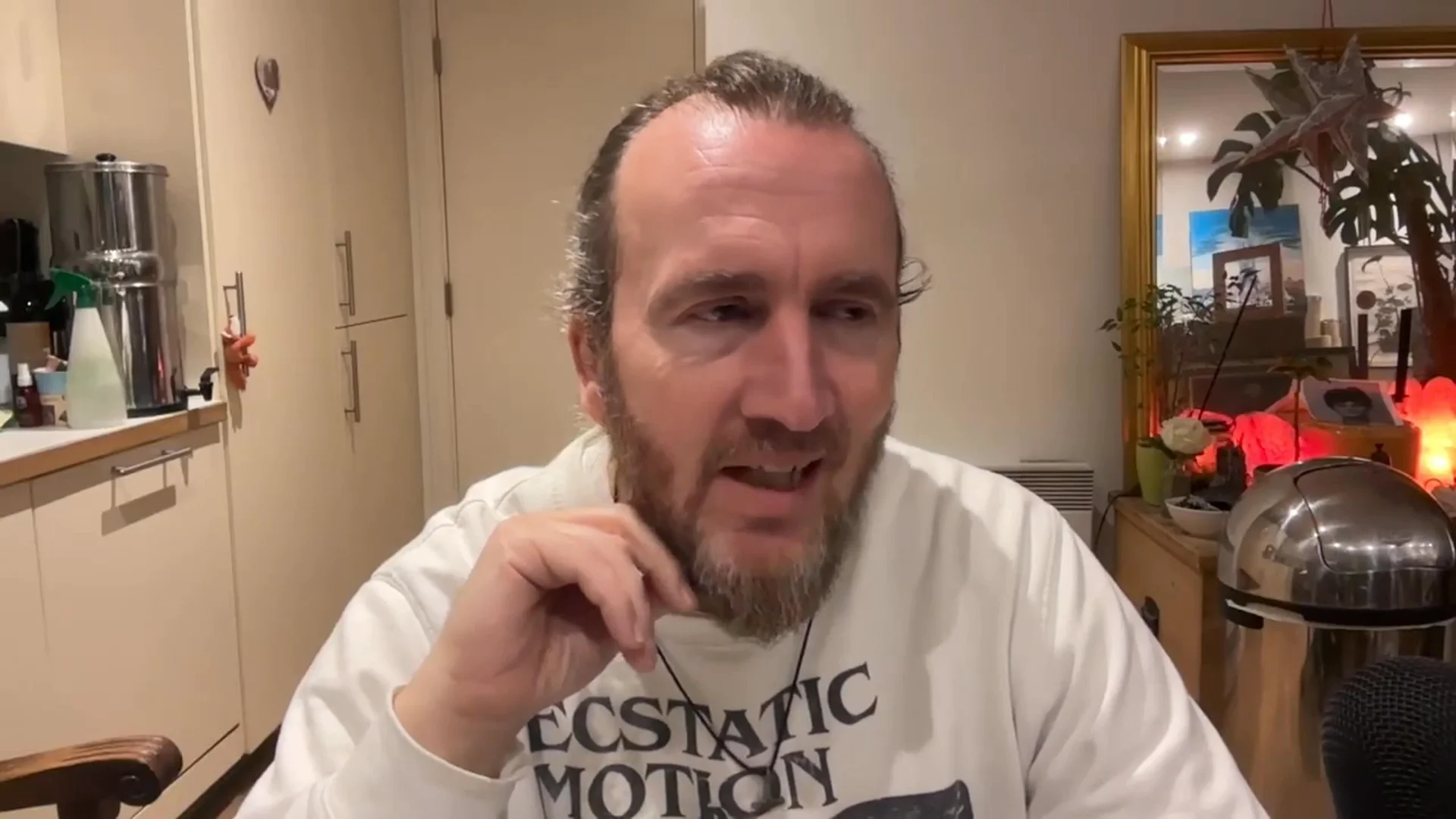
No. 32 of 44 · 13 January 2026 · 1 h 18 min Carl Hayden Smith Becoming Hyperhuman Watch the conversation On YouTube Everything said in it, in the order it was said: 94 turns, 62 of them Carl Hayden Smith's. Press one to hear it from its second. 0:00 Carl Hayden Smith I think a lot of people are realizing that we need mechanisms. It's like we need to use technology to undo the damage caused by technology. Whether that's technologies that tell you how much you're using technology, the typical sort of breakdown, oh, you've been on the internet for 12 hours today, maybe you want to have a dinner, or just the ability to use like your screensaver to grow a tree. And then if you don't touch your phone in the meantime, and an actual tree, the tree grows to its fullest size in digital pixels, then a real tree is planted. So it's it's almost like we we are still very much children and need these mechanisms to undo this damage. And of course, I'm not a Luddite. I think that we can use technology in a hyperhuman way, which means that we can continue to thrive, but also to continue to really become human. When I was first at Imperial College London, being paid to take LSD in hospital and to work on my creative projects, I was like, finally, it's come full circle.1:01 Carl Hayden Smith Whereas I'm actually legally being paid to trip in a British hospital. And actually, it wasn't the acid that was a revelation, it was the one-hour-long holotropic breath work session that I had, which was the control group. And that was like a game changer because that was like a five MEO DMT experience that I was able to have just with music and my own breath. So, again, very much shifting my entire worldview and building context, building this ability to be an overman, to realize that I have these technologies within me which don't require anything else, but just require the knowledge to activate them.1:58 Michael Garfield It's 2026, a new year, and already a crazy one. We're back from the Halcyon days of midwinter mania with an ironically sober perspective on wisdom and technology from one of my favorite inveterate psychonauts. Because, as Doug Rushkoff recently wrote on Substack, it's time to see things from another angle. Hunter S. Thompson may have put it best. When the going gets weird, the weird turn pro. So I'm ringing in the new year with you, as a professional scholar and cartographer of the weird, one of many, in a growing mass, divergent, open search of possibility space. And when it comes to taking another angle on technology and humanity, I can think of no one more appropriate than Carl Hayden Smith, Associate Professor of Media at the University of East London, founder of the Museum of Consciousness at Oxford University, co-founder of the Cyberdelic Nexus. Raising over 10 million pounds in research funding, Carl has given over 300 invited public lectures, conference presentations, and keynotes in 40 countries, and published more than 50 academic papers. His research interests include embodied and distributed cognition, context engineering, spatial literacy, umwelt hacking, and sensory augmentation.3:24 Michael Garfield He's also a director at Noanautics, where I sit on the advisory board, and the head of context engineering at Eleusis. His research concentrates on the relationship between technology and the human condition, exploring consciousness through multimodal lenses, including cyberelics, psychedelics, and sound. In parallel, Carl is developing hyperhumanism, reframing technology as a catalyst for developing our own innate human abilities, rather than outsourcing them as in transhumanism. For the last eight years, Carl has been very fortunate to be a participant in the NN DMT and 5MEO DMT research at Imperial College London, which included NNDMT EEGs, EEG and FMRI, NN DMTX, and more recently, the 5MEO DMT nasal spray produced by Beckley Citech. He was the first person in the world to sustain all five doses of NNDMTX during the pilot phase of the study. In other words, he's precisely the right person to get you thinking straight about our twisted reality. Big thanks to everybody who supports this show and my work in general: the writing, the music, the art, the community weaving, and a special shout out to new subscribers, Henry, David, and Eric.4:45 Michael Garfield Patreon and Substack are paying out about as much as they were before I had two kids in a mortgage. And this work is kept afloat primarily thanks to the largesse of a few heavy lifters. But I am immensely grateful for each and every one of you who chips in in the ways you can, the paid support, the reviews, the tax-deductible donations, telling your friends. It's a weird thing to be such a social and relationship-focused person holding down this fort as a solopreneur. And especially so when it feels like the work that really needs to be done is between us. But that's why our monthly member hangouts are so wonderful. And the next one will be this Sunday, January 18th at 10 a.m. Mountain Time. Patrons will find a link to the call in the show notes. If you haven't tuned in for one of these, let me just say they are consistently magical, inspiring, and nourishing. And I always look forward to what emerges on these calls. And I have some more book clubs planned for this year to announce soon.5:46 Michael Garfield So if you're someone for whom deep discussion on brilliant and edgy works is an essential nutrient, drop in at michaelgarfield.substack.com or patreon.comslash Michael Garfield as suits you. And with that, I give you the eminent, the inimitable, the legendary Carl Hayden Smith.6:36 Carl Hayden Smith Yes. Finally, finally it happens.6:40 Michael Garfield Yeah, I imagine you are still scintillating from listening to Max Cooper's unreleased new album. Yeah, yeah.6:48 Carl Hayden Smith There's some really uh I mean I love Max because he's a scientist primarily, and he comes at this with a very unusual perspective. New album is yeah, there's some gems in there. Forward to getting to listen to it on my own sound system. I've just listened to it on the L acoustics surround sound system. But uh anyway.7:09 Michael Garfield Anyways, let's talk about you. Let's start off with all of the silly stuff, young Carl. Yes, the embarrassing, awkward backstory. All right, like you gotta trace the whole arc, right? You'd be like, Oh my god, who is this guy? Yeah, so cool. Who does he think he is? Well, once upon a time, yeah. So, how far do you want to go? How far do you want to go back?7:37 Carl Hayden Smith I would say I became conscious at 28, so maybe we start there. 28 was the beginning, being a head on a stick from majority of the time since then. I don't know if you've seen that experiment where you can get a tuning fork. I've got a tuning fork which is the om sound, and you whack it on your knee and you put it on your head, and then it depends on how sort of I don't know, embodied you are, the further it'll go down the body. Mine goes to about here still. So I'm still on that journey from the head to the heart. It might take the next 50 years if I'm lucky to have that long. But but yeah, it's and some people it goes all the way through, right through into the ground. So I guess I'm starting to really value my body in a way that I haven't done previously. And I think it's high time to be embodied. And I think that as we'll discuss, I think AI is a big opportunity now to get into the body and to really realize that's the only thing that's safe.8:31 Carl Hayden Smith Although organoids could be another conversation starter that may well happen. But yeah, I think that the typical sort of young boy, very awkward, but also very much interested in all the things. I got my first computer, I think at eight years old. It was the ZX Spectrum. I remember the upgrade from 24k to 48k being the big up the big news was that upgrade, which was huge. The abilities that you could have with that extra 24k was a considerable. Then I got my my next computer at 12, and I was very, yeah, I was doing nuclear physics at 12 as well, was at degree level nuclear physics, obsessed with fusion and fission and all the rest of it. And I was very mathematical, was into physics, electronics, computer science, maths at A levels, and then discovered cannabis at 17, was like, oh my god, like there's philosophy and history of art. And so I suddenly became very much more using both sort of hemispheres. And then ended up in Iran, my first job, reconstructing the Palace of Darius in Persepolis, which was thanks to the dot-com bursting in 1999, which we may now see mirrored in the potential AI nuclear winter that may be upon us.9:47 Carl Hayden Smith But yeah, it was pretty severe. I remember doing my master's in Java programming, and everyone starting that program was on £140,000 starting salary. If you finished your masters, then the dot-com went west, and everyone was stacking shelves. But because I had the art background, I got into a research project which was 3D modelling back in the day using CAD and the VRML to reconstruct an extraordinary site in the middle of nowhere, which is Persepolis, and I was working on the Palace of Darius, so that was my first real foray into academia, but also into 3D modelling, which changed my worldview. I did a whole TEDx Oxford talk on that, but it yeah, it was a real game changer because it took me back to the Greek or the Greek mystery schools, the the orators never writing anything down, having these seven-hour speeches that they mapped that seven-hour speech into virtual architecture and amphitheatre being typical. And so, from that from that experience, I was then placing my PhD into these structures. So I carried on for about seven years building building out sacred architecture.11:00 Carl Hayden Smith I was in Yorkshire reconstructing six Cistercian Abbeys, these massive, like cathedral-like structures, and it made me a better driver. I could see further down the road because I was building all these structures virtually in my in in CAD, but also in my head. And I then mapped my PhD into those structures in order to have it communicate with itself in a way that you can't do with 2D. And yeah, that's early Carl.11:25 Michael Garfield At what point did the recursion and introspection start for you? Why was it 28 when you grew up?11:36 Carl Hayden Smith I don't know. I think I was very skinny and I discovered cheese, and in three months my whole face filled out very large, and I was at 27 and a half, and then suddenly I discovered cheese and I put on a couple of stone, and then I was there, I was fully there. So I think it's down to cheese. That kickstarted my existence. The microbiome. Yeah, it it all just clicked into place.12:00 Michael Garfield I can't thank cheese enough. What about the psychedelics and technology link?12:07 Carl Hayden Smith Yeah, well, as I said, cannabis was a big start for me in terms of writing. It was I was always, you know, aware of the channeling that it opened up. And I guess I've been interested in anything that opens up that channel to writing, to the introspection, the ability to everyone everyone says that if you write stone, then it's all nonsense. But I I never found that. I always found that even now I can look back on some of those scrambled journals and find nuggets of gold. So I feel like, yeah, the living archive. I was at my most poetic when I was 15. I always find that very interesting. That why are we so poetic at such an early age where we haven't lived yet? That yet we're just spilling out all this poetry. And it strikes me that it just is more evidence that life is not linear, that there is no linear progress. It's more like a spiral where you're having these abilities and then losing these abilities and then maybe getting them back.13:01 Carl Hayden Smith And then it's all about this going backwards and forwards, but constantly trying to resolve things that you may have left unresolved. So that I find that very interesting. And that's part of the whole journaling adventure that you realize that you're not in this linear timeline.13:16 Michael Garfield Well, there you go, adding a dimension. I think that's one thing you and I have in common is maybe I told you the first real serious encounter I had with an unidentified flying object was in 2006. I'd already seen them a couple times, but that was the time that I felt like I was being instructed. And what it taught me, among other things, was if you imagine a plane composed by three points as not just dimensions in space, but perspectives in subjectivity, then the synthesis of those points is figured by a fourth perspective that creates a tetrahedron, and that this is the way that the cosmos is constructed, that you just keep building out by adding a dimension perspective indefinitely. And they're like, So that's basically what couples counseling is, and that's what trigonometry is, and that's what your radar and all this like everything that is about orienting oneself in space and studying that the Jainist Anacontavada, the plurality of things, is about that. So it makes sense that now I have a through line that puts you in architecture and 3D modeling and so on.14:48 Michael Garfield There's a clear looking into the computer, seeing how you can structure things inside of the representations in a computer, and then turning it around or inside out, and starting to think about some of the stuff that you sent me about structured journaling and Hegelian synthesis in reflective process on one's life. But where I want to start you is in this piece that you sent me over becoming hyperhumanism as a bridge towards interbeing. Because this being a show with humans in the title, you lay out uh a frankly absurd number of kinds of humanisms, trans, meta, post, over, hyper, etc., in this. And I think paying all of this out will give people a grasp of where you stand with respect to the metaphysics of technology and what we can do well with it, and what we can do poorly, or what we can do very well, but in a wrong-headed way.16:00 Carl Hayden Smith So have at it. Yeah, thanks. I think that I think this is why I'm involved in technology and utilizing hyperhumanism. And if we just talk about hyperhumanism versus transhumanism, we're really seeing a push and an agenda which is pretty violent in terms of Neurolink. And uh we can argue that transhumanism is very much here. If you've got a phone, you're already fully kind of cyborged. And it's very hard for people to to relinquish that uh that addiction, that that utility. And of course, it's I think that as I mentioned, AI is an opportunity now to really return to the human project in a way that we haven't done before. And I think that as I've mentioned on on in previous contexts, I don't think we know what we are as humans. I think that there's a misunderstanding that we are these discrete entities that are humans. I think that we are, as we know, half bacteria and we are covered in fungi. So we are three queendoms enmeshed in this nested ecology. And the sooner we realise that, the sooner we can really progress because we're not we may not be human yet.17:11 Carl Hayden Smith And I'm very interested in the opportunities that this new sort of fork in the road gives us. Where I think there will be you've got kids, the alphas, as opposed to the Gen Z. What will the shift be in terms of their relationship to technology? Will they sort of downgrade from it's interesting going to different cities and seeing how in London we're very technocentric, in Amsterdam, they're more cautious, more in the world. And I think that there is this opportunity now to really question what we have atrophied with these digital technologies that are very poorly designed, they're designed from a technocentric perspective rather than any kind of concern as to what is happening to humans as a result of using these things. And I always quote the idea that we are we're the love of your life walked past, but you had no idea because you're just stuck on your tiny little bit of real estate. It doesn't matter where you are anymore because you're on your tiny bit of real estate. So I think a lot of people are waking up to that and realizing that we need mechanisms.18:16 Carl Hayden Smith It's like we need to use technology to undo the damage caused by technology, whether that's technologies that tell you how much you're using technology, the typical sort of breakdown. Oh, you've been on the internet for 12 hours today, maybe you want to have a dinner, or just that kind of the ability to use like your screensaver to grow a tree, and then if you don't touch your phone in the meantime, and an actual tree, the tree grows to its fullest size in digital pixels, then a real tree is planted. So it's it's almost like we we are still very much children and need these mechanisms to undo this damage. And of course, I'm not a Luddite, I think that we can use technology in a hyperhuman way, which means that we can continue to thrive, but also to continue to really become human, because I don't think we are, and I like humans in the loop in your context, because I think we're a lot of people are grasping that quite quickly, and hyperhumanism may not be the ultimate term.19:15 Carl Hayden Smith I like hyperhumanism, that we should be more humane to not just ourselves, but all the other kingdoms, queens of which we are one of six, as we as we know. I don't think the wisdom is with humans. I think that if you look at the mycelium underneath the everywhere we walk, their default mode network is to share, as soon as they're in abundance, they share with not just their own kind, but with the trees and the plants. So that's the ultimate trip to see that woodwide web in in action and to understand that the mycelium have survived five mass extinctions whilst we caused the sixth. Where is the intelligence? If we are looking at AI as everything's all about intelligence, but that's not what it's all about. What about wisdom? What about all the other things? You know, I don't I don't see a lot of wisdom in our human space. You know, I have a lot of people criticize this focus on nature, and a lot of people want to go post-biological. I think that's again the big narrative.20:13 Carl Hayden Smith It's it's not we're just here as a stepping stone to produce the general artificial intelligence, and then we just either maintain the machines or we get out of the way entirely because we'll be just taking energy from them, and people seem to be like welcoming that. And I'm like, really? I mean, in the same sense that we are now giving the machines the opportunity to be poets and musicians. Surely that's what we want to do, isn't it?20:35 Michael Garfield So I appreciate the way that you anchor all of this in Friedrich Nietzsche, and I'd like, if you will, just in brief to explain how you lay your thinking onto the thinking of Nietzsche and how his work pertains to this conversation.20:58 Carl Hayden Smith Yeah, the reason why it was linked to Nietzsche in that context, anyway, because it was an anthology on Zarathustra, and in Zarathustra we have the archetypes which are the Afterworlds Man, the last man, and uh the overman. And a lot of people associate Nietzsche with transhumanism, and I felt like that needed to be corrected because it's the lot the transhuman in Nietzsche's thinking is the last man, which is your everyday man that's just trying to get through it, who doesn't really want to be stuck here in meat space, just waiting for God O, anything to blunt the instrument and to nullify or to just to numb themselves into oblivion and not really realize the jackpot win that it is to be human. The afterworlds man is living for the afterlife, all the virgins that you're gonna have access to when you pass is the afterworlds man, the religious man. And the overman is what I consider the hyperhuman that is really considering this existence as an opportunity for ontological design, for context engineering, for realizing that we may not just have five senses, but 30, 40 senses, how many people are utilizing those senses, how many people are aware of those senses.22:12 Carl Hayden Smith So now we move into a new economy, which is a context-based economy where we can we can change the way we see, we can change the way we hear, and that transforms all the content that already exists. So, much like with my students in London, where we're talking about trans media, it's not so much about the story or the song anymore, it's about the story plus the story world. So it's not enough to just create songs or art. You're creating you're creating a world with that piece, and I think that's the opportunity that we have, that we now have the ability to change the context. And of course, you can do that in multiple ways. And I'm documenting as many ways as possible with this project Holotechnica, which you're part of, which is the idea you're either using your endo technologies, which are your typical fasting, your breath work, your meditation, your anything you can do without any external technology needed, everything you can do on your own. Then you have your traditional plant medicines and entheogens and all the research chemicals, etc.23:18 Carl Hayden Smith etc. And then you have your cyberdelics. So these are the tools. Some of them create context more effectively than others. When I was first at Imperial College London, being paid to take LSD in hospital and to work on my creative projects, I was like, finally, it's come full circle. Whereas I'm actually legally being paid to trip in a British hospital. And actually, it wasn't the acid that was a revelation, it was the one-hour-long holotropic breath work session that I had, which was the control group to the acid. And that was like a game changer because that was like a five MEO DMT experience that I was able to have just with music and my own breath. So, again, very much shifting my entire worldview and building context, building this ability to be an overman, to realize that I have these technologies within me, which don't require anything else, but just require the knowledge to activate them. And so, yeah, Nietzsche talks a lot about amorfati, the eternal recurrence. And I think that let's maximize our days, let's not just try and get through it, but realize that we have the potential to become overmen, to become gods.24:33 Carl Hayden Smith But let's not go down the Atlantis route where we just I think that this is the real challenge at the moment. We may have seen entire civilizations wiped off the face of the earth because they, I don't know, because there is no they, who knows? But I just think that we, when you go to ancient Egypt and you see the kind of technologies that were present that must have been present to build these structures, we are maybe still cavemen in relation to our ancestors. So that's what I find fascinating.25:02 Michael Garfield So among the principles of hyperhumanism that you list here, and bound by this idea that rather than trying to escape our humanity into technology, hyperhumanism is about a deeper embrace of it, and therefore implies we may not even be fully yet. We may not know even know what that means. You know, these technologies of reflection. So you have one of the principles is as you said earlier. The human being results from hybridization, that we are already composite entities. And so, yeah, one of the things that I'm exploring in this, and that you've already paid care to highlight, is that this is not the rejection of technology. How could you the technology, as you and I use the term, is so broadly defined that it includes things like your own ability to operate on in your body, but specifically, this idea of hyperhumanism technology acts as a temporary and supportive container scaffolding that nurtures the development of new skills, skills that are innate and currently unexercised that we can reignite to regenerate a form of human enhancement prosthetics.26:29 Michael Garfield It's funny because you know, when you say we're like cavemen to what we could be or possibly even were, that seems to be due to the fact that if you think about like physical therapy, it's there's a huge conversation in the States right now about the healthcare system and keeping people sick for life, and this idea, like, oh well, I've introduced something so that now you are both more and less. Freud talked about this, like the way that the prosthetic, as this frame introduces it, diminishes us as it magnifies us. And so I'm curious because I think you and I both know that this is not something that is necessarily a property of the tool, but arises in a way between us. If a hyperhuman includes technology, that there's a hyperhuman way to use a phone or to use AI or whatever, and then there's the transhuman way. The big question I want to linger on with you is one of what the difference is, because yeah, we can design tools that are easier to use in a way that gives us new abilities without coercing us into dependency.27:52 Michael Garfield The human on the loop piece, you know, which is all kind of related to the Amor Fati thing of Nietzsche, is like, well, this is what we have. Like, we are already here. Decisions have been made, and you're never entirely out of the loop, but you're never entirely in the loop either. How do we get on the loop in a situation where we were off the loop without deluding ourselves that we were in the loop, or that we can achieve this sort of transcendent power, the pursuit of which just draws us ever deeper into chaos and instability?28:32 Carl Hayden Smith Yeah, I think it's for one thing, it's not all about transcendence. I think that's the that's a fundamental error. I think as it's as much about incendence and going into our darkness and into the earth, and we're constantly trying to peek beyond the veil. DMT Extended is a great example, right? Where we we now have a technology that could easily be used in a transhuman way where we go hikikamori and we eject or reject our humanness in favor of living in hyperspace because we know that there is very little tolerance to a continuous infusion of DMT. We know that you could be, as in Andrew Gallimore's vision, you could be kept in a pod, a suspended animation where you are controlling your own dose, you're coming across entities, you're having these incredible meetings, you're bringing back languages. You could either do that for the benefit of yourself or the benefit of the human race. I love that term, human race. But I think that my vision for DMTX, and I know we're both involved in this project, is a much more of a hyperhuman uh approach because I have done like three months of DMTX, and I was the first person in the world to do all those dosing sessions and have zero anxiety ratings.29:54 Carl Hayden Smith So I think that there are ways of treating this opportunity as an opportunity that doesn't atrophy our human project, that does potentially give us two-way access to this sentient other. I'm still completely on the fence as to whether we are interacting with uh an independent parallel reality, or whether it's higher self, our own archetypes, our future self, even. But yeah, there are there's a hyperhuman approach to that and there's a transhuman approach to that. And I think that the danger is the transhuman approach where we use it as another escape. There's plenty of escapes that we're generating as technology advances, and whether it's living in virtual reality, living in DMT land, living just like a typical hikikomori in Japan, which is half a million plus young, mostly men, that have decided reality is too tough. I can't have a family and support them. Um so I'm just not gonna bother, I'm just gonna check out of society altogether. And I think that's the real danger that we see a mass exodus from society, and we are social creatures by default, that's the whole point.31:09 Carl Hayden Smith And I find it hilarious when you see all these billionaires building bunkers thinking that they're gonna have an advantage by isolating themselves. Or if I've got a friend who's got 11 tons, I think, of imperishable food in a lock up in London, and I'm like, Well, you're gonna be the only fat one. You know, do you think that's gonna work? So I think that yeah, there's lots of people just trying to escape the human condition. And I see these conversations, these frameworks as ways of working through what is adjustable in that human condition, what's more or less permanent. You could argue that we haven't really, as we talked about with the ancient world, in some senses, we haven't progressed at all. In fact, you could argue that we've gone backwards. So if we also think about language, and a lot of the time when I'm in these DMT worlds, I'm communicating with these entities very easily telepathically. And I think telepathy was probably the primary form of communication. Then we built language on top of telepathy, language was less optimal.32:15 Carl Hayden Smith Now we're building the metaverse on top of language, this mixed reality world, which again is a further abstraction away from telepathy. So we live in very interesting times. And I think that these large language models means that people like my girlfriend maybe will be in an advantage position because she's an amazing writer, she's an orator, she is somebody that you know would have been valuable in the past. Now she feels like her value, her currency is dropped into the ground because she's not a technologist. But at the core, we have oration. How good are you with language? Because it's all about the large language model at present. Who knows how long that will be in the ascendancy? But I do believe if you know the words the world is made of, you can make of the world what you will, as Terence McKenna points out. But the key thing I think is that we need to understand that we are receiving the signal, we are channels. So how do we maintain? And I think this relates to this humans on the loop, but how do we maintain our channeling?33:19 Carl Hayden Smith How do we understand that the more we press these buttons, these instant give me a girlfriend, get me a job, get me it's these one button solutions to everything. Everyone's just pressing, make me an essay. And I tell my students, don't just get the computer to do the work for you because you'll end up useless. You'll end up with no skills, and you will have wasted all of your precious time at university at great expense by outsourcing your intelligence to the machine. And I think we're already seeing evidence that the convenience, the instant results. Of course, we are creatures of comfort, we are creatures of convenience. So it's almost like we need to build friction back in. And I know people that won't even go to the internet unless they found out uh other ways of getting the answer, they won't even go to the bigger brain, as they call it, without trying their best to get there, without that ease of access. So I think the key thing is how do we understand that we are these channels?34:21 Carl Hayden Smith We need to respect the signal. And if you don't, if you suddenly start pressing buttons to get all of your creative work done, you're likely to atrophy that channeling ability. And I think it's mirrored in the way we understand consciousness. I think that we are receiving consciousness, I don't think we are transmitting it from our brains. I don't think the brain is the core of our ability to be conscious. I come from that group, that sort of perspective. But yeah, how do we build friction back in, but understand that life is hard? And how do we maintain our willpower? I think is central here. How do we maintain our will to thrive, not just to survive, but where's the human flourishing? And not only that, but what am I doing now that will benefit the next five generations to come? I think that's a great frame. Think about what are you doing now that will benefit not just your family, yourself, your community now, but the next five generations to come, and then the next 50.35:23 Carl Hayden Smith So that's really where I'm coming from.35:25 Michael Garfield So to make this a little bit more tangible, if I think about what it means to rediscover our humanity, you bring up John Vervake and the notion of transjectivity, which is something I adore, and it gets back to this notion that part of what it means to be human is to be inseparable from it's an act of reconciliation. So, like the friction only occurs in points of contact. So, concretely, what changes for you about the way that you relate to the smartphone or the language model as a way to create useful friction? I just finished my conversation with Kailato McDowell, and they're hugely inspired by Dale Pendell pharmacogenosis and the notion of the poison path and the idea that technology can be engaged in the way that we engage psychedelic drugs. Because you talk about psychedelic drugs, is hey, you're not tripping all the time, and it has enormous metabolic demands to open the brain up like that. So there are situations in which that is good. It's instead of thinking of technology as the enhancement of our leverage, thinking about technology as the ability to help us structure ourselves.36:55 Michael Garfield And that this is where we might as well just put the other foot in your piece on Hegelian journaling, because I was reading all of this and I was thinking this has a lot of resonance with what I hope more people start seeing as the real utility language models. You use uh Joël de Rosnay, I hope I'm saying that right, the macroscope. Yeah, the idea of being able to see beyond one's concept of self and the patterns and the relationships and the systems. And this is what journaling and the essay have done for us historically. That I think about the language model as a scalable mirror. And yes, obviously, we have run right into the narcissistic component of that mirror in what Josh DeCaglio calls this the scalar synecdoche, which is as soon as you see the earth from space, you start thinking about technocratic conquest, global systems management. But I want to hear how you in your life have played the other side of this in ways that that people might shift in their relationship to the things that they actually have in their built environment and that are a part of them, but are not part currently of this transjective self.38:17 Carl Hayden Smith Can you just explain what you understand by the meaning of transjective?38:21 Michael Garfield Yeah, that if subject and object are co-arising, then what you're calling friction is the relational property, like well, the friction is not in my hand or in the table, and none of this stuff is. You make a point that I in your work that I make a lot, which is we're already in VR, that this is the way that the brain presents phenomena, yeah. So it seems like the both the objective and the process of hyperhumanism are tied up in this shift of frame from I'm gonna use the smartphone to get what I want, to the smartphone is already a part of me that is make that is making certain things harder when it's being used at times that it the function more appropriately belongs to that of some other organ, if that makes sense.39:20 Carl Hayden Smith Yeah, I mean I really love that. I can't remember, you know, the paradox of choice and the idea that you may be watching your kid play baseball at school and you're thinking this is fantastic, but I could be checking my email, my work email right now. And even if you don't check your work email right now, the fact that you are thinking about checking your work email right now means that you're not there, you're not there with your kid. And I think that's really fundamental. And one of the ways I have been hacking or using my technology from a hyperhuman perspective, I don't know whether I've shown you this, is I've smashed my screen, half the screen at the top there is unusable. And when I did that the last time, I was told because it felt like locked-in syndrome. I was like, okay, I'm locked into my device, I can't access all these contacts, I can't access my data. And of course, it's not the phone that's important, it's the data that you really want, right?40:11 Carl Hayden Smith And all the functionality that it provides. So then I was told that you can plug a dongle, so this is just a USB-C dongle, and then a mouse. So this is a trackball. And so I literally I now I've been using this for over a year, and so now I can use this to control my device, and I'm able to, you know, separate my hand from my phone, and suddenly I've got good posture because I'm able to keep it at a certain perspective, I'm able to utilize the everything about it, but I downgraded the keyboard so that I'm actually typing each letter. In Wales, they just introduced a 20 mile an hour speed limit, and I've said to my friends that are like pulling their hair up, going, Oh, I can't go any further than 20 miles an hour. I'm like, just treat it as a meditation. So now I treat my interaction with my device because it's clunky, because it's a barrier to entry, as a meditation. So I'm intentionally utilizing certain things, I'm using much less.41:10 Carl Hayden Smith I'm using it instead of 150 times a day, I'm touching my phone, I'm going through about five times a day because I have to. I can also plug a keyboard into this. It's not just the mouse. So now I'm only interacting with the globe, right? That's that's my a whole new range of muscles are being brought in. I got rid of my repetitive strain injury. My arm was freezing up to the point where I couldn't use it anymore. Now I've completely got rid of that in one year of using it. This was initially a massive trackball bigger than this one. I was walking and it was lit up, and I was walking around, going on the underground in London with a big red button for at least eight months, and nobody said a word. There was not a single tap on the shoulder to say, What are you doing, sir? What is that a huge red button? Like, as if there's nobody watching. Of course, if I was Muslim, it'd be a whole other story, I'm sure.42:04 Carl Hayden Smith But this is just one way where you can get your life back, and you can still have the access to the technology, but you remain in control. It's a simple device, it's 20 quid to and I refuse to go back. And in fact, I I could upgrade my phone, but I don't want to because the temptation, I have to have this, I can't use this device without this because it's smashed. So I'm either encouraging everyone to smash their screens to force them to become hyperhuman, but this is a really tangible example of how we can get our lives back. I know so many people that are just scroll dooming to that that either keep their phone in their hand permanently, it's like an appendage, it's like an extension, and it's terrifying how we've been suckered into these terrible devices. Now it's just another object, it's not my other half, it's just this barrier to entry that I've created that really has worked, it has had a tangible effect on me that I feel as if I've become more analog, I've got more agency as a result of this smashed screen and this dongle.43:11 Carl Hayden Smith But you're right, we are already already living in VR. Again, I've done if you look at my TEDx talk at Oxford, the fact that we look in the mirror and we don't see ourselves as we are, our images flipped, and other people see us as we are, other people hear us as we are, but we don't. You know, we are fundamentally removed from our reality, from our own self. And then we're stuck in these tiny bits of real estate, we are stuck in social media. In the pandemic, we were stuck in without any optic flow, which is this movement through space. When you move through space by activating optic flow, and without that, you become a goldfish. You lose your ability to think. It's a bit like when you sit in front of a screen all day, creativity's dead, it seems to just vanish. So there's a direct link between movement and creativity. Again, another hyperhuman principle. Be in move. I would love to have the ability to be on a treadmill, constantly in movement.44:06 Carl Hayden Smith I know that if I had an accident, I had a bike crash years ago now, about I couldn't sit down for three years, no sitting. It was amazing because my health improved no end and my creativity improved no end because I had movement constantly in those essays. If I look back on that time, I was like probably at my not a peak, I wouldn't say, but I was certainly going places, and I would look around everyone on the tube scrambling for a seat to sit down for five minutes between stations, and it was mad, but it was an amazing insight into this connection between movement and creativity.44:43 Michael Garfield Yeah, you're one of the first conversations I've had for this where I'm at my standing desk.44:49 Carl Hayden Smith Yeah, nice.44:50 Michael Garfield And obviously, I very much appreciate that. And I want to think about all the other kinds of movement with you. There's something in the smashed phone that is well, it can be your it can be your destiny if you choose it, or it can be your fate if you sit and just let it happen to you. And you've embraced it after the fact, there's an opportunity for people to catch it. In the moment that I'm really interested in. And so the other axis we could rotate on is, and I I feel like I'm getting ahead of myself in this, but like I really do want to hear you talk about Hegelian journaling and then link it to the idea of the language model as a tool for thought and how it can help us structure our knowledge and discover new things about ourselves in better ways. That rotation, just to be super clear, maybe from having the machine spit out the writing that you want to having the machine to your writing and reveal patterns in it you might not have otherwise noticed.46:04 Michael Garfield Or to who was it recently? I was just reading, oh yeah, Charles Eisenstein said he tried to get ChatGPT to write an essay in his style, and he was like, Oh, it was hackneyed and awful. And he's like, But I realize sometimes I'm like that. Like sometimes I do this. That's again, that's the on the loop piece, is if you actually wherever you want to put it in as you balance the equation, if you actually do reflect on the output of these systems, if the reflection is there somewhere, then you see the automaticity where it's not. And yeah, I'm curious to hear you reflect on that. Thank you.46:48 Carl Hayden Smith Yeah. I think the key thing being a professor in London at the moment in teaching some of this technology and thinking about how I can is a moral question. You know, a lot of my a lot of the students I'm teaching are wanting to work in the creative industries, and the creative industries are the lowest hanging fruit for these technologies. And if you want to be a lighting engineer or a cameraman, and then then it's well, do I point out that a lot of this stuff will be automated or people will be making films with large language models, they're already doing it. I know DJs that are no longer downloading tracks, they're prompt DJing. So they're literally don't know what's going to come out. It's a bit like the algo raves back in the day, right? So literally, this is a whole new thing that's being birthed. And I think that it's fascinating that we can't really stop students from utilizing these tools. Some people try, but the problem is that some people write like an AI, they just do.47:50 Carl Hayden Smith That's how they write. So this is very difficult to police, and whether we should police it or not, that's why I say it's just your, like you say, having the machine attend to your writing, enabling you to reflect. I think that's again, we'll start talking about the journaling, but the ability to reflect on your own creative output, as long as you are still creating, as long as you're still tuning in and receiving the signal, I think that whatever tools help with that, the better. I think that's the thing. As long as you feel good in yourself, that you are still mastering the technology. The technology is not you're in the ascendancy, not the technology, I think is critical. But I see a scenario where a lot of lecturers at the university are like getting so pissed off because all the kids are now writing their essays by via Chat GPT or whatever, and then they're like, Well, why should I bother marking them? I'm gonna I'm gonna use Chat GPT to mark the essays, and then it's just a conversation between two nobody's there, the humans are not in the loop, there's no humans present.48:55 Carl Hayden Smith So when it comes to the journaling, I think it's what Kierkegaard says that life must be lived forwards but can only be understood backwards. That we're not taking an active role in our construction. I think that's what the journaling practice gives me. I write from three set sort of semantic levels content, what I did, context, what I felt, and concepts what I thought. So I have the perfect data set for an AI, really, because I have thinking, feeling, and doing. And it's multimodal. So all of the ideation is handwritten, because there's something about writing by hand, and again, this is what I tell my students in day one of class is get yourself a notebook, get yourself a pen, start writing by hand, because there's something about imprinting that occurs, and that's why I choose to write down the ideas, they stay there, there's an imprinting going on. The uh the doing, the to-dos is the content that's all written into a word document, really enough, roughly around three million words long. It's 38 years now that I've been writing my diary, and it's an extraordinary resource because it's keyword searchable, and then the context, which is all of the mood, all of the emotion, that's captured in photographs and videos and some audio recordings.50:12 Carl Hayden Smith And I've been writing a Facebook for 20 years, and Facebook is its own beast because I don't write, I don't write anything personal on my Facebook. It's all about again ideation. I'll come up with a term like context engineering, and then I'll create an image and say, This is context engineering, and then the next day I'll have another image and then another image and another image, and then people start sending me examples of context engineering. They'll be going, is this context engineering? I'm going, yeah, you got it. And then I'll be invited to Japan to do a whole symposium on context engineering, and that's what I think we should be using these social medias for is creating our reality, context engineering. This is exactly the point, right? Whether it's double consciousness, creating these literacies that you actually then create movements. I think that this is part of it, and then you're all obviously all my chat, all the social media chat and everything else. This is all something that I can take as cross-sections. So I can look at this day last year, and the year before, and the year before, and the year before, and the year before, and I got 38 different me's communicating again.51:14 Carl Hayden Smith And as we mentioned earlier, different skills occur at different times. You know, I was most poetic when I was 15, and then I'm probably not very poetic now, but it demonstrates the spiral that we are going in a spiral through life, and much like that's reflected in the cosmos, right? So that we're on planet Earth, spaceship Earth is also moving in a spiral through space, so it's almost like revealing the cosmic structure that I'm getting as a result of journaling. And you know, I'm very much in this reflective shine, as Hegel talks about it, that it's work, it's a lot of work to, but it doesn't take a lot of time because it's something that I've automated and I've become a detective. I can become a detective because I've got the data. I can become a detective in my own life. I can create the overview effect, I can jump out of point of view and go into field of view at any point where I lose perspective, which is twice a day. I can see I'm on the path because I've got the data.52:12 Carl Hayden Smith A lot of mental health is a direct result of not having any perspective or any ability to regain your perspective. So even if I'm having a shitty day, I can still see shit, I've done all this month. So I think wisdom is gained. And I, as I mentioned, it's not all about intelligence. I think wisdom is gained by taking this higher order perspective, this overview effect, and also making sense of your life as a whole. Going back to that transjective thing, it's I can get this journal gives me a real sense of not so much, yeah, it's kind of purpose. It's this I'm writing my diary in order to live my life, and I'm living my life in order to write my diary. I can't have the same material every day. I need new material, I need to maximize my day. As in Nietzsche's Amor Fati, Nietzsche talks about the eternal recurrence. And the eternal recurrence is maybe you don't reincarnate, maybe, just maybe, you have the same life over and over again. And even if it's not true, imagine it is.53:12 Carl Hayden Smith Imagine that as the operating system because that means each day is infinity. So make sure you want to do what you're doing forever. And that's a really amazing way of understanding that you don't want to fuck up, even on a daily basis. So it also really, I think it comes down to balancing the tantra and the sutra. We talk about the psychedelics. I'm very strong when it comes to having time off from any journeying, because otherwise, it's just epiphany porn. Unless you action the insights that you gain in these higher realms or lower realms, whatever in the incendents, then you're just pissing in the wind. I think you need to really go out there for a specific purpose, maybe go into DMTX for six hours, come back with a new language, come back with some sort of like yeah. But I think uh the dynamic range of our human existence is to have the highest highs and the lowest lows, because that's what gives you your human character, your canvas, and you want that to be as wide as possible, really.54:18 Carl Hayden Smith And this is the problem with SSRIs that people are narrowed in, they're locked into these very narrow perspectives. They can't feel the highest highs, they don't get the lowest lows either. But I think there's a great cost at that. So, what I did is the content, what I felt is the context, and what I thought is the concept. So I think that structure is really helpful. And again, it's not I only write for five minutes a day. I only write what I did at least for five minutes a day. Everything else is automated, but it does give me this superpower where I can say I've been in a relationship for a year, I can read that entire relationship in an afternoon, and I can get a bird's eye view over it. I can start to see pattern recognition, anything stuff that I would never see in real time. And I think that's this is also reflected in social media where you can see on Facebook, it used to be called memories, it's now called On This Day, where indeed you've shown through a cross section of your timeline.55:10 Carl Hayden Smith So you see this day last year and the year before, and the year for however many years you've been on Facebook. So it creates a feedback loop, it forces me to live. And I think that there's nothing more useful than that, and in much the same way where you take photos and you think, Am I ever gonna look at this again? Which, of course, all those people at gigs where they're just like not even there, they're just holding their phone up, they're looking through their shitty phone and they're recording constantly, even though they're never gonna look at any of that again. And that's how I treat the diary. I'm like, is this worth doing? Because does it fit into the body of work that already exists? And when I take the cross-section through it, am I gonna gain anything from doing this? So it really does, in some way, limit what I do, but also makes me push forwards in that hyperhuman way where I want to get new experience, new ontologies, new types of experience.56:02 Carl Hayden Smith And I'm thirsty for it because I want to I've had a life review, this is a whole other thing, but I had a life review, and in that life review, I was able to access anything in the scene. So this is where double consciousness sprung from because I was in, I'd stopped moving forwards in time, I was only able to go backwards in episodic chunks. So I was in my normal consciousness, as I am talking to you, but I was also in the consciousness of my avatar going backwards in time, so I was in a double consciousness. Then the first thing I tried to do was go into a table and become wood consciousness, and I successfully experienced what it was like to be a wood consciousness. I was in a triple consciousness, and then I was able to access anything else in the scene. So whether it was books, I could become the author, films, I could become all the actors. Don't get me started on that. But that made me realize that in the death state, we are most likely experiencing a field of view, not a point of view.56:55 Carl Hayden Smith So I now realize that it's my responsibility to drive my point of view to access the field of view in the death state. Because I do believe your life becomes a product, it is a learning chamber, whatever we're in, it's some sort of learning experience. And so, therefore, be very careful about who you spend your time with, be very careful about where you go. So I need to go to the Amazon at least for a day, so that I can then access the Amazon at will and go into every life form that's in there, which is again like don't spend all your time with humans, don't even make music just for humans, make music for the other species because you'll be rewarded in that double consciousness.57:37 Michael Garfield Again, I I feel like normally I'm on the other side of the table here, but in conversation with you, it's my job to keep things mundane.57:45 Carl Hayden Smith Oh, please, please.57:46 Michael Garfield Uh and I feel like I had in a previous episode of this life a long entanglement as a social media professional. There's like two points I want to make on that that I think tie into everything that you just said, and I'd love to hear you embroider further, which is that I get the sense that most institutions still treat what Fred Turner would say is networked media as though it were broadcast media, that they're using social media to amplify themselves rather than, and again, this gets back to the transjectivity piece. It's rather than to understand that to carry it forward into language models. You know, when you prompt something, you get something back, and then you you review it, you reflect on it. It's not just a it's not a one way thing, and that. What works best on social media to solicit engagement is often to ask questions. It's like this is a chance for you not just to say what's on your mind, but to ask what other people notice. And that this is a means to a double consciousness in that you've got the on this day, you know, the linear axis of time.59:15 Michael Garfield If you're gonna collapse it down to that, then you have the spatial and the sociocultural axis, and then likewise, for reasons I completely sympathize with a lot of my friends lately have been not just deactivating Facebook and Twitter, but deleting their accounts. And I get it because I was somebody who journaled obsessively through high school and then got to a point in my life where I decided I was going to burn them all, and I did, and now I look back on that without the embarrassment of whatever it was that I felt like I was trying to distance myself from, and given enough distance that stuff becomes useful again. I've been telling my friends, I'm like, look, I get it. If you never want to be on Facebook again for the rest of your life, I'll support you. But there's an opportunity there that you're you know, you're like throwing in the fires of Mount Doom, which is all of that data by destroying it, you're not saying you're not harming Facebook in any meaningful way.1:00:27 Michael Garfield And it gets back to that thing of me versus them. It's well, I'm sorry to tell you this, but actually, Facebook is part of you now, you're not gonna get away from that, like you're gonna cauterize it, maybe. Yeah, but then you have a phantom limb, yeah, and there's no chance that you'll ever learn anything new from that. And so I would just, yeah, there's again these like all these mundane ways that I think the really exciting opportunities available to us through the very bleeding edge of technology are already present at every layer going back down the tech stack. And I just love to hear you riff on that.1:01:11 Carl Hayden Smith Yeah, so just starting with Facebook, I have such a such an amazingly, I spent so much time cultivating that, and of course, none of it's yours, right? It's all for you, but none of it's yours, and uh so I've printed it all out. I printed it all into books, and you can easily do that with something called my social books. So it's not even Facebook that enables it, but it enables me to have a whole bookshelf. Each year is 400 pages, it was less during the pandemic, so there were no events, but I have now 20 books, thousands of pages, and what's interesting about it is that each post in that book has a QR code, so I can go back to the digital from the analog, and I find that super empowering because now, even if they even if for whatever reason I get thrown out of Facebook, I've still got it, and I really value that journey. It is a journey that I've been on. And uh Zuckerberg, God bless him, like you say, he's created a huge opportunity for me.1:02:11 Carl Hayden Smith Even I even met my girlfriend on Facebook, so there's no denying that if you use these services in a hyperhuman way, you can really benefit and you can break the algorithm, right? Because the algorithm doesn't know what's going on. It can't it can't operate or it can't really it can't really understand what how you're using it. And that's again this whole thing about technology, you don't know how it's going to be used. And that's very what made me very cautious about my world my work. A lot of my work has been using mixed reality to train astronauts or using cyberdelics to change consciousness. And of course, all of that have been approached by the military many times to say, can we use your work? And of course, they always say no, but they all use it anyway. There's no way of avoiding it. So no matter what we do, it's a triple-edged sword. I think that's the thing, the transjective thing. We are we're all in it. There's even if your intentions are good, those can be bastardized.1:03:06 Carl Hayden Smith We're also media. The fact that I've got a bunch of talks online means that I can be cloned at any moment. I could my voice could be talking in other contexts that I'm not aware of anymore. In the same sense, a lot of authors would be horrified to see their books put through Chat GPT. But unfortunately, your book is out there and it can easily be uploaded, bastardized, re-remixed. So so yeah, I think it's a fascinating time to be a professor of media. It's almost ironic when we're all becoming media and uh media is the virus. I saw that sort of been on I saw a t-shirt with media with media is the virus. I think that what's fascinating is that we don't know we we do live in a virtual reality and we don't really want to get what we think we want. I think that's a zhizek perspective. So again, if you can reveal your own will to yourself, because we are living in these kind of obscure in these obscure times and obscure worlds, there are certain people that can't forget anything, that they have these sorts of memories that I think there's only about 30 of them in the world, but they cannot forget.1:04:12 Carl Hayden Smith They literally have this problem where they can't forget. And I remember that terrible Black Marit episode where there was this couple arguing and they were going, Oh, you said this, and they were going, No, I didn't like it, and they were like, Let's have a look. And everything was recorded because they were recording everything through their contact lenses. And of course, if we unable to forget, it's a disaster. I think the only reason that we can have any kind of friendships is because we heavily curate how much time we spend with people. When you're stuck with somebody on a holiday or you're living with somebody, that's when you really know someone. Most of the people that you're friends with, you probably don't even know who they are. So yeah, I think that it's very important that we have these paths that we can we can really notice that when one door closes, another one opens, because often it's the case. But unless you've got that data set, you can't necessarily keep track. I guess I'm aware that I only keep what I share, which is another big insight from journaling, is that I'm able to remember or find something if I've shared it with somebody.1:05:17 Carl Hayden Smith So it's a really yeah powerful thing to be like a mycelium and to share as much as possible because we're here for such a short time, and it's a thousand months, and that's your 83 years, a thousand months, and we think we're immortal. How many parties have you got left? How many good parties have you got left? And uh, I think that's a real impetus. And uh, it's like having I've got like 10,000 vinyl records. When you've got 10,000 of anything, it really blows you your mind because you I can only really play I can only really play each record once. That's it, that's all I've got to do. And it's absurd to have uh such a record collection unless you can share it, unless everyone else can access it. And I know John Peel, God bless him, when he passed, his record collection was digitized so everyone could have access to his records. So so so I'm a hoarder, I'm a living archive, and it's all a bit of a paradox because I try I try not to stop living.1:06:13 Carl Hayden Smith In fact, I hope to live to maximize my life in that thousand months, but it is it is a constant trip.1:06:22 Michael Garfield Because you and I agree it's a constant trip. And because okay, let me I want to give you two images here. One is tech bros microdosing in Silicon Valley to enhance their innovation to juice the ideation process or turn up the temperature on search. And the other is people who have no choice but to adopt technology because otherwise they cannot compete in the economy. They're homeless, but they need a phone. And it's this seems like a Mobius strip to me. The more I talk about those two things, the more they seem like the same thing. But then opposite that across the diameter of the Mobius strip is on both sides something like someone who got dosed at a party without their consent and ended up having a really good time, or someone who started going to yoga because they wanted to pick up chicks, but they discovered the power of the practice for their personal transformation. And what I would be remiss to neglect if I didn't land it here with you is something like what do you offer for people who find themselves on either extreme?1:07:56 Michael Garfield What is the way if you are deluded enough into believing that you are off the loop or in the loop? What is the way that you get back on it? In my case, for instance, I can't stop my kids from watching TV. I can exert enormous effort to curate that more responsibly as a parent. I can introduce friction, I can make it a reward for chores, I can do all this stuff. What are like the other ways you see people who are in the situation? They are on the whether you want to call it a hill climbing algorithm or gradient descent or what have you. What is the turn that you recommend to people? And can you give some examples of instances where you find yourself, like you did with your smashed phone, leaning into it and covering a new, in your case, literal axis of movement, being able to like actually restore lost motion to the arm.1:08:59 Carl Hayden Smith Well, I think it's I never rest on my laurels. I think no matter I always I'm always actually in a poverty mindset, no matter how much success or whatever you want to call it. I think that we're in a time when you know the polycrisis or the hyper objects that we're all embedded within. I I feel as if you need to have this multi-perspectival ethics, you need to have this pluralism, you need to be as adaptable as possible. I always, even though I've even though I'm constantly hoarding, I'm all I'm always thinking. I remember living moving from Glasgow to Sheffield, and I was living out of a bat in like a just a bag, and it was so liberating to have no no stuff. So yeah, I guess it's this imagining. This is why whenever I do a psychedelic trip, I always introduce cannabis because cannabis opens up the shadow. I don't want to live in a yin without the yang. I want to be challenged. I will it's same with my listening with the Museum of Consciousness.1:10:05 Carl Hayden Smith It's funny going to Berlin because they can't stand the yin, right? They can't stand the healing sounds, they want the challenging because they're so jaded, because they live in one of the most karmically heavy psychogeographies of any place on earth. So you can play them the most sort of yang sounds and they lap it up. And I think that it's the same for me. I don't want well, I want constructive criticism. I want I don't get much from praise. And I think that's the case for humans as a result, just as a result of our human condition, that we learn way more from our troubles, from our crises, and I don't see that changing. This is why I think the big problem with this convenience, this leaning towards one button solutions for everything is it leads to disaster because you you need the grit in order to flourish. You don't really flourish from success, unfortunately. And in some ways it's it's this this cosmic joke, right? That we we learn only from things that go wrong.1:11:09 Carl Hayden Smith So I think sharing your not your best practice, but the worst things, like what and it's common more common now where you you'll start a conversation and it will be how are you really? And then people are starting to authentically relate. I think that's a huge part of hyper-humanism. And it's not about sugarcoating it. It's yeah, I'm in a really shit place. I've just I fucked up my foot and um hobbling around like a homeless guy. And I think it's really important to be able to drop into being homeless, even if you're wealthy. I think that you know what's that brilliant film, the game, Michael Michael, the Douglas film. Where everything can be taken away from you, and in fact it should be, because you've become jaded and you've lost your perspective, and now it's time for you to be kidnapped and taken to Mexico and have all your bank accounts emptied, and then you have to work your way back to your life with no help, with no access to your friends. And even though if that's a simulation, I think that it's even a service now, it's even something that you can pay for for your jaded friends.1:12:13 Carl Hayden Smith So I think it's important again, comes back to the journaling practice to have that reflectivity to understand that you're living a gifted life if you're not struggling to raise a dollar a day to survive, which is the majority of the world. So if you are in a privileged position where you do have time, just be creative, don't fucking succumb to the convenience of oh, I'm uh I've just made an amazing album and it was all done by my LLM. So, yeah, hopefully that gives you some perspective on my position.1:12:45 Michael Garfield Tomorrow I'm releasing a thing I might have sent you already, I forget, where I went a uh text into uh text to music and got all this really cool stuff back, and then I was like, I'm gonna make this hard, I'm gonna try and layer and agonize over this for a year. I'm gonna I'm gonna spend a year on one seven-minute track, and that ended up being the theme music for this show.1:13:18 Carl Hayden Smith Beautiful.1:13:19 Michael Garfield Because there are certain things I'm just not good at, you know. Yeah, but I'll let the machine. Do that, and any part that I feel I can do better or might be able to do better, and obviously at some point it's you didn't have to grow your own hemp to make your own rope to all that, but yeah. So let's land this in your best future vision. We're there, we're here, it's now. Where are we? What do you observe about this amazing world that includes all the things, not just the stuff we were trying to avoid, but they're there. But the things that we thought were too good for us, and we've we have those too.1:14:06 Carl Hayden Smith Yeah. I guess it's a world where we've abandoned screens altogether because we can no longer trust anything on them, whether it's audio or visual, which is not really thought about as a potential outcome for where we're at with media. That we may just abandon screens altogether. This is again a very thought experiment. But I think I love this term hobbitism. One of my friends came up with it, and he says that the ultimate art project over the human is to become a hobbit and to be in nature and make a really good cup of tea. And I think that there's something in that. I think that maybe we've gone around the houses and we created all these things, but it's we already have it all within us, and a lot of my pontificating and coming up with all these different technia polytechnica and all these different things that we can do to change consciousness. For me, it's about how do we move away from this obsession with altered states and we move into a place where we can start creating altered traits.1:15:02 Carl Hayden Smith So lasting change that is meaningful, that is multi-generational, that will help the next five generations, that isn't just creating epiphany porn, which is never integrated. So, yeah, I think let's really understand that we are in a nested uh ecology. We need to feel that. I think if we can use technology to understand that we're in this nested ecology, start to actually understand that everything's alive, everything's also a hallucination, and it's all you, and you need to yeah, just be part of it. Try to stop being a part.1:15:39 Michael Garfield You just gave me this idea. I think I heard about somebody doing something like this somewhere where it's if you hear a party around the corner, you're gonna go, even if there isn't actually a party. That there's a if you play bird song in wounded meadow, and then birds start coming, and then eventually there are enough birds there, and then you take another field recording, and you're like, it's an even bigger party, and then more birds show up, and that it's like a sourdough starter or something. I was just talking with I don't know if you know Richard Bartlett, but he and I have something in common. And if you don't know him, I'd love to introduce you, which is this he was talking about how he loves to code his own psychedelic experiences, write the music, play the music in advance, and then there's just something, it's like a fecal transplant. It's there's just something about getting that closing that loop. Gordon White says this about chaos magic, also. It's like part of the magical working with sigils is that you kind of have to forget that you what it was that you did.1:16:44 Michael Garfield The intent has to cross the manifold for it to come back. Nice, and yeah, I don't know. That's just a lovely place to leave it. I love the idea of us not being the last on the biospheric dance floor, but the first.1:16:59 Carl Hayden Smith Yeah. Being like, hey, it's the right kind of deep fake. Exactly. Yeah. I think the key is that we need to make culture, continue to make culture, but make it not just for your own limited bandwidth human project, but let's start making culture for everything that is us, that is around us, and let's see what happens as a result of that.1:17:24 Michael Garfield Well, I'm glad to be in whatever impoverished layer of cultural topsoil still includes both of us.1:17:32 Carl Hayden Smith Yeah, man. Let's live it up while we can.1:17:35 Michael Garfield Thanks again for listening. Humans on the Loop is a listener-supported project committed to making public goods that help us dream better together. If you like these conversations, find a link to the Discord server in the show notes, subscribe and review the show wherever you listen, and consider becoming a patron at humansontheloop.com, where you will also find my enormous list of recommended books, an interactive knowledge graph, and years of provocative writing. Our next dialogue is with another hyperhuman marvel, the trickster octopus shaman bodhisattva, known to some as Layman Pascal. Until then, stay tuned and remember, imagination and attention are our greatest natural resources. Before · No. 31 Manda Scott Giving Wisdom to Power and Power to Wisdom After · No. 33 Layman Pascal Fostering "Prodigies of Uncertainty"