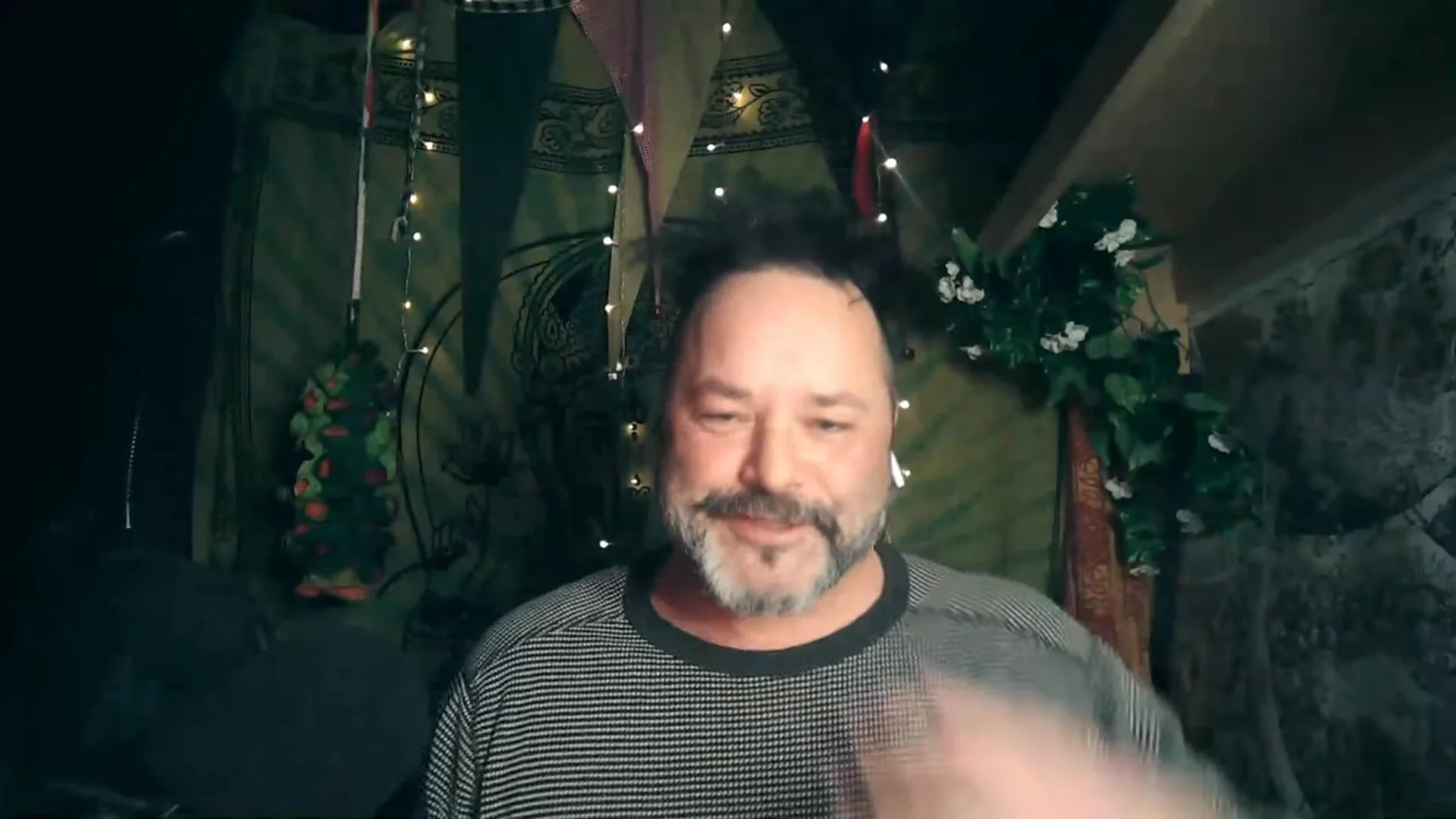
No. 33 of 44 · 27 January 2026 · 1 h 29 min Layman Pascal Fostering "Prodigies of Uncertainty" Watch the conversation On YouTube Everything said in it, in the order it was said: 87 turns, 56 of them Layman Pascal's. Press one to hear it from its second. 0:00 Layman Pascal The thing that I'd come up against, for myself, but also for kids especially, is the difficulty of maintaining a fully engaged benign attitude as your ability to trust information environments degrades at a rapid rate.0:16 Michael Garfield Right.0:17 Layman Pascal Trying to figure out how do I be fully committed to the information I'm receiving while simultaneously not believing anything that I'm receiving. Right? How can I be a full political participant when I don't believe any piece of information on the mainstream news? And in fact, any video footage could easily be faked at this point, and that becomes more true each day. That's one of the disconcerting elements that I've had to paddle the most in order to keep being submerged by. I think it's a really tricky one, and I think the looming possibilities when your grandmother gets that call from a robot voice that's impersonating her granddaughter and asks for that card number and away plausible. I feel the imminence of that world scenario and of all of the sense-making options we used to use that are not applicable in that scenario. And I don't know what to do about it. I think I'll manage better than most, but the shock of the overwhelm of what's imminent, that that is something I have to make efforts to be ready for.1:36 Michael Garfield I'm your host, Michael Garfield, and this week we decant an episode recorded one year ago, which means it's had time to ferment. And yes, it fizzes with meaning even more than it did when we committed it to record. The world is, after all, getting weirder every day, and we need weirdness specialists. Maybe the best guy for the job is Layman Pascal. In his own words, he used to be a Canadian meditation teacher, yoga instructor, and philosopher of integral meta-theory, but he's feeling much better now. He leads the Meta Modern Spirituality Labs, hosts the Integral Stage, Soulmakers Plus, and Ontegral Stage podcasts, and provides unique online courses. He is also a founding member of several think tanks in the developmental psychology and spirituality space, acts as senior editor of Emerge Online, and is allied to numerous institutes across the field. In addition to many journal and anthology articles, he is the author of Gergief for a Time Between Worlds, Sex, Death, and the Occult, and an upcoming book about Nietzsche. Lehman is known for his philosophical work on the metaphysics of adjacency, complex nonduality, coaxial developmental stage theories, sacred naturalism, archaic futurism, embodied spirituality, and the integration surplus model of religion and spirituality for a post-postmodern civilization facing numerous accelerating and converging crises.3:14 Michael Garfield He refers to all his work as the serious playground. Maybe it'll catch on. Before we dive in, I want to announce the next Humans on the Loop book club, Wendell Berry's 1983 collection, Standing by Words. It's a masterwork of systems thinking, an eloquent indictment of modernism and romanticism, and a carefully crafted manifesto for the virtues of humility and land-based contextual knowledge. In discussing his essays on poetry and place, people, land, and community, poetry and marriage, we'll get to the heart of what it is to use language as a wise technology and the nature of our responsibility to each other and to the world. This is one of the most beautiful and moving books I've read in the last few years, and it'll be a joy to dive into it with you all. Patreon and Substack supporters and anyone making comparable recurring tax-deductible donations at every.org slash humans on the loop. You are all welcome to join us Sunday, February 15th at 10 30 a.m. Mountain Time. Grab your own copy of Standing by Words and support independent booksellers at the bookshop.org link in the show notes, where you will also find a reading list containing hundreds of other books we have mentioned on this show.4:37 Michael Garfield We'll prep before the call in a members only channel of the Discord server where I'll share reflections on some of my favorite passages. And even if you don't have time to read the book, please, if you are a member, join us for the conversation. It's going to be wonderful. Lastly, if you're in the area next week, I'll be at IUBloomington January 27th through 30th for the Weird Academia Event Series hosted by Weird Studies and the Center for Possible Minds. There are many wonderful discussions to be had. For more info, visit possibleminds.org and or email elfthoughts at gmail.com. Thanks so much for listening. Please press every available button to get this show into the ears of everyone who would want to hear it. And I hope you enjoy this conversation with the inimitable layman Pascal.6:06 Layman Pascal Maybe it was just for us. It was withdrawn back into the shamanic dimension to which it referred.6:12 Michael Garfield Yeah. Well, so where I would like to start, as is my custom for this show, is to anchor everything that we're going to talk about by giving people a point of reference, a cosmic address, if you will, for who you are in the most mundane autobiographical sense and at great length. I want to hear about your childhood traumas. I want to hear about what it is that you do, and I want to hear about how you came to care about the things that you care about, why it is that you devote your energy as such in this life.6:56 Layman Pascal That is devastatingly broad. I grew up on a little island on the British Columbia coast, and so I was pretty steeped in like deep ecological experiences, pretty interested in the local indigenous scene. I was pretty obsessed with the vague bits of esoteric literature we had on the bookshelf. And it was a pretty stable, well-nourished, loving environment with parents who were willing to let you be interested in and talk about anything you like. And it turned out that what I like to talk about pretty compulsively was somewhere in the spiritual, religious, mythological, psychological domain. Right. So a lot of that became an interest in philosophy. A lot of that became an interest in kind of classical religious training, largely in the Buddhist sense, but also sampling other practices. But over time, I've come to see that a lot of that is basically what I would broadly class as shamanic. If we think about this notion of shamelows, you think of like a percentage of the population as being more or less instinctively driven by their internal ratios towards some kind of for the greater tribe that has to do with accessing altered states, so always being at thresholds, looking for existential development practices that take place more or less immersive and ecological environments, treating themselves as an inner plurality, trying to be negotiators with quasi-intelligences with non-humankind.8:29 Layman Pascal And so it seems like there's a lot of people who fall into that bracket. I'm definitely one of them. I like thinking about the process as well, and everything else I've been doing in terms of trying to retroengineer theories of spirituality and religion, or working on building up community and overlapping developmental, transformational, and regenerative spaces, or writing, or any of these kinds of things. They all for me fit broadly within that schematic or meta-shematic category, you know, sort of extracted from its traditional ethnic notion.9:01 Michael Garfield And yet, I know you as someone who has at least in my social network, substantial voice, which is uncharacteristic of shamans in modern western civilization. Obviously, it's like you're not on Joe Rogan or whatever, you're on my show. We've already self-identified as weird. But you do seem to have at once both a complete comfort with edge realms and somehow an interoperability with the status quo, the world that is, you know, moving in business and tech world stuff. And for purely selfish reasons, I'd like to make sense of this.9:55 Layman Pascal Part of it's just temperament. And maybe if we were like going to speak in a very broad sense, we could speculate that there are shamanic subtypes, right? I think we both fall loosely into that category. And you do see people who have these temperamental dispositions showing up in the broader world. There's shamans on Wall Street and there's shamans in Hollywood and things like that. We just don't necessarily have the same kind of categorization and recognition and social support for that function that they might have had in a long-running archaic civilization of some kind. But I've temperamentally always been straddling that particular kind of liminal threshold. I can remember times at school where I felt like it was my responsibility to look after the weirdos that I was somehow capable of playing the sports really well, getting good grades, and having nice, friendly, mature relationships with the teachers. And this gave me a kind of security that I felt the need to extend to some of my favorite other kids who were just absolute freaks. And they couldn't show up in a friendly, well-modulated, benign kind of fashion that would get them endorsed by the institution.11:08 Layman Pascal I'm it's not like every mainstream institution could necessarily endorse me, but I do play that. I am happy with that. I have it maybe a kind of solidity or something that people don't mind. And sometimes I can do this Rod Sterling narrator voice thing that makes it sound like I know what I'm talking about.11:26 Michael Garfield So I want to keep an unusually long standard interview format primer on this until we really get into some dirt and start co-improvising. And I want to start by asking you to characterize what it is that you think we being humankind or the biosphere or whatever, what is going on on this planet right now? And I'll frame that as you and I both recognize, among many other people, that big shifts are underway. You have been reporting on those shifts and helping make sense of them for a long time. How are you thinking about this? First of all, what is changing? What do you recognize as sort of inarguable as something that it seems from your perspective, most people will acknowledge is underway? What are we moving out of and into if we're going to talk about it in that kind of egregiously simple way? And then since I know you're willing to take a risk, what do you see as changing that might be harder for people to grasp or stomach or recognize?12:52 Layman Pascal Speculative changes. If you hang out in developmental communities, they'll tell you the story about a general upgrade in the consciousness operating system. I think that's an interesting option, but it's a debatable option. I think the less debatable options are we're passing out of nation state book culture into some kind of biodigital civilization that's characterized by enormous and surprising degrees of automated intelligence characterized by transcultural encounters of all kinds. Characterized by increasing strangeness. I think sort of the unarguable feature of the current civilization at the moment is something that someone like Terrence McKenna was able to put his finger on really well. It's just that the overall levels of ambiguity and curious juxtaposition are going through the roof in the sense that you have to be able to either surf intense peculiarity or you will be shocked by it and put into a traumatic recoil of some kind, which leads you either to paralysis or to emerge in a bipartisan neoliberal hegemony or to some kind of useless reactionary regressive pseudoconservative move. We more or less miss what's happening because we're reacting to the last thing that emerged.14:08 Layman Pascal If you talk to people about artificial intelligence, they want to debate with you whether or not LLMs are conscious or something like that. And you're like, it's not about that. It's about what that technology is going to converge with from other lines of technology over the next couple of years. It's about LLMs crossed with Wolfram's irreducible algorithms crossed with quantum computing, crossed with Michael Levin style synthetic biology, right? It's about convergences that are on the imminent horizon with momentums that are already in play. So I think that's one of the things that's difficult for people to stomach is the radical surprise that's arising, not just from the innovations we see, but from the crossing of those innovations with each other. And also just the sheer sense of the monstrousness of the future. I think there's a sense in which, you know, like when I talk to our kids, they have this question of like, well, what are we planning for? Is there even going to be an ocean in 12 years? These sorts of questions, and it makes you feel like no one has a sense of the future anymore.15:12 Layman Pascal But I think it's actually the opposite. I think we're, as a civilization, just getting a sense of the future. We're starting to see that it plays out on enormous scales. We're starting to see the emerging technofeudal lords really grapple with long-termist thought of various kinds. We're starting to see a return to an archaic sensibility that built into it when you look at the relics of the early megalithic civilizations. I think it's going to be surprising, it's going to be strange, it's going to be human and transhuman at the same time. But I think we're feeling the ultra-peculiar shockwaves of the emergence of an enormous amount of future that we haven't encountered before. We were able to sort of minimize the actual effects of the future on our lives over most of recorded human history, and now the future is out of the box all of a sudden.16:00 Michael Garfield Yeah, I we spend a lot of time, we being me and anyone who will play ball, talking about precisely this apparent paradox that the imminent horizon feels even more imminent all the time. And then also somehow further away. Like I remember that some of the first notable spiritual experiences I had, which I think file under maybe like a sleep paralysis category in high school, were lying in bed and being paralyzed by this sort of strobing sensation that my body was somehow infinitely large and infinitely small at the same time. And then all my friends are like, Are you sure you're not on drugs? I'm like, No, of course. Well, I mean, now I have the language to talk about endogenous DMT release and so on, but there is this effect of digital technologies that seems to pull in both directions at the same time. And I would love to hear you riff a bit more on the both at-on-ess of this. And for bonus points, I would like to know what you have found most challenging or difficult or surprising in all of this, given that you seem unusually well disposed to handle a movement into a higher logical order that isn't about one or the other, but has found a way to navigate all of this with enough capaciousness to accept apparent contradiction.17:46 Layman Pascal Well, two of the simultaneities that are of greatest interest to me. One is the timescale situation. I think every new technological innovation we've seen, more or less, has amplified the expanse and has contracted the part of our meaning-making system, right? So when you get into like McGurney, suddenly we're like, oh no, it's not a 6,000-year timescale, it's a 14 billion year timescale. But we also shrink to the split second from pre- from what a water clock could deliver for us, right? And so we've come into this new sort of digital expanse, and the world that digital tools reveal to us, both spatially and temporally, is so unbelievably vast and multipleistic, and the pieces of the reality are so simultaneously unfathomable, right? The nanoseconds and the multiple simultaneous narrative pathways unleashed by a multiverse perspective on physics. The sense that there is a greater universe outside the humble sphere, and at the same time, this sense that in order to describe the universe accurately, you have to look at subatomic particles that do not at all behave like regular particles.19:01 Layman Pascal That kind of stretching in the cosmology, in the ontology to which we're subject, that really intrigues me. And I think that is a function of the universe as revealed to us by electronic tools. But the other aspect of it, the other simultaneity that really interests me is, and I called it biodigital, because you will talk to people like Alexander Barr or somebody like that, he really favors thinking in terms of this emerging civilization of distributed digital networks. But it seems like these things always throw up their opposite that gets highlighted by contrast, right? And if you sit long enough in front of digital devices, you don't just get confused and abstracted into a virtual world. You get the situation of your body, right? Your back begins to ache. You start to think, Jesus Christ, I got to start doing something with my body. I got to stop just playing these games and start listening to Dr. Huberman or something like that. Right. There's an arising sense of biological awareness that goes along with digital immersion.20:00 Layman Pascal And I think we see the parallel structures emerging in our analysis of the body and of the nervous system that we see emerging in the way our technology is laid out on the world. And the similarities in that architecture reinforces the double sense that we're more embodied and more disembodied through this technology at the same time. And you see something that's come up in the last couple of decades of work on developmental theory and in spiritual communities as well, is this enormous emphasis on embodied practice, right? That was not a hugely highlighted feature of traditional spirituality because it was taken for granted. But now, because we're seemingly at risk of being immersed in virtual worlds so much, we have a consciously highlighted awareness of the body by contrast to the digital. So I think it is better to think in terms of the biodigital, but I do think those polaris stretch and pull us to our limits simultaneously in two different directions. Hard to grapple with both of them at the same time. Now, yes, I have some personal dispositions and I have a lifetime of practices.21:08 Layman Pascal Which allow me to be pretty good at dealing with strangeness, dealing with paradox, dealing with higher order Mobius strip type structures of insight making and things like that. Given all that, what's still been difficult for me, or strange, or astonishing in all of this? The thing that I come up against for myself, but also for kids, especially, is the difficulty of maintaining a fully engaged, benign attitude as your ability to trust information environments degrades at a rapid rate, right? Trying to figure out how do I be fully committed to the information I'm receiving while simultaneously not believing anything that I'm receiving, right? How can I be a full political participant when I don't believe any piece of information on the mainstream news? And in fact, any video footage could easily be faked at this point, and that becomes more true each day. That's one of the disconcerting elements that I've had to hattle the most in order to keep being submerged by. I think it's a really tricky one, and I think the looming possibilities when your grandmother gets that call from a robot voice that's impersonating her granddaughter and asks for that card number in a way plausible.22:26 Layman Pascal I feel the imminence of that world scenario and of all of the sense-making options we used to use that are not applicable in that scenario, and I don't know what to do about it. I think I'll manage better than most, but the shock of the overwhelm of what's imminent that that is something I have to make efforts to be ready for.22:45 Michael Garfield Yeah, so this issue of maintaining a poise with great doubt, and then the and yet we must act thing is at the heart of many of the conversations I've been having for this series and for future fossils. And I want with you to move freely between the way that looks as you just described at the level of one's individual umwelt. How do I, this legal name, navigate this stuff? And then the other piece of it, which comes up a lot in the conversations that I have with people, the social sense making piece. And so if you're tuning in for the first time, one of the six core domains of this project is in multi-scale regulation. So if we start with the Lego brick of you can think of thoughts competing for attention or blood glucose or whatever in your mind as something that proceeds according to market-like dynamics. And then over evolutionary time scales, the market-like dynamics generate capacities for regulation, you know, like the neocortex being able to reflect on the inner workings of the brain and decide which thoughts to listen to, etc.24:24 Michael Garfield It seems important to recognize a working analogy between actual regulation and market activity at the level of a society. And so that I want to use to lead us into the first piece of yours that you've already discussed to death, but is new to this series, which is the Meta Modern Business Bureau, right? Because this notion that society in the common sense of it, the Western civilization sense, is failing in some way to find its place for the margins, the noise, the intrinsically valuable that, like culture has been increasingly enclosed by market and state activity, and we're losing this important function, or we have been losing this important function. And this question of how can we support things that are conventionally seen within the world that you and I were born into as useless art and philosophy and other illegible goods and services, right? A lot of this is predicated on Hunter S. Thompson's quote, When the going gets weird, the weird turn pro. So I want to nod uh also to the essay that you wrote on the society of partial deterritorialization and how things that seem to be useless or illegible or in opposition to those forces, as they become legible, they function in a different way.26:20 Michael Garfield And so I think the place to start would be for you to just outline what it is that you're getting at in these two pieces so that we can start playing around in there.26:32 Layman Pascal One where there's something like the backstory of the part economic moment, which is traditional economies become the modern economies. The modern liberal economies have a basic kind of logic to themselves, but they also have a really limited notion of what constitutes progress, what constitutes profit, right? They overcollapse things into singular variables, and as we all know, enormous amounts of things get exteriorized by that process. And then over time, you get the buildup of these as if postmodern forces that critique how modernity functions. They can point out the fact that it's always going to make certain kinds of mistakes. The mistakes it makes are largely around not being able to price in a lot of the important work that goes on in the organic system of a human culture. And over time, there's an accumulating problem of losing a lot of your best creative people, losing the input from your esoteric voices, and also not valuing the partial leftovers, the partially deterioratorialized places and ideas and structures that are important to get remixed back into new structures.27:42 Layman Pascal And all of that is something that goes on within organic systems that is not yet going on at the scale of our economies. Now, a subset of that general problem is a huge number of people who we might call multi talented meta modern characters, right? They fill up these spaces. They are either doing something like this, they're either like hosting their own little information spaces or they're writing books and running courses, or they're just fitting this interest into their ordinary lives somehow. But they're out there in huge numbers. They have a visceral sense of the metacrisis, of the integrated sense of the overlapping plural crisis we face as civilization. They have an instinct for the kind of balances you would need to have in living into the future in a way that's creative and encourages driving. They have all kinds of competences. And yet they're not funded. If they're in the United States, they may be one step away from some kind of overwhelming medical bankruptcy or have someone in their family who does. There's an incredible squandering of this really valuable resource.28:52 Layman Pascal And then the question becomes how do you increase the value of that population segment, not just for their own well-being, but in order to cause them to have a greater share of civilization's mind space. And in order for them to feel valuable and have the resources to mobilize on their ideas, because these are people who are out there right now, every day they are obsessively driven to think about the fundamental existential problems in the system and speculate about solutions. Right? There's a feral army of these people, and they need to be brought together so that they can live and work in ways that allow them to have lives and reproduce. Because if they're not reproducing, there aren't more of these people in the future. It has to be situations that don't take up so much of their time that they can't also work on their compulsive analysis and cultural production of potential tools for helping with the current situation. And whatever goes on has to be easy enough for them to get into in large numbers so that it can exercise some kind of collective economic impact.29:59 Layman Pascal So you need somebody that I was calling the MetaModer Business Bureau that can help make that an easier transition. So if these people wanted to say drop out and join with other people in their city and create some kind of business whose sole job was just to pay for them and their families and at the same time leave them enough free space to work on all of this stuff, how would they do that? How would that be twice as easy as it is right now? And how would the knowledge of how those experiments go get captured and preserved and passed on? And then how would all of that operate in a way that short circuits some of the obvious ideological problems that come along with money-making processes? And how could that also function as a generator for market speculation of various kinds, right? Why aren't there investment guilds supporting these people and organizing things like that? There's a huge number of other aspects to that. Like how do you receive funding? How do we set up all kinds of different programs?30:55 Layman Pascal What's especially good about these people? Jim Rutt and I have had a lot of conversations about what game B people might be better at so they could outperform in the normal marketplace other types of people. So there's a lot of dimensions there, but maybe I've thrown out enough pieces for us to play with.31:10 Michael Garfield Yeah, and just to make this super clear, in case people are confused at this point, the link that I'm drawing you into here is that there is something like the people that you identify as members of a hypothetical future Meta Modern Business Bureau, the artists, the philosophers, that I think represent at the human scale, meaning like within each of us, that function of doubt, of critical thinking, of curiosity, of exploring hyperspace as new domains become available. And that society largely doesn't recognize these people precisely because they're operating in domains that are molten still somehow or inherently liminal or ambiguous, that makes it hard to finance them, specifically because only certain things are legible to regulation and to economic like financial speculation. This is why I heard when you're talking about the challenge of approaching information with doubt and still being able to act on it. What I heard was that famous quote from Harry Truman who said, Whenever I talk to a scientist, they always say, But on the other hand, it's like, can someone please find me a scientist with only one hand?32:41 Michael Garfield And so this is not a new problem, right? William Erwin Thompson talks about these as being kind of evolving archetypes that remain in place through every new civilizational epoch, you know, that it was the artist and the industrialist in 19th century, and that the electronic communication era is one between the technocrat and the shaman. You know, so that brings us back to where we are with all of that. So that other piece about the society of partial deterioratorialization is that there is always some region that has yet to be formalized in our language or our mathematics that starts off in the crazies and then flows downstream to the artists who make it legible to the savants. And then Bill Thompson's last stage was the pedants, at which point it becomes obvious. And there's a nice similarity or congruity with the adoption curve of technologies, right? You know, that the earlier you invest in something, the crazier you seem, but that subfractal of this bigger issue. And so I want to link that back to your point about the fact that we're never gonna get to a place where the forces that seek to render legible this world to bring the the, you know, in Hakim temporary autonomous uh into the empire and then force all the pirates out to form new pirate utopias even further out under the margins that we have to accept as part of the complexity of our situation.34:29 Michael Garfield And for me, the the question becomes do we actually stand a chance at finding a way to make all of this valuable but economically expensive doubt? Do we find a way to actually support that in any kind of metastable, enduring way? Or is it the case that the faster things change, the more intense this problem becomes? Or like another way of putting it would be you know, now we have the revenge of the humanities, right? In Steven Johnson's language. And I'm seeing a lot of people, rightly or wrongly, say, you know, don't teach your kids to code, because that's going to become just zero marginal costs on tap stuff, but teach them how to engage in the things that were the subject of the liberal arts in a more historic sense, you know, to think critically, to engage in philosophy, to develop their people skills and all these things that were until very recently considered relatively unimportant. And so, yeah, I'm curious where you see this balance, like in what direction is it growing? And I honestly, you can answer that, rant, however, you please.35:56 Layman Pascal Zelleman of these patterns like the adoption curve that I think are very old, historical to human beings. And I think for the most part, it was the adoption of sensibilities and moods, right? For the longest period of human history, it was rare that there was a technological innovation that occurred within a given generation. So most of what was going on in terms of a small number of esoteric people really being tuned into strange possibilities opening, and then a midsection of people who kind of got it, worked with it, played with it, tried to figure out how it worked with the rest of the tribe, and then the rest of the tribe adapting to it as variously as they could. I think that's primarily and still probably primarily a matter of states of consciousness, of attitudes, of moods, of postural comportments, and things like that gets passed in. That's been going on the whole time. There is something that could be new because we do that kind of argument and go, there's no way to really change the system.36:58 Layman Pascal It's always only going to have these characteristics that we've seen it have. The question is, how long have we seen it have those characteristics? Right? That pattern could be an artifact of modernity, it could be an artifact of modernity plus classical civilization or something like that. It's not necessarily that it characterizes humanity in general. So I think one of the things that's problematic at the current point is that given our political economy and given the types of technology we've been running for the last little while, there have been all sorts of resources and types of minds that we haven't been harnessing in the organization of the infrastructure of the civilization. And then at other periods in human history, sweet spots, renaissance modes, things like that, it has been possible for us to fold more of that in structurally and get more of a cultural engine coming along. And I call that religionization essentially. My model of religion is essentially the same as a Renaissance, it's an upgrade of culture to the point where the different kinds of domains of cultural engagement cross-fertilize to the degree that some additional spirit is formed that people feel divinizes their cultural engagement and allows them to mobilize on information they already have, but in ways that aren't pre-bound into their existing behavioral commitments.38:17 Layman Pascal So that's happened periodically and it can happen again. The fact that we haven't seen it happen for a while doesn't mean it's not possible. However, none of that's utopia, right? There's always going to be the role of the frit and the the pushing out of people into uh you know pirate alternatives, heterotopias of various kinds, things like that. But that doesn't mean that you can't make the system a lot better. That doesn't mean that it's not possible to draw in a much wider range of voices. There's also all kinds of things you can do, right? Like if you have a healthier population in general, just physically, if you have stronger social safety nets, then when people fall to the side, that falling to the side is less catastrophic and they're more likely to be able to find some ways to add their input back into the system. So there are a huge number of ways that we could redesign the system to capture some of the magic of the best moments of human civilization. Then, however, that runs up in some fairly short period of time against the scale of the challenges we're currently facing as a planet.39:25 Layman Pascal There may be things that absolutely cannot be solved without a radical mass mobilization of some kind or just dramatic restructuring of civilization. We don't know what those structures are. We can speculate, we don't know when that moment's coming, but it's probable that some moment like that is coming before too long.39:43 Michael Garfield One thing it seems like we're gesturing toward again and again is the frame within which opposites are understood as mutualistic within a higher logical order. And this is where I want to call to the essay that you wrote, The Two Handed Demons, Wisdom versus Parasetic Ambidextrous Collective Intelligences, right? Because it's like even in saying that the status quo absorbs or re-territorializes its radical fringe, what we're talking about is not in final analysis, two things, but one thing with a core and periphery. And I really appreciated this piece because you make the point you write here, building on the idea that a wise mind tends to see the world in higher order reciprocal patterns. I want us to at least consider the possibility that the polarized struggle, e.g., woke versus maga, conservative, liberal, etc., is a facade. We may be dealing with pseudo-entities that have both left and right hands. The two pedals of a bicycle are not competing. So I made this mistake very recently. Like I fell out of my understanding of this and into a question that a lot of people in the so-called liminal discourse seem preoccupied with, which is how do we beat Moloch?41:13 Michael Garfield Like, how do we get rid of this violence? You know, that like even in game B language, there's this question of like you you mentioned a moment ago, out competing all against all conflict. And yeah, if you could set up the observation that you're making in this piece and the question that you're asking people into, then I think we have a little bit more to play with here.41:40 Layman Pascal Yeah, there's a really interesting thing, which is that there's a lot of these liminal, developmental, transformational, regenerative communities, etc., etc. There's a tendency in these communities to be very partial to paradox-friendly spiritual practices, right? I'm a big fan of Zen Koan work myself, right? And we go, okay, of course, there's some spiritual condition, there's some state that I saw in a peak experience or on a drug or in the Zendo where I saw beyond opposites, I get that in the spiritual domain. And I get that in the philosophical domain. I'm interested in metamorphism, integralism, hegelian thought. I'm interested in thinkers that seem to go beyond the ordinary opposites. But when it comes to The way that I imagine my daily life as a participant in the political and social order, then I suddenly fall into a very simple kind of dichotomy thinking. Then it's suddenly pro-vax or anti-vax. Then it's simply uh the system or thwarting the system, changing the system, killing the system, healing the system, some kind of adversarial relationship. And I think one of the ways to imagine this, and the people who've done the best job on this so far have been like post-Marxist critics of ideology who are like really suspicious about how flexible an ideology can be.43:03 Layman Pascal And there's a sense in which an ideology can protect itself by like an animal would do, presenting an apparent weakness, right? A killer whale, an orca whale has a fake eye. If you attack that eye, you will not fly the whale, right? There's a lot of animals that can lose a certain body part and they make that body part seem like it's the one you should attack. So the person who's either trying to undermine that structure in some way or oppose that structure makes the obvious counter move and it never changes the system. These are really complex systems. And one way to think about how complex and self-protective these systems are is to think about egregore's being ambidextrous. And what they always create is an alternative to a mainstream narrative of some kind. One of the most amazing. So Jacques Lacan, the French psychotherapist, had a great phrase the non-dupes that are the non-dupes go astray, right? That you'll fall for anything if it's the thing that makes you feel you're not being duped like everyone else, right?44:03 Layman Pascal You'll you'll be absolutely duped by that one. I remember 9-11, all of a sudden people were like, Oh, it was an inside job, right? They felt like there was something wrong in the mainstream narrative, but they didn't inspect the fact that they felt like they, with no problem at all in a quick perusal of the internet, were able to crack the code and discover the secret altar story. It didn't occur to them that the altar story is created by the same ideological and institutional phenomenon that create the mainstream story, that the mainstream and the primary alternative are usually created together, usually reinforce each other. And if you were a conspiracy player in some vast game, you would always output a kind of Abby Dexter story. If you wanted to prevent change, you would make sure that both the options, the conformist option and the revolutionary option, basically serve the same function. Now, that's a way of describing it that makes it seem like agents are behind it, and to some degree, agents could be behind it.45:04 Layman Pascal But I think we need to think about this more as an unfolding of complex systems at the social level and as something that's systems of a certain kind just fall into a rhythm of operating this way because it's structurally functional and it preserves what they're doing.45:19 Michael Garfield Just to double down on this being a metabolic challenge, you know, the idea that to be present to something and to doubt it and still to act does require a lot of us and to link back because I feel like you know I'm scraping the enzo into a canyon on this conversation, but it's because it's the one point I really wanted to embroider with you. I hear people ask, what is the unifying story? What is the new narrative? And yet it seems like everything we're talking about suggests that we're moving a level up to recognizing that there must be, in order for a harmonious planet scale society or culture, multiple different narratives, and that it's a kind of cognitive dissonance writ large. And then you and I already seem to agree that this would be less of an issue if society had the means, meaning not just the resources, but the ability to distribute resources such that people had the security or the liberty, although those being different things, but like the bounds within which they were free to actually fill a niche in this larger ecological sense of culture.47:00 Michael Garfield And that you know, that's where the Meta Modern Business Bureau comes in. And so it's like the question of if we acknowledge that apparent polarization can be folded into a greater unity, but if recognizing this takes work, it takes time, it I think that there's actually something structurally important about the fact that so many excellent sense makers are not preoccupied trying to optimize for some sort of narrow function, then it's more about how can we do a better job of allocating unity and plurality, or where does centralization belong and where does decentralization belong in the structure of this thing? And that's related to another question I had for you about actual practices for navigating what Eric Davis calls global weirding. What are the practices that are compatible with the familiar, the normal, quote unquote? And then where do we know that we are gonna have to take a leap of faith? Those two questions are at angles to one another, but I would really like to hear you, Riff, about if you want to call it a new, like chaotic level of organization in society, like where do you imagine that the pieces are likely to start to form into a metabolic structure that can actually sustain all of this rather than it feeling like pieces yanking against one another?48:42 Layman Pascal Well, when it comes to practices, there's sort of two ways to think about it. One is collective and the other is personal practices. Collective practices are going to involve what we're doing here, right? A lot more conversational sense making, punctuated by in-person sense making sessions as well, so that we're not constrained by the medium itself and we have more time to exchange more different dimensions because we don't know which aspects of what we would communicate with each other are essential to doing the sense making that builds the anti-fragility to the new conditions. And networks of people engaged in these very things are going to be central to this, and their effects on the general population will form like an intermediary layer of some kind. So what they need are good ways of exchanging information and critiquing information with each other. They need to function like their own kind of media and sense making and judgment system collectively. One of the things I'm most interested in is the individual practices, right? I think one of the things is, like I was saying, the return to the body, but that has a subjective component that's very interesting coming out of spiritual traditions, which is just your sense of inhabiting the body, right?49:50 Layman Pascal Of being the interior individual of the flesh. You can feel all your parts from the inside, and you can feel your whole body from the inside. And when you maintain some awareness of that, you're not as easily captured by either the virtual content or your reactions against the virtual content. But that requires, first of all, intentional attention work, right? That's a skill that we can build up. That's a skill implicated in most meditative and spiritual and contemplative practices. The other thing is the ability to bear the cognitive dissonance of the simultaneity of various forms of information processing. Some of those simultaneities are denying. They're just like two things we need to learn to track at the same time. And some of those simultaneities are very difficult. They are tension, they're struggle, they're angst, they're friction between different systems, between different behavioral investments and interpretive options ourselves. So that's what kind of there's a lot of talk about metacognition and building up this new capacity. And very often there's a kind of reductive move where the way to become metacognitive is just to witness yourself and turn what was subject into the object of a new, more complex subject.51:01 Layman Pascal But there's a resilience, there's an anti-fragility, there's a strength, there's a daring, there's a growth mindset struggle that has to go on. And I think that comes from these two factors: intentionally coordinating different intelligence systems that we're using simultaneously through practices, and also being better and better at bearing the tension of the competition between different interpretive options and ourselves in a very visceral way, in a way that reminds us of our worst moments of freakout and angst, and you know, all those kind of domestic arguments that just want to rip you in half. Like to be able to be there inside, be the inhabitants ever more deeply of the cognitive dissonance. That's a skill that we need. And these are not skills that everybody is going to be able to develop very well. So there is going to be some kind of stratification or specialization here, where, as there was traditional, some people practice a lot of this, some people understand they need to do it semi-regularly and put wisdom from those people into the system.52:00 Layman Pascal And most people will do it occasionally at most.52:08 Michael Garfield I want to execute what at first might seem like a dog leg into the conversation I heard with you about the soul of AI with Lee Chazen. And in that, you mentioned at one point that language models, as currently understood, will not be enough for us to make the most of the opportunity that's being presented to us by these new paradigms of artificial intelligence, and that ecological intelligence in many forms does not exist. And I think about okay, well, what's the next weird? And the next weird seems like if we manage to bear the full fruit of a humanistic value system, then what about everyone else? And so, how do you see the strangeness of the non-human, even within the human domain, as playing a crucial role in the kind of collective intelligence predicaments that we're facing as we stretch ourselves to accommodate more and more orchestrated diversity?53:45 Layman Pascal Yeah, we're we're at a point, and this is one way to go back to these questions around where are we historically? One of the places we are is the unveiling of the insufficiency of adult waking state linear representational consciousness. We know that's not enough. We're playing in bigger games already, and what does it take to play in those bigger games? It takes subconscious intelligence, it takes collective intelligence, it takes artificial intelligence, maybe it also takes biospheric intelligence. These things are a different style of patterning than the one that our left brain is used to compressing, right? That consists of patterns that very often don't look patterned to us. It consists of patterns that are very hard for us to track and predict, that there's a workability that comes through engaging them that we can't necessarily get by using simplified models of their processes. So they're always going to be strained in that sense. There's a sense in which the subconscious elements, right? We don't know how much intelligence might be subconsciously available to our organism relative to the small amount that we wake up with in the morning.54:56 Layman Pascal But that subconscious is always going to be strange. It's going to be surrealistic inherently because that's what the surrealists were doing was trying to bring patterns from the subconscious into the conscious, right? Thinking yourself as a subconscious subject is to other the self, which is an inherently weird move. So there's always going to be an uncanniness to that dimension. There's always going to be an uncanniness to the emergence of devices that we can't tell if they're intelligent or not, and that operate from different substrates than the one we've evolved to use. That's going to be uncanny. And I think even if we imagine, as I sometimes do, how all of this fits into the notion of the biosphere as an agent of which we are organs or components of a process, I think it has an inherent strangeness that anybody who takes a psychedelic in a natural environment is going to experience. And it might not be a bad strangeness, it could be horrifying, it could be delightful, but there's a sheer love craftian peculiarity to things that are operating at those scales that we can't get our hands or our models around.56:04 Layman Pascal So in order to be on the lookout for how we play in these other domains, we've got to be aware that the places to highlight are in fact the ones that feel weird to us. And that means that we need weirdness specialists to lead the charge on that. Now that's not enough, right? But it's a necessary component. You also need people to stabilize the weirdos and force them to deal with each other and mature and become functional in the world, and people who can help translate back and forth to the rest of society. Not everybody can bear the weird all the time, but we have some people who are instinctively driven toward that terrain, and we would be fools not to make best use of them.56:42 Michael Garfield So in thinking about a well, I won't call it a people's parliament of weirdness specialists and weirdo stabilizers, but you know, something like that. I want to land this on the ground in a particular test case, right? Because Los Angeles is on fire. And I was just reading an interesting reflection on how wildfires in 2022 in China, thanks to the umbra of a more complete and totalizing national identity, led to the mobilization of effort to put out those fires across provinces and across age cohorts. That seems unthinkable in the United States. That, you know, to go back to polarization, like I'm curious, starting from where we are now, and then going back out of what you know, your practical recommendations for accommodating or being with these inherent tensions in oneself out to the level of what it actually looks like in social coordination. I think the question on many people's minds right now is where do we push on the structure of a polarized society, or how can we nourish different aspects of it in order to make itself more aware of itself as a single entity?58:25 Michael Garfield And I look at the US over the majority of my own adult life, and it looks like that video of the dog snarling at its own tail, you know, which is weird, right? It's weird in a funny way, but it's not so funny when it leads to crisis response that is kneecapped by the fact that everyone would rather find someone to blame than actually deal with the fire and make sense of it later. And I'm curious, as we're leaning more in the direction of what is the vision, you know, what is the most promising and broadly appealing version of the future into which people, regardless of identity or belief structure, can pour themselves. What does it look like for a country at the cusp of tearing itself to pieces? Not just ours, but many others. And by ours, I mean me here down in the US, not you in Canada. You guys are doing great right now.59:28 Layman Pascal Yeah, it's you know, it's we only compare ourselves to you, so it's a low bar. We should actually have a small goal, I think.59:37 Michael Garfield Yeah, there are some similarities. So, on what path do we set our first step? And what do we see along that path toward a future where people can stop biting each other when something bad happens and work together across their differences?59:54 Layman Pascal So, this is really pertinent for me. So, on the Intical Stage podcast, one of the things we do is we break it down into sub-series, and a sub-series that we recently generated following the American election has been on nationhood, civic spirit. What does it feel like to be members of a society or a country or a national identity of some kind? Right. And obviously, among the many different people I've talked to, a lot of them are in the United States. And one of the questions I remember I asked this of Marianne Williamson a month ago when I interviewed her is you know, what are the elements that are holding back the formation of a coherent sacred identity in lived citizenship that can overcome or make workable these polarities? And it seems like what we came up with was three things. One is there are some traumas to heal, right? There are lingering unprocessed elements of the history of a nation. And healing that doesn't mean you have to give up the heroic image of the nation.1:00:53 Layman Pascal You actually have to keep the heroic image of the nation, but you have to be able to take on board responsibility for your errors so that you can steer more correctly into the future. Then there's a huge problem. This one actually may be the most difficult one to solve the incentivization of the destruction of the social fabric, right? Some people get paid when the civic spirit is destroyed, so to speak, right? So you have to have some method of blocking that as a highly profitable thing to do, to engage in the turning of people against each other, to engage in the promotion of anxiety and tribalism and identity politics of various kinds in the United States. Because that has, for the last little bit of history, been an extremely efficient way to make a lot of money is by duping people into that. And in order to dupe them into that, you have to turn them against each other, you have to present dichotomies, you have to have a news media that just constantly makes you outraged or worried, right?1:01:55 Layman Pascal That's what's on sale because that's what sells. So that's a huge piece of this. But then there is the thing that maybe we can do something about, which is how do you build institutions and programs and spaces and practices that generate civic spirit, right? And this is where we start to address something like none of the things I've been talking about are direct responses to a fire, right? The idea that there's something valuable about the shamanoid subset of the population does not mean rush to the park and get a schizophrenic and put them in charge of the LA fire department. But it does mean that these people we've been talking about may have a special role to play in religionizing the current cultural situation. That there is practice, there is vision, there's mythology, there is ordeal, there is ritual of all kinds, right? And these things are traditionally part of every society that can flourish with a shared sense of the sacredness and worth of the social body that they are a part of. So we need to do that.1:02:57 Layman Pascal And that's partly institutional, it's partly ritual, it's partly aesthetic, right? One of the simplest things people can do to start contributing is to start building up aesthetics that violate the culture war norms. Uh, I've always been interested in, you know, Jack Daniels with kale, solar panels in the back of a beaten-up pickup truck, these sorts of things, right? There's a mood, and it's gonna feel like a strange mood because it's not the dominant mood, but anything you can do to create the peculiar coherence that violates the existing culture war dynamic is probably useful. There are classic, awful waves to generate shared civic spirit, right? Obviously, a big war usually doesn't America was coasting on a wave of uh shared optimism after their successes in the second world war, but we don't want to have to go through a second world war in order to get that sense of the greatness of the American soul again. So the question is, what did we actually do, say, during the Second World War as Americans, if I could throw myself into that mixture, that helped create the spirit that mobilized the 50s and the 60s, the time period to which most existing Americans who lived through it look back on as a kind of golden age, whether they were conservative or liberal in their orientation.1:04:16 Layman Pascal So one thing was there was common mobilization. Another thing is that people mixed with other people that they wouldn't normally have mixed with. One of the most fascinating things about a wartime mobilization is it puts you in a different place and it puts you with different people among your fellow citizens. And I think that's essential for generating this the kind of intersubjective intensity that's necessary to overcome these polarities. And I don't mean overcome that we remove them, but that they fit into it as a natural piece of some broader thing. Like my the metaphor I often use is if you have an electrically conductive mixture and you have to keep stirring it, say, in order to get the electroconductivity to maintain. If you leave it alone and the sediments separate, and suddenly you lose the conductivity that was a property of the mixture itself. And you can imagine the population being like that. As long as people are, let's say, allowed, although that's a bit totalitarian, as long as they are allowed to group into their own areas and only deal with their own kinds of people and not mix with other citizens with whom they do not share very much except for citizenship, then there's no general conductive fluid.1:05:29 Layman Pascal Uh, in Singapore, they may still have it, but at least for a while there was a rule that you couldn't have more than a certain number of people of the same ethnicity or religion living in the same area. Because the idea was if you have that, they cease to feel themselves to be Singaporean and they start to feel themselves to be American or Chinese or Christian or Muslim, right? So there has to be active efforts to mix the citizens with each other, or they will naturally separate, like the you know, the Cheerios in the circus tension of the milk.1:06:00 Michael Garfield You know, I might be a bit dark when I talk about this, but I have a non-trivial amount of Scottish gallows humor running through my veins. And it's interesting, like this third point about promoting civic spirit, and the second point about deincentivizing destruction of social fabric is like, well, in a way, I'm inclined to imagine that perhaps I hope I'm not being Pollyanna-ish about this, and you can call me out if I am. But as a paleontologist, you know, Doug Irwin talks about this. You know, you look at the fossil record, and he was critical of even the notion that we're in the sixth mass extinction, given what a mass extinction looks like 66 million years ago or 252. So, if we're talking about what makes the destruction of the social fabric so profitable, it seems like it's the fact that there's a high enough signal-to-noise ratio in these systems that we still trust them to work. And, you know, I think about you brought up false eye spots on butterflies and so on. Like at some point, when the lie becomes the truth, you learn to no longer go after that juicy nugget.1:07:16 Michael Garfield And it's like maybe the solution is not making these systems more trustworthy, but the fact that they are becoming less and less trustworthy is precisely what we need to move through some sort of phase transition where we know it's fake news, or we know that we can't rely on some given authority and our priorities flip. And you know, like I'm thinking about is it possible that you know, it's like right now, we're where we are now as a civilization has often been compared to the moment right before the rock bottom of addiction. And it's in a sense, in this larger mythic sense, if we're talking about keeping the heroic image, then there is that moment of dark night rock bottom in which something changes profoundly, and it doesn't seem possible to make that decision to lean into it. But as society becomes noisier and noisier, like for instance, you know, in talking about the mixing of populations, I think, well, what could do that better than mass climate migration to put people into contact with other people that they don't choose, thanks to the affordances of their first world convenience efficiency landscape to interact with, or you know, William James's essay on some mental effects of the earthquake and how when you lost in the 1906 earthquake in San Francisco, you lost all the signifiers of prestige and of social place that people had.1:09:00 Michael Garfield And in the wake of that, people found a way to self organize and allocate help as per their expertise. You know, people were like, I'm a doctor, you know, but it wasn't about I'm a doctor. And so, like, I'm curious about you know your thoughts about this in terms of if what we're talking about are egregoric social egos. Then it strikes me that the most graceful and equanimous position that I can take with regard to everything that seems so scary to people now is that it's actually in the biggest frame good that we have to go through what I will like rudely call an inconvenient epoch in history, that we need some sort of initiatory brush with reality, you know, so that we don't continue to believe that we can just burrow ourselves deeper and deeper into the convenience solipsism that we're hoping we can maintain somehow.1:10:15 Layman Pascal Relate to that, but I'm very skeptical of it as well. You know, I think there's a tendency of people who have what we might call left liberal or progressive sympathies to always imagine that the magic moment of social awakening is possible. And maybe that if things got a little bit worse, that the people would suddenly rise up in solidarity and self-organization. And we've seen moments like this historically, and they only last for that moment. They don't usually characterize the implementation of a structure that can deal with the complexities that caused that moment in the first place. All right, so if every if you're like show of hands, I'm a doctor, great, get to work, that's fabulous. But that's low scale, right? That's tribal, ancient kind of tribal organization scale. It doesn't address where our existential challenges are coming from. To address those, we have to be thinking about structure and function on a layout that supersedes the national, not returns just to the local. There's a sense in which we often fantasize that if things were a little more disrupted or a little more stressful, that we would spring into action and finally, you know, shed our foolishness and really arise as dynamic, authentic human beings.1:11:27 Layman Pascal And that does happen once in a while, but I think more often than not, increased disorganization and increased stress brings out the worst in people and makes them less adaptive, less virtuous, and less cooperative. So we need some way to get those processes without having to go through the collapse to get them, because the collapse might not bring them. The collapse might bring them, but it might cost more than we get. Or it might bring some totally other, even worse set of solutions. So it is possible if collapse arises that we can try to assimilate that and fold that into something valuable. But I don't think we should anticipate that as being a primary mechanism for the reorganization that we need. We actually need to think it out, feel it out, get the right kinds of minds on board and implement it before we get to that point. But I think that the imagining of the crisis tells us a lot about the specific elements that we need to instantiate before the crisis arrives. The kids are binge watching Walking Dead now, they've just gotten old enough to be able to watch it, but it's a joy to go back through at least the first couple of seasons with them.1:12:35 Layman Pascal But one of the things you see there is this is a story about the transformation of ordinary American citizens, right? They go through some kind of ordeal, they have to mobilize differently, they have to uh do something different with their aggression than they've been doing in their regular lives. It shows you all of these elements. And these elements are brought out through the imaginal scenario of apocalypse. And even though the apocalypse might not really bring out those elements in people properly, even though the apocalypse is something we want to try to avoid, nonetheless, what we imagine about that, the thing that we find really juicy and engaging about apocalyptic stories, show us the very elements we need to be instantiating in our system. So, like the shaman, if we're going to keep using a metaphor like that, one of the things they anciently do is preside over ordeals of various kinds. And if you have a system that has no ordeals, then you start to fantasize about a condition in which the ordeal might come and cause a transformation for you.1:13:33 Layman Pascal But really, what we need are benign instantiated ordeals, well understood and implemented from.1:13:40 Michael Garfield Yeah, thank you. This is exactly it. To get formal about this, there's the difference between what I really want and the desperation that has led people to vote for the dismantling of American government and vote in whatever sense for chaos, you know, this sort of fourth turning attitude that seems to characterize so much of politics. It's like the ordeal isn't chaos, it's the edge of chaos, right? That's where real complexity thrives. And so the last real juicy nugget I would hope for from you is about, and this gets back to a question I asked earlier about where do you see like where we need centralization, where we need order, and where do we need noise and mess. And if I ask that question in like in terms of Chesterton's fence, right? Okay, we've asked what the fence is good for, and we know which fences need to stay and which we can pull up. And we trust a little bit that the sort of move fast and break things, disrupt everything approach of the technocracy and the traditionalist conservative attitude that sees itself in opposition to that, are the two pedals on one bike.1:15:16 Michael Garfield The question would be: where do you think that we can actually lean into stressing the system in order to have a safe ordeal versus what needs to stay put so that people can, if not safely, because part of the ordeal is I've had ayahuasca, you know, it's like you really do think you're dying, you know, and that has utility, but it's hard to structure that kind of thing and actually still participate in it. So, based on your broad review, what needs to stay put for us to endure and thrive beyond all of this upheaval?1:16:04 Layman Pascal Images coming to mind for me. One is again, I mentioned this a few times, dealing with children, right? And you understand in dealing with children that what they need are challenges, but that they can only take the challenges that they have enough support to be able to handle. So there's anti-fragilizing chaos, and there's fragilizing chaos, and there's fragilizing order. You're trying to get the anti-fragilizing chaos, but that requires a certain amount of just organic support, right? You have to be reasonably functional, reasonably well fed. When I think about Nassim Taleb to speak of anti-fragility, Nassim Taleb places a lot of hope in mass entrepreneurial failure, right? That the engine of social change is having enough entrepreneurs so that they can constantly fail so that they periodically generate what we need. And in order to have mass entrepreneurial failure, you need a pretty robust social safety net, and you need some central thing, central in metaphorically speaking, because it doesn't have to be literally localized somewhere. It has to be a reliable system that creates the support conditions under which people feel emancipated into taking risks of various kinds.1:17:16 Layman Pascal Those have to work together really well. This is an important question because a lot of people in the current space have this sense that we've seen the death of the institutions, the universities, the nation states, uh books, all that old thing is gone. And what we're going to have now is a digitally distributed, decentralized, mesh and network kind of civilization. But it's got to be some kind of relatively stable, anti-fragilizing balance of both of those things, right? It's not just a monolithic structure, nor is it just a mycelial network of some kind. The thing that we really see that works in evolutionary history is the kind of pattern associated with the human nervous system, which is a broadly distributed set of multifarious interacting networks, but it has significant centralization and localization that can't be ignored, right? It's getting some kind of balance right between those two factors. I remember during the South Asian tsunami years ago, there was a situation that went on with water purifiers. They had a number of centralized water purifiers. And the problem was, in addition to the fact that they didn't purify well enough, that people just formed encampments around these water purifiers.1:18:29 Layman Pascal And in these encampments, with families trying to get water, disease and all kinds of problematic conditions spread. So the idea is not to, this is my metaphor, not to centralize the water purifier, but to centralize the distribution and production of water puricals. Everybody, every family should have their own water purical. That's the thing you have to centralize, is how they have that so that they can move out in a decentralized way and undertake experiments and risks of various kinds. You don't want to centralize the water purifier itself and create a need which creates a backlash. So we don't want to get in too much to how we would deploy that and then afford a bunch of different domains, but that's the image that comes up for me because we do want to ask ourselves the question of how we maintain ourselves optimally at the edge of chaos, and how you maintain yourselves optimally at the edge of chaos, in addition to spiritually informed inner practice, which is a huge component of this, is a situation in which you have enough supportive condition and enough desire or interest in chaos to constantly stray into that edge.1:19:37 Layman Pascal So getting that balance right if the chaos is too much, you need more support. If you're relatively stabilized, you should be led to become more interested in that chaos. And then that has an element that shows up in the educational system. So, you know, Carol Dweck's book on the growth mindset was really interesting because it's suggesting that the main thing that is of valuableness to children and to the development of their self-esteem is not reinforcing the idea of their self-esteem, which turns out to have bad effects, just like reinforcing the idea they have no worth. The main thing that gives them worth is efforts that they make to get better at things they feel like they're not very good at, right? So that's an attitude that you could implement in educational institutions that makes people value the edge of chaos. You have enough support and you have a story where the edge of chaos is valuable, where people want to experience overwhelm, they want to experience failure, they want to put their toe in that water, and then that's where that growth starts to emerge more efficiently.1:20:44 Layman Pascal But those are some things we can look for.1:20:46 Michael Garfield Yeah, I mean, it does, in the sense that my own skepticism about there even being a single narrative or a banner under which all of humankind can unite. I think you did answer that, which is again a major pillar in this show, is thinking about technology broadly as an act of parenting. And so, what does it take? What do we require? We require not a story in which everything is a game in which we have everything to lose, not a story in which nothing is at stake, you know, we're just having fun. Although I feel like some people would benefit from a few steps up along that gradient to taking all of this less seriously, but that's not a universal prescription. The other way of putting it is like I used to preamble talks. I talk about this in episode 23 of Future Fossils with the old Chinese curse, you know, may you live in interesting times versus the Irish toast, you know, may you live at the end of the world, you know. So I appreciate you helping me bring into focus that, especially with my own kids right now, as they develop a self-esteem, that this is in some sense really about how do we encourage that sense of, if not comfort, at least enthusiasm with challenge.1:22:30 Layman Pascal My sense of of what's going on, what we need in terms of paradigm is to produce prodigies of uncertainty going forward, right? People who are viscerally better able to handle a huge amount of complexity and nuance and indeterminacy, whether it's in the sciences or whether it's in the world or whether it's in themselves psychologically. And there's something about that. I'm working on a book on Nietzsche right now, because everybody asks me about Nietzsche all the time. So I figured I'd just get it another way in a single volume. But one of the things in his first book, The Birth of Tragedy from the Spirit of Music, he talks about the tragic wisdom of the pre-Socratic Greeks. But if you look at their art and their entertainment, all of it is a terrible story, right? Every hero is destroyed or goes mad at the end of every play. And they used to love these plays. People would come out of prison. Yeah, if you even if you had a sentence in prison, you were brought out of tourist to watch one of these plays, like watching Breaking Bad or something.1:23:23 Layman Pascal The guy always goes down in the end. And they would tell each other these aphoristic jokes about how life was terrible and dumb. But these people were one of the most amazing generators of cultural energy and innovation we've ever seen, right? The golden age of Athens and all the sciences and philosophy of political rethink and democracy we got out of there is essentially the flowering of the practices that were going on in just that pre-Socratic period, where the moon was generally tragic and apocalyptic, but with a certain kind of cheer to it, right? May you live at the end of the world. You don't have to sell people on a story that things are going to work out. That kind of fragilizes them. But you can meet them in the dark and say, hey, this darkness is normal and okay, and we're gonna work on it anyway. Let's do what we would do even if it were doomed.1:24:19 Michael Garfield That's a story that I can get behind. Layman, just in closing, since we're meeting here in the darkness, I always try to make time at the end to ask someone about the blind spot in the conversation. And, you know, to the degree that some of my power user chat GPT aficionado buddies say that the most interesting thing that you can do with a language model is ask it to provide the perspective that has been absent in conversation. I'm curious whether it's my own blind spot on this, or whether you think there's just something that you feel is missing in public discourse right now. That's where I'd like to bring this home.1:25:22 Layman Pascal That's a very interesting story to tell ourselves. I think self-destruction, nihilism, the way that gives rise to fascism, the way that might stimulate people to not want these situations to work out. But there's a secret willingness among people to not have good outcomes for human beings. That's really worth exploring because there's a deep rich philosophical and psychological history to the nihilism element of it. But what do I not hear being discussed adequately in the general situation? I'm gonna come back to what I said at the beginning about the future. I feel like the future is emerging as the future for the first time for us. We're really starting to feel a future, and yet we don't really discuss it. I was a pretty close observer of the last American election. I didn't hear anyone discuss the future at all, right? You get a vague little bit of discussion about climate change or something like that, but none of the major candidates were in any way futurists, none of them had an agenda for America for the next 10 or 20 or 50 or 100 years.1:26:24 Layman Pascal None of them were talking about how things are going to be different in the future. They're just arguing the same basic culture war points as if nothing had changed since 1980. So the thing I'm not hearing in general discussion is the fact that the future is huge and it's coming on fast. And if you're so I'm Canadian, so I grew up with these aphorisms about Wayne Gretzky playing hockey. And famously, Wayne Gretschy would always say, you don't skate to where the puck is, you skate to where the puck's going to be. That's what I don't hear in popular discourse is where the puck's going to be.1:26:57 Michael Garfield Well, I feel very validated knowing that technology as a property of the biosphere and paying more attention to the future are perennial favorite topics. So thank you for that. And uh emboldened in this way, I shall move forward with this project, knowing that I'm on the page that you at least consider underserved. Any closing remarks, knowing this might not be out for a couple months?1:27:29 Layman Pascal Yeah, well, on the one hand, I feel like we're barely beginning this discussion. Uh, but I had a great time. It's always nice to see you and uh I love the haircut.1:27:39 Michael Garfield Thanks, man. Likewise. Yeah, let's do this again on a panel or something. Let's bring more people in. I appreciate it. Thanks again for listening. If you enjoyed this conversation, please consider liking, subscribing, and commenting on your favorite podcast provider. Humans on the Loop is made possible thanks to gifts from Oshonacy Ventures, Cosmos Institute, Imaginal Seeds, BitTenser, and listeners like you. Explore the show's extensive archives at humansontheloop.com. And email humans on the loop at proton.me if you'd like to work together. Next week, we take a look at an alternative view of computing and explore the possibilities of a world in which sovereign personal AI models broker data on your behalf according to your own evolving policies. A much more humane and agentic future, a vision in the mind of the sizzling intellect of Alex Komarowski. Until then, take care, and remember, attention is our greatest natural resource. Before · No. 32 Carl Hayden Smith Becoming Hyperhuman After · No. 34 Alex Komoroske AI Doesn't Have To Be This Way