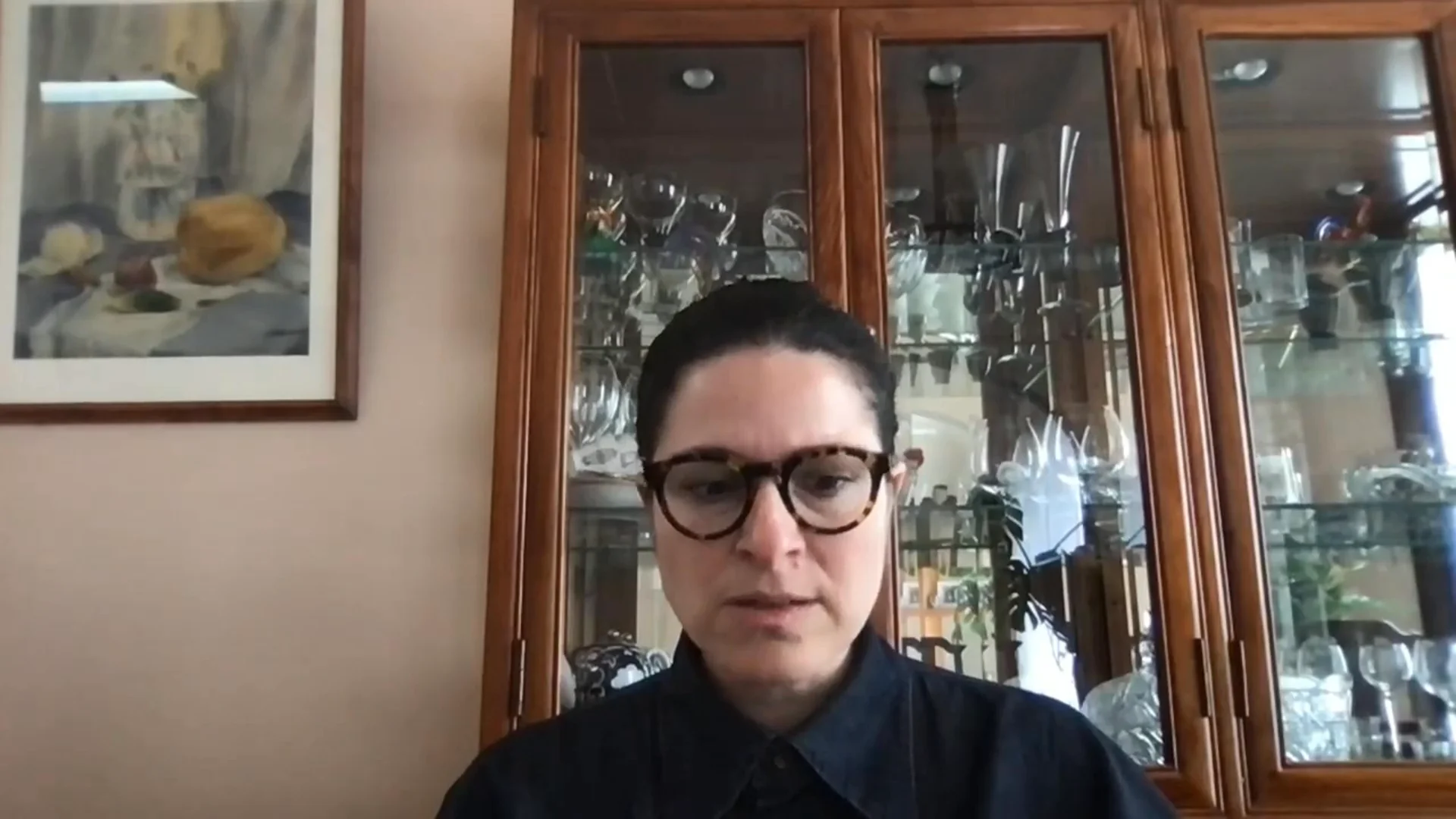
No. 30 of 44 · 10 November 2025 · 1 h 6 min Rimma Boshernitsan Co-Intelligence & Planetary Perspectives Watch the conversation On YouTube Everything said in it, in the order it was said: 96 turns, 51 of them Rimma Boshernitsan's. Press one to hear it from its second. 0:00 Rimma Boshernitsan We think with we think with each other, we think with other things that are happening around us. So I think it's actually great to be able to have a thought partner in the technology. We have to just come to it in a way that is just really aware of what it's doing, right? Because I've got stuck in so many loops with AI. We just keep going circles, and like, oh my God, where did I even start? Why do I even care? I delete the thread and I start over. It can get crazy. So I it's important to also have your own process with it. And again, like, what control do we really have? But we have agency. And I think that's the other piece is like how what is our relationship with control when we engage in decision making with something that is giving us the information.0:59 Michael Garfield This is a podcast for a metamorphic age, and we are definitely in one. What it means to be a country, to be a person, to be a company, all of these things are changing. And as today's guest Rimma Beschernitson puts it, these days it feels like anything is possible. This morning I saw someone post on Twitter, Do you think a caterpillar knows what's going to happen to them? And then someone else quoted it and replied, Do you think a human being knows what is going to happen to them? That's the stew we're simmering in now. And I'm glad to have such an excellent partner in conversation to, as the Taoists say, feel our way across the river stone by stone in a discussion about all of this and more, the re-emergence of nomadic populations and intentional communities, fumbling toward an idea of planetary culture, the role of intuition in leadership and biophilia in the design of our workspaces. It's a marvelously non-disciplinary co-exploration. Rima is a speaker, interviewer, facilitator, and advisor who has partnered with senior leadership at Fortune 500 companies, guiding them through transformation and growth.2:13 Michael Garfield Her writing has appeared in Fast Company, Inc. Magazine, TechCrunch, and Forbes. She began her career in management consulting at Deloitte before moving into industry, advising across healthcare, consumer business, and telecommunications. Later work in the art world taught her how cultural and political insights could drive innovation and transformation in business, leading her to found dialogue in 2016. She now combines strategic foresight, human-centered innovation, and interdisciplinary thinking to help her clients reframe challenges, identify opportunities, and lead with intention. She sits on the Board of Trustees at Headlands Center for the Arts and on the SECA Council Board at SF MOMA and is also an advisor to Stanford's Women in Design Program. Her most recent focus and a focus in our conversation today is in co-intelligence, integrating human, machine, and planetary intelligence to build future-facing organizations. But before we dive in, I want to make a big announcement. Half an apology and half an offering. This episode was recorded in April, folks. I've been so busy helping stand up not one but two amazing organizations that I'm months behind on this show's publication queue.3:24 Michael Garfield And for that, I am truly sorry. There's a lot of wonderful insight I've been struggling to edit and get out to you in reasonably short order. But the good news is that I am about to publish all 17 of these unreleased recordings into a special vault for founding members. In about a week, you'll get the keys to a trove of dialogues with Stuart Kaufman, Tyson Yunkaporta, Carl Hayden Smith, Lehman Pascal, Alex Komarowski, the Technosis Collective, and many more. And I will continue to upload all of the raw footage for founding members as soon as it's recorded, giving you as close to real-time engagement with this project's evolving inquiry as it actually happens. It's the best way for me to thank you for your support and to maintain my production standards while I continue to juggle humans on the loop with raising my kids and being part of inspiring new collaborations like AICACP, the AI Capabilities and Alignment Consensus Project, about which you will hear much more soon. To become a founding member, sign up at Michael Garfield.substack.com or Patreon.com slash Michael Garfield at the links in the show notes.4:32 Michael Garfield Thank you for listening and enjoy this wonderful wrap with Rima Boschernitson. The future is Mad Max, and we're gonna homeschool our kids, and we will live in place. We'll live closer to the land. We'll follow the buffalo or whatever that means. But it really is like that sort of the future of the United States is like RV culture, burning man post-apocalyptic thing. Like some part of me is just like, can it happen? Because the suburbs are like, God, why we don't need all this overhead.5:39 Rimma Boshernitsan Oh my god, it's funny. The first time I went to Burning Man in 2000, early 2000s, I realized this, and I was like in corporate at the time. And I came out, and it took me like two or three weeks to calibrate back into the real world where I was like, oh my god, why do we have all these things? Why do we need and then had already owned a house? It was a whole mindfuck, but I agree. I don't think I can do the RV life, even if it's fancy. Like I don't even the airstream doesn't sound exciting to me. Like I just I don't know. I can't do the compact, but I could do like tiny homes. I can do that.6:10 Michael Garfield Yeah, I was gonna say you might be more of like a tiny home village person.6:14 Rimma Boshernitsan Yes, exactly.6:14 Michael Garfield Yeah, yeah. Like I've always thought as like it's like they're roughly equivalent. It's just about whether you are thinking more in terms of circling up the wagons, ephemeropolis, seasonal migration, or whether you're like anchored into a bunch of food gardens.6:31 Rimma Boshernitsan Yes, and those two don't have to necessarily. I think there's still a way to be communal and have individual property and have the garden, but like you just have to readjust how we live, like how in that perception, how we think we should be living.6:48 Michael Garfield I guess is a bit more it's like you know, in Middle Earth, right? There's the dwarves, the elves, the men, but then there's like Gandalf. When you start thinking about it in terms of these bigger frames, it's like you need circulation, you need the storytellers that move between communities, yes, and and all of that, and are actively conveying ideas, but then if that's all it is, like when I had Robin Sloane on the show for episode five, he had this multi visions of society in his science fiction novel Moonbone, and one of them was this city in which like people were constantly changing their fashion and their identity, and like feeding all of their old stuff into matter recyclers and 3D printers, and joining teams and quitting teams, and it was like if Burning Man were like a real city, yes, and then there was this sort of more post-humanist Star Trek-y, long now, like aspirational, long time horizons society, yes, and it was like, yeah, like they each offer something different, but like neither of them actually seems complete unto itself, yeah.8:07 Rimma Boshernitsan Yeah, no, I I'm with you. And then there's this other part that's I had a friend who shared with me that I guess I don't know, for whatever reason, his parents and him moved around a lot when they were young. And every time they would go to a new place, his mom would set up the environment in some gorgeous, curated, beautiful way. He just would like always this notion of home was always present. And so then I also think like it's really just about how you what you value, how you place it literally and not, and how you want to create like the space outside of yourself and within yourself that really shapes it, and the material isn't so important. Yeah, it's and I yeah, I have a hard time reconciling certain things too. Because I'm like, I love to convene people in my home. What would that look like if I had a tiny home on a property with many other people or a number of people? Because I've talked to the kitchen sisters.8:59 Rimma Boshernitsan Have you heard of them?9:00 Michael Garfield Yeah, yeah. You interviewed someone, Nikki Silva. Yes, I read that.9:04 Rimma Boshernitsan Yeah, so Davia lives here in San Francisco, and then Nikki lives in Santa Cruz on a commune, and like she just was telling me how she raised her kids in this way of they had their own property, but then they all lived in one land. I was just like, that's amazing to have the autonomy, but then you're also in community, and then you can go out if you need to, and someone's watching your kid, but it isn't intrusive to your space either. I don't know, there's something that we are not doing well in capitalism that I think could be not, and I'm not like a pro-communist type of like my perspective is very capitalist, but not in the capitalist way that we live right now. I think it's wrong. I feel like a place for how we could be living that actually nature optimized for, but we're not realizing that because everything else is impacting us. So anyway, my babble.9:47 Michael Garfield Well, I think the the thing in the capitalism communism conversation that usually gets ignored is that you can see in a rainforest the ways that both values can be recognized in the organization of life forms. Yeah, it's like hyper-individualism actually emerges out of bacterial colonies. But this question of like, you know, is there fair distribution? Well, yeah, but it's not planned top down. And then is there intense innovative competition? Yes, but they're not all pegged to the same currency, yeah, right? Like the thing that the mushrooms and the thing that the trees and the thing the animals are optimizing for are all different things. Yes, you know, there's a boundary that prevents this sort of dimensional collapse. And that's actually one of the things I wanted to talk about with you today, because you wrote that piece with Susan Magsamen. How do you say your name? Yeah, Magsiman. Yeah, you wrote that piece on neuroaesthetic spaces, healing and hope. Yeah, and yeah, this thinking about biophilia and human health and well-being. But first of all, before we get there, yeah, okay, now that we're in it, we warmed up.11:05 Michael Garfield I want to get there, but I want to get there through the piece you wrote for TechCrunch on social media's flawed hypothesis. And I don't want to start there, I want to start with you and you giving us a sense of who you are and where you come from and your formative early childhood experiences, and whatever else seems like it might help people address the ideas that you have and share and the work that you do.11:32 Rimma Boshernitsan Yeah. So I came from the former USSR, born and raised there, and raised for the first eight years of my life in Ukraine, what is now Ukraine, the south of Ukraine. Moved here to San Francisco in 91, and my parents have been here ever since. I've lived in Santa Barbara and LA and Newark and Paris and London and Moscow for work and for other things. And then came back here to San Francisco because it ended up being the best place for me, I think. And that's where I'm from, from there. So grew up in a very in a in an environment that was shaped by communism. And I saw how that affects like my parents and how they think about things, and very much didn't like it, didn't feel like there was opportunity for Jewish people there in the Soviet Union, which is true. My dad had to attend university by mail. So like Moscow University was where he got his degree, but he had to do it on mail order because he was a Jew.12:27 Rimma Boshernitsan And then my mother also had to do the same thing for university because she was Jewish, she wasn't admitted to many places that she wanted to attend. And they both were and are engineers. Both of them came here and worked as engineers, which is quite rare to have your experience from there translate well into the workplace here. But they got really lucky when we moved here. They were in their 40s and were able to establish themselves. So I grew up here and then traveled a lot, went to school in Santa Barbara, and then lived in New York and London and Paris and and visited Moscow a lot for work when I was at Deloitte consulting. I had to my Russian was useful to them. So I would frequently do MA deals because I was uh working in MA when I was at Deloitte that were not necessarily headquartered in Russia, but had like affiliate companies were based in Moscow, and so they needed me to be a Russian person on the ground. So that was very interesting in the early 2000s to be in Moscow as it was like rebuilding itself and gave me a taste of what I left in many ways, which was really nice.13:26 Rimma Boshernitsan I knew that I never wanted to leave and I was never fascinated with Moscow in general. It was a very oppressive kind of place. But people that live there love it. So I maybe it's just my narrow games, spoiled, privileged. But like I already had been formed here, and then it went back there, and I was like, oh, this is what it would have been like. Thank God I never stayed. I don't know if I answered your question, but I think Yeah.13:48 Michael Garfield Although you raised another question for me, which is Do you think San Francisco is going to be Moscow in another 20 years?13:58 Rimma Boshernitsan No, I don't know. I would think I think it's safer to say that California would be its own country than San Francisco being Moscow, I think. But I have been chatting to my parents about this what's happening here and how closely it looks like what's happening there and what has been happening there for the past 30 years. And they're warming up to the idea that I might be right because I've been warning them against what's going on right now. And they were like, Oh, please, you're just like you're such a democrat. You've never lived in communism. All Democrats are socialists. And I'm like, there are social democrats, yes. And I don't think I'm one of them. I'm totally like centered moderate in the political sphere, but they always think of me as very liberal, which is hilarious.14:38 Michael Garfield Yeah, I got the analogy wrong. It's more like California is Ukraine, and that we get the United States trying to take back California in order to secure its data pipelines.14:53 Rimma Boshernitsan I never thought about it like that, actually. We'll see what Gavin does. It's interesting, actually. Probably not really. I don't like if you look at on paper how it looks, I don't think that is actually likely. But like it does feel like anything is possible. I do feel Gavin, for all of his faults, is focusing on California first, which is interesting. Yeah, the whole world order has been disturbed, right? And especially if our court system is gonna be any slower than it already is, nobody gets in trouble. It's very bizarre.15:23 Michael Garfield Yeah, it's very scary. I don't know.15:24 Rimma Boshernitsan I yeah, I don't know if I could quite make the analogy of Ukraine to Russia because it's just not the same. Like it's totally not the same. But I can see where you're going, I think is an interesting thought experiment.15:36 Michael Garfield Okay, so context is I just finished reading William Erwin Thompson's book Imaginary Landscape, which is about the emergence of a Gaian mythos from biology and cognitive science and ecology. And he plugs all of that into his theory of the evolutions of culture and consciousness and talks about, and not just this book, in several of his books, talks about the transition from modern industrial civilization to planetization or planetary culture and how none of these things that have been engulfed by the next level of organization truly disappear, they just get transformed. Yeah, you know. So I've been thinking a lot about that in terms of national politics. The thing about planetization is that the nations still exist, but they're basically subsumed within a planetary order that is not national in the way that he says the technology of each age slays the victim and resurrects it with art that, like modernity kind of slayed religion and then resurrected it as an aesthetic project, you know, that the modern self-authoring individual was able to choose a religion and to make new religions, yeah, and that the planetization is doing that to the mind and is resurrecting the mind through art, which is like something I read into the stuff that you and Susan McSammon wrote about neuroesthetics and how we're now thinking about biology and ecology and architecture together into these spaces to design mind states that we can quantitatively measure.17:27 Michael Garfield And it shows up in people using AI to create these like bespoke psychedelic experiences that are tailored to you as a person. And anyway, so that is one side of it, and then the other side is that this is because in Thompson's language, we're moving out of the sort of linear dynamical mathematics, like Tonyan ballistics, into chaotic and complex, nonlinear dynamics, because now it's not just intercontinental trade, it's like planetary commerce and and cultural exchange. And so what he sees as happening there is that this period, which he sees as starting like in the 70s, really, the decoupling of the dollar from gold, and we move into this regime that is fundamentally volatile. Like when you say that anything is possible, and that the strategies that are most rewarded now seem to be strategies of disruption, and that the consequence is much like modernity ruptured the world in which you were held by the values and mores of a particular culture, and you knew your role within that culture. Now the value systems themselves have been ruptured by this like weird, turbulent, unpredictable, emergent interaction between all of these things going on at once.18:59 Michael Garfield And this is in your piece on TechCrunch. You talk about how it felt to be on social media originally, and it felt like we were glimpsing participation, that this sense of global participation is what Thompson sees as taking over from the preoccupation with representation and modernity. I am this and I want to be represented in my government.19:24 Rimma Boshernitsan Yeah.19:24 Michael Garfield And now it's like, I don't know who I am, but I feel like I need to be involved somehow. And it shows up in different ways. It shows up in my mom making friends on Facebook in India. It shows up in this like intense desire that you and I were talking about to be part of a human-scale community, which you speak to in this piece.19:48 Rimma Boshernitsan Yeah.19:49 Michael Garfield But that puts the center of gravity of like identity formation, not at I am deciding my values, but like I need to find a place within which I make sense.20:01 Rimma Boshernitsan Yeah. I think that's just the evolution of how of our like relationships somehow. Like, I don't know. I just there's so much noise, and I don't remember what I wrote exactly because it was a few years ago, but I do think that how we participate changed and the value of our participation to ourselves changed. Right. Just the idea that threads exist and is valuable. Twitter was valuable, maybe it's still valuable to some people. I don't know why, but yeah, we're like blue skies is valuable, is interesting to me. I can't engage in these platforms. Like a bunch of my friends get news from them, and I just I'm like, what value can I add here? Like, what how and what would this actually mean for me to be commenting on some of these posts? I don't value my participation enough in this to spend time on it. And I don't think other people would value it my participation either, but I don't really care so much about other people. But I also think it's generational how we've evolved.20:52 Rimma Boshernitsan Like maybe you and I probably are similar in terms of how we want to participate in social interactions online, on social specifically. But I wonder if the younger generations, it's such a natural part of their like this other way of communicating that it's they're not even questioning the role of their participation. They're just participating. And I think that's also what we've seen over the past year or two years on college campuses, right? It's like the intention is so beyond. Them in a way. They're like it just feels like there's almost no understanding of what people are participating and what that means for them to participate in something. I feel like it's a very different thing than what happened in the 60s and 70s when people were protesting and ideologically against or for something that was happening around them. So I just think it we're living in a very interesting moment right now where it is like we are flying the plane, half the plane isn't built, nobody really cares to finish building it, but it's somehow moving and still able to play.21:55 Rimma Boshernitsan And nobody understands how. So it's a yeah, it's just very weird. But I'm not sure if I'm answering a question.22:01 Michael Garfield To set clear expectations for this, like I am sitting with questions, but I don't really know how to answer them, nor am I really asking them of you. I'm just like putting stuff together in a way to see if it like sparks something for you. But I will say that one of the things I really appreciated about this piece was the point that the platforms at least originally did feel like they were connecting us. And then it wasn't obvious at the time that the more time you spend on them, the less time you're spending with people face to face, the less time you're spending in your own community for the most part, and the more you're exposed to people against whom you are going to compare your life. So like you get this like counterintuitive or what was counterintuitive effect of the harder you try to connect, the more isolated you become. But like part of that is because of this vertical structure that you speak to, where you say rather than forging or maintaining relationships as they set out to do, social media platforms became focused on becoming the global town square, not just of communication and connection, but also of consumption via e-commerce and shared knowledge fueled by social echo chambers.23:12 Michael Garfield So, like there is this sense of keeping people on the platform in order to sell them things in order to support the platform, became the charter. Yeah. And I was thinking about this today because right before we got on this call, I was writing a response to the controversy around the all-female blue origin civilian astronaut thing.23:37 Rimma Boshernitsan Yes.23:38 Michael Garfield I know a lot of really excellent people working in space or in the space sector, and I really believe in the virtue of the experience of getting people up to see it and understand that this is one thing.23:56 Rimma Boshernitsan Yeah.23:57 Michael Garfield And I'm also aware that the way that these missions are being done is like propaganda for the phenomenon that Doug Rushkoff talks about in Survival of the Richest, which is they're again like this is the representation and participation thing. It's like they are performing representation by getting more and more diverse astronaut crews up into space for what is explicitly about trying to transcend the planet. And then meanwhile, people are on the ground like, shouldn't you be like, if you really want to empower women, then what about the billions of women who are like hungry or diseased? And so it ends up being this thing where both sides are either afraid they're gonna be abandoned or afraid they're gonna be trapped on a dying planet, and then see the other side as a separate entity rather than being like, there is no real escape velocity. Like you can get out of the atmosphere, but eventually you have to come back down in like a figurative way of you still have to accept the way that our destinies are bound together.25:10 Michael Garfield And that's the same kind of thing that we're seeing in social media of the people that are making the decisions about the direction of these platforms are shareholder rather than stakeholder concern. If that's a question, I'm curious how you make sense of all that, given all the interesting people you talk to and so on.25:27 Rimma Boshernitsan Oh, I read something yesterday that changed my mind on this, and it's to do with the fact that there's the people that went on this blue edger thing. I mean, it the vanity, it looks like a vanity project, and I agree with you, like all the things that people are criticizing them for. I understand that makes sense to people. But then an astronaut who was part of the mission but didn't go to space with them. I saw a post by her, and she said she's there were no carbon emissions that went literally, they had a clean ride into space. The amount of influence that people in this spaceship have as out of space is actually quite amazing because when you go into space, you see an overview effect, right? You go back and you look at Earth and you have this sort of awe, right, that everyone talks about, and that shifts people tremendously. So the amount of change that can come from these people doing something in the world after this experience could actually be profound to help the what the people that we're talking about to to direct their philanthropic funds towards something of value.26:30 Rimma Boshernitsan And then multiple people on this mission had to fundraise for their seats, so it wasn't like they were like, here's a $600,000 check, Jeff Bezos, take me. So there is intention behind putting them in space. The timing of it is I don't know what was going on with them. I mean, this was maybe in I don't know if it was intentional or not, but I can see the criticism and I agree with it, and I can also see what could potentially happen and how investing in people going into space for even five, six minutes and coming back could be something that shifts our relationship to the planet and shifts our understanding of planetary consciousness, even to some end. I don't know if these people are in that space to be thinking about it more philosophically and actually zooming out, but let's give them the benefit of the doubt and maybe they could. Then that could actually, if I'm not saying more people need to do this, but maybe there's ways of diffusing the BS that goes on and on the planet by allowing certain people, like putting them in a corner in space and letting them look backwards and what they just experienced, and then shifting that rather than doing ketamine, maybe they can actually and see have some real like, I mean, that is a real experience too, but you know, have a different experience that might shift them, right?27:36 Rimma Boshernitsan So I think that what we value as a culture is interesting, but I think what we don't do well is communicate the potential intention or the opportunity that exists by these women going into space. I don't think it's a feminist thing, I don't think it needs to be like magnified that women are going into space. And I know women don't get to go to space a lot, and there's a whole controversy around that. I get that, but labeling it as a thing for feminism is also dumb, in my opinion. Just let it be what it is and let them experience what they do and then let them talk about it, and then we can say, oh, that was a worthwhile spend of money or not, right? Like I just feel like we put so much on top of other people's experiences and then have to define them for them rather than just having the conversation or allowing them to like process and then come back like we would after our journey, for example. Like it's an integration thing, right?28:24 Rimma Boshernitsan I think the next six months are gonna be real interesting for them, and we should continue the conversation with all the six of them. And one of them gave up her education to be an astronaut because she had some other points to prove in Congress that actually helped women and moved things along for women and women's rights in terms of I don't know how you call it, around like sexual assault and violation or whatever, women or whatever government was able to do then can't they cannot do now, which is actually a good thing for women. So there's a lot of different threads here that I think are important. And I don't think that we as a culture allow ourselves to process the things that people experience and allow them to speak for their own experience before we start criticizing and judging and virtue signaling on things that like they don't really need definition for people who are not qualified to even provide an input. And I think that ties into the conversation around the social media and how we use it because it's the same thing, right?29:20 Rimma Boshernitsan Who deemed me someone to comment on this mission, let's say? Like I have no. Connection to it, other than I could say that it's amazing that people can see the overview effect, right? And like experience that that's worth it for me. If I had an extra half a million dollars to go to space, perhaps I would do it. But that would be after I've contributed significantly to other causes that I care about. And the value piece, I think the values piece is what we don't focus enough on.29:45 Michael Garfield Yeah. Yeah. Yeah. I don't want to come off as sounding purely cynical. It's just like, of course, you want those people to have these experiences. And that's a perfectly reasonable thing.29:56 Rimma Boshernitsan Yeah.29:57 Michael Garfield Where it gets complicated is the question of okay, now we're still thinking in terms of a few people who have a lot of leverage, and the opportunities that we might have if we introduce like some kind of intervention, then we can change global discourse. We can affect planetary solidarity among human beings. But like the logic of that, there's two problems. One is the question of you've got the overview effect, but what's the underview effect? Like, how do we like what is it like that reality show where the CEO goes down and works in the sewers with his buttons like how do we affect that more often? Yeah. So that people start to develop a sense of solidarity on both sides of the equation.30:46 Rimma Boshernitsan Yeah.30:47 Michael Garfield And then the other piece is that when I spoke to Josh DiCaglio, who wrote this fabulous book, Scale Theory, about contemplating the unthinkably big and small, not as we've mapped it, therefore we can control it, but holy cow, the bewilderment is transforming what I understand myself to be at the level that I'm capable of directly perceiving. And he wrote two really beautiful chapters in that book about the overview effect, one about Edgar Mitchell's experience and one about Stuart Brand and the whole Earth catalog. And his point was it's like one thing to be Edgar Mitchell, and it's another thing to be looking at a picture of space, and that it getting that experience secondhand doesn't really work because you're not up in space realizing that you're still part of this, you're engaging with it through an abstraction. So Josh's point was basically like, we don't actually really know. And complex systems research tells us pretty unequivocally that behavior at planetary scale can't really be engineered at human scale. And to peg back into earlier in the conversation, it's like, well, yeah, things are different for the US now than they were for Russia because the development of the global economy is so much more sophisticated and is pushing so much more on the behavior of the whole system than it was then.32:18 Michael Garfield And so really they're not perfectly equivalent situations. So, like this question about somebody like uh Yeats and the influence of artists, mythmakers, poets on collective imagination. I hope that people come back and they have these experiences. But to your point about timing, it doesn't fix the issue that like they're coming back into a culture that sees itself as divided. And so something else has to be done on the other side. And it cannot be designed top down. It has to emerge naturally. But there are things that we can do to structure that environment. And that's where it brings back to like neuroesthetics and working with Google to create spaces where creativity happens, conversations and so on.33:08 Rimma Boshernitsan And I think it's sort of where AI can play some sort of equalizer, I hope, as well, right? Because then now you have people, because I think when you think about collective imagination, I think the people that participate in that are people that are inherently comfortable being creative or philosophical or some version of that is not necessarily recognized by society, but they're okay with that, right? There's probably a parts of you and me that are like that, where we're really comfortable swimming in the like this ambiguous sort of waters where we can pontificate and create and philosophize, and then it doesn't have to lead to anything, and yet we can still be comfortable in it and bring it into different conversations. And I don't think that there's a lot of people that are exist like that right now because we have industrialized people into verticals where they can be productive in a way that society recognizes the productivity in a way that then they feel value. Versus for us, our value isn't derived by money or and maybe does, but we I think try not to be defined by the the product being a KPI of some sort.34:15 Rimma Boshernitsan And where I think AI can help is if people are using it, they can see themselves as someone that contributes thought, not just like computation, let's say. And if they can see themselves as a more cultural figure that is synthesizing many things at once for a particular purpose or no purpose at all, whatever that is for them, then they might see themselves more in the polymath capacity. And if they see themselves that way, then they'll participate in that way. And they won't be siloed and they won't keep themselves in a vertical. Because what I'm seeing too right now, increasingly, is portfolio careers that are emerging in ways where like someone can be a Google fellow or some sort of higher up at Google and also be a thought leader in a very amorphous space around intelligence and other things and whatever, right? Like very kind of curious place. But they can have this corporate job that does not define their role in society anymore. It's sort of a part of who they are. And then there's this other bigger piece that they're playing where they can be of opinion about something that they're qualified to talk about or they deem themselves qualified, whatever it is, and they do.35:22 Rimma Boshernitsan Whereas before, I think you were either a philosopher, either a teacher, a corporate person or whatever. And you had to kind of this is why I left corporate, is because I could not understand how people could work nine to five, nine to nine, whatever it is, and still be human outside of work hours. I was like, What how do I participate in the world if all I'm doing is this all day? And so then I had to force me to create my own thing, which comes with its own thorns, as we know. But like at least it allowed me to extend myself into a place where I'm now, even without AI, I can speak to many things. I can be in this polymath kind of space and be very comfortable. Not everyone needs this, right? But I'm just saying that we are not inherently created to do one thing, one thing well, or two things. I think we are shutting down parts of ourselves to be accepted. And what I'm hopeful with the technology can help with is letting people have a more imaginative ability to see themselves in a different way and their values implemented, or whatever the word is, so that they could.36:20 Rimma Boshernitsan Coexist so in a way that feels more conducive to our actual nature. So I do see technology actually helping with that, not hurting it. Depends on how we use it, but right.36:31 Michael Garfield And I want to dig into this, but like this all sounds maybe just only one degree away from in listening to you talk. There's a pattern. I read your interview with Ivy Ross. Which one from 2018? Yeah. Is she still VP of hardware product design at Google? Yeah. She was talking about intuitive leadership. And I really liked this because it was like obvious that she was into like binaural beats and like Bruce Lipton and like all this new agey stuff. So it's like an example of what you're talking about, I think, in a more multi-dimensional person. And the conversation hinged on her cultivation of intuition and the courage to listen to your intuition. And I was just thinking, like, in her case, how did she put it? She says, My intuition allows me to see who people really are, what their talents are, and where their true gifts flourish. We often put people in organizational chart boxes and we keep them there because they become an expert in the box we put them in. But my sense of intuition is encouraged me to create situations or roles that allow people to shine in new ways that in some cases were very atypical.37:41 Michael Garfield And it's like, yeah, this is again to talk about like bottom up or top down, if we can get smart people in space or if we can redesign the newsfeed algorithm or whatever, is still that kind of HR thinking. And then the question of how do you get the listening in these systems so that you can really treat the needs of your users as Facebook rather than creating them in some sort of Ed Bernays way, like the role of advertisers to create desires.38:12 Rimma Boshernitsan Yeah.38:13 Michael Garfield So there's the intuitive pieces like on the ground, and the leadership is in the space, and they work best when they're together and they're recognized as part of a thing. And then yeah, just like thinking about how that plugs into what you had said about AI just a moment ago and what you wrote for developing leaders quarterly about machine, planetary, and human superintelligences in a cohesive framework. It's funny because reading this, you emphasize intuition as a human skill, but also I've thought a lot about how some of the most interesting things going on in AI are when it surprises us and when it acts in ways that strike us as very intuitive. So it's yeah, I don't know. I'll leave it there.38:59 Rimma Boshernitsan Yeah, yeah. I think with AI, it's all pattern recognition, right? And so if it sees a pattern in our behavior and the way that we ask questions, it can respond in a way that feels like we perceive as intuitive, right?39:14 Michael Garfield For so it's our unconscious in some sense.39:18 Rimma Boshernitsan Yes, and it's also very consciously designed to recognize specific human behaviors to then form ways of us then interacting with it. And that's where I think the hard part is to then decipher when it's behaving in a way to create and create a context for us to respond into in the way that it perceives that we can for us to then recognize that it's intuitive versus it just being a machine learning algorithm that then an LLM that's smart. And so there's that part of it that I think we should definitely have on the table because if we're talking about real intuition, that is not a thing that a machine will do. And then there's the whole consciousness conversation, which we can at some point go into, which isn't even it's just still new in my brain around how to talk about, but we can definitely go there. But I think in terms of like how you brought Ivy into the space right now, I think, and I know her very well, and in the way that her intuition works and generally how intuition works, I think that she senses, right?40:17 Rimma Boshernitsan Like we all sense outward and then create and then make sense of the thing that we're sensing in a way that is also, in a way, kind of pattern recognition. Our bodies are recognizing patterns and things, and it's based on our lived experience. So let me think, how do I piece this together? So there's a way that she has been able to see that her teams need to be developed beyond the regular ways existing as designers to then be able to create products that resonate with people who are using them. And that's pretty evident in the way that they display their product in both like retail-wise, and every year for the past probably five or six years, they've been going to Salon Day to Milan to exhibit like a conceptual understanding of an element of water, of air, of I think else that they do. There's they took elements and basically created exhibitions around them. And I think that all comes out of an experiment, an experiential kind of place to help people understand how to connect into what they're designing and also how they're using what was being designed for them, whether it's a Google product or a cup of tea or whatever it is, and have some understanding of the intention behind these products and how they're engaging with us and vice versa, how we're engaging with them.41:39 Rimma Boshernitsan I think where we can tie that into sort of the this triade of sense-making intelligence that I've been speaking to, which is like human, planetary, and machine, is that we are we're not necessarily in this current moment, I think it's not one, two, or three. It's like how we make sense of the three together that should be informing how we think about the world. And so intuition plays a part of it, but then there's the way that machine intelligence is operating that also plays a part of it. And then there's the way that the planet informs, like the biophilia, sort of the way that planetary sapience comes into an intelligence space that then also informs how we are evolving as a species. And then from there, there's all sorts of computational kinds of epistemologies, like heuristics, whatever, however you want to call them, that come into play that like we should be using and understanding. In how we communicate the decisions we make, the way that we are, that we the way that we exist.42:42 Rimma Boshernitsan And I think right now we really see intuition is siloed, then machine is siloed, planetary is over there somewhere. Most people associate it with climate change, which has nothing to do with it. And I think there's ways of integrating those two things. So what I'm saying is there's a framework that can exist that puts all these things together that allows us to actually expand ourselves in a way that would help us create more value for ourselves in our existence than creating these things that we tap into here and there. And I think that goes back to the conversation around collective imagination, the conversation around sense making, and then this sort of as an approach to exploring our own futures as the species on the planet, which then could you could break down into various ways, like I know I'm speaking at a very macro level. So all of it feels emergent and very much not, what do you call it, not engineered necessarily. Although there are parts of it, obviously, that are engineered. And I think the dark side of AI is for us to be watching of what is of what is engineered versus what is reality and then how we engage with that.43:44 Rimma Boshernitsan It's not all for us to be in love with, right? There's so much critical thinking that needs to be happening at this point. But I do see us being interstitial beings, whether we operate that way or not, everyone's different. We all just need, I think I see it all as a flow. And it's not one way that the other, it's all together, and then us making it like a real clear, conscious, deductive sort of reasoning around it all. And it doesn't have to be logical necessarily, but it can be emergent, but which could be logical, it could be not. I don't know how you look at it given the whole complexity angle, but that's how I see all those things interconnect. I don't know if I've missed anything. I'm like trying to think.44:21 Michael Garfield No, this is great. So in that piece, you okay, there's a couple things. One, you say AI should serve as an enabler, not a replacement of human intelligence. Oh, back it up just a second and say for a long time, and it stretches through the commentary on Blue Origin and all that stuff. I feel like at least when I was in my 20s, I felt like it I was on a mission to get people to think about human beings as something the planet is doing. And then you've got you interviewed Kevin Kelly, and I've interviewed Kevin, and he had that book, What Technology Wants, and he talks about technology as the seventh kingdom of life, as something that the planet is doing that is as that is as natural. And it's like those are useful up to a point, but then at some point it is also useful to make distinctions so that you can start to think through relationships. So I started thinking, okay, so if AI is or could be an enabler of human intelligence, by extension, does HI, human intelligence, serve as an enabler, not a replacement of planetary intelligence?45:34 Michael Garfield Because we're botching both of those things right now. And then, of course, like it's a whole trinity. Planetary intelligence enables AI and HI, and human intelligence enables AI and PI, and AI enables is then like the thing that I feel like a lot of people aren't talking about is how does augment how does artificial intelligence enable planetary intelligence? And so I was like, okay, if we're looking at like all of this stuff as like a kind of a Celtic knot, right? Then you get into some interesting questions. Like, if states and markets are making their own decisions that are not reducible to the decisions of leadership and are certainly not reducible to the vote or people's individual decisions in an economy, can AI be used to make it possible for those institutional entities to listen better in the way that we're suggesting that big groups like Facebook could actually serve their own success and serve the needs and well-being of users at the same time. And maybe like I've been really enjoying playing with this idea.46:57 Michael Garfield Okay, if anything is possible, what if the way that people are thinking about the issues of agency and the restrictions of agency by AI are missing a whole other plot that's going on right now, which is that, like you were saying a few minutes ago, maybe this is a way for your own singular person to become more legible to the leader of your organization or to the country in which you participate, or you know, like the idea that the AI is like a not just a telescope, but a microscope, but not a microscope for us. It's like a microscope for the these larger systems in which we participate, and there's a rhyme between human artificial planetary with like animal, vegetable, mineral, or these other kind of old fundamental triads, and there's already in that a sense of ecological relationality and you know, mapping all of the ways that these things can serve each other so that we're not like on top of or underneath them, but braided in and mutually reinforcing each other in the way that early on in this conversation we were talking about, like the animal, vegetable, and fungal.48:23 Michael Garfield Yeah, like everyone's optimized for something, everyone's producing waste that's actually the food for the other thing. And then all of them are participating in something else that is not purely what we think of as nature or technology or culture. We don't have great language for what that is.48:42 Rimma Boshernitsan Yeah. Hold on, let me think about this. So, is it the interrelationships that you're speaking to?48:49 Michael Garfield Yeah, and just like how I feel like the conversation right now is very focused on either AI being something that's gonna replace us or something that we can control. And it's all still lodged in this sort of 18th century logic. Right.49:09 Rimma Boshernitsan Yes, I'm with you. To me, planetary also relates to the Earth's relationship with the universe and the cosmos and how the earth was formed and how much of an accident that was. And then thinking about that accident and what that means for us as a species. Like I think people look at the world as though humans are controlling it, right? And I think that's inherently the wrong way of thinking about it. I'm not saying that we're not, but we are also a product of the computational kind of realm that we live within. And that shapes us just as much as the nature and biology of the earth shapes us as well. And so, in some ways, I wonder if it's if the planetary intelligence actually is the grand one. And then the human and the machine are subservient to it if in a hierarchy of in relationships. And again, it's all very theoretical. There are people that are proving this much more scientifically than I'm speaking to it, but there's also the larger consciousness that's created out of their interrelationships that I think we are all naturally part of and are influenced by.50:13 Rimma Boshernitsan But because it is invisible and is so much around energetic the energetics that we we forget that is a big part of what shapes our reality on a day-to-day basis. The machine and the human, it that's an interesting one to explore too. Because I think in the triad, I didn't really talk about the interrelationships because I think I was still exploring it at the time that I was writing, and I didn't feel like I had enough of a grasp. But then I went to a summit in November of 24 in Italy on the planetary, like the concept of the planetary that gave me a words to describe the things that I'm feeling or seeing. And that kind of gave depth to what I think I wrote it. Then that gave it even more depth to talk about it. And now I'm in a different place. I'm going to start writing more about on the consciousness space and intelligence space. But I think to sort of go back to where we were, on one hand, human intelligence shapes the machine intelligence, right?51:09 Rimma Boshernitsan Because the data is coming off of our existence and our ability to create the data. And then, of course, then it the data shape we shape the data shapes us, right? Like in to use like Winston Churchill's old quote about like buildings, I think it was like from back in the day. Not that I ever quote Churchill in general, but I think that there's a part in of this that almost feels like in nature, computation naturally exists. And if we think about that tying into machine intelligence, I think there's part of computation and biology that is linked in nature and forms intelligence as we see it. And I think that computation comes into the machine intelligence space and naturally comes into our existence, right? Our biological existence. The hierarchy is almost hard in some ways to define because all of it is interconnected in a way that feels very natural. And I know that we see it as synthetic, and there is synthetic nature to data, of course, especially how we're using AI. But if we just step back and observe, I do think that there's a depth of existence across all of the things that shape our value systems and how we are in the world.52:22 Rimma Boshernitsan And unfortunately, I think there's parts of science that could completely disagree with all of this because they they're inherently total materialists, they might agree with maybe 60% of what I said, but the 40% that ties to consciousness will be like, no, that's a feeling, that's a whatever, that's like not real. But the more I look at computational analyses and plan and tied to the planetary, and I see the way the data moves, and then you look at even like frequency and energy and that anything that has to do with like human body or objects in space, and you see how that data moves, and then you look at the planetary and you realize that it also moves in that same way, and all of it is creating a consciousness, then you can say, okay, like it's there's no one without the other. There is no one leads to the other, they're all just in existence. And there might be other components that we haven't even touched on that are maybe metaphysical, that are never going to be proven and never gonna be seen, but we're squarely planted in the material as humans.53:17 Rimma Boshernitsan And I think the less we are in the material, which Ivy excels at, the more we are able to tune into the thing that is existing around us. And we don't necessarily have to define it, it doesn't need definition, it just needs an awareness that it exists and this is not a God, it's not a religion, it's not like any of that. For some people, maybe it is, but for me, it's not. But I think there's like a realm of sense making that sometimes we attribute to people having like extra sensory abilities, but we all have this inherent ability. We just dumped it down or shut the parts down, and our society shut parts of ourselves down. And I think the complexity work actually ties beautifully into this whole theory of I don't even know how to explain it per se, but you probably would have better words for that since you're like much more versatile than I am. There is probably some level of that that can be extracted to tie it all together that I don't know that science is doing a good job of, and and the metaphysical stuff is also not doing a great job, and they're focusing on one aspect of it too.54:15 Rimma Boshernitsan There's like a coexistence, co-intelligence piece that is centered around resonance, I think, that we're not naming in an obvious way. And I think that language too sometimes disturbs people.54:26 Michael Garfield Yeah, I want to see if this sits in or with what you're saying, like that talking about AI, P I H I, and then saying, oh, it rhymes with mineral, vegetable, and animal in a pre-modern way. There's also like physics, biology, psychology. And one of the things that really does firmly come out of complexity is this okay, reductionism is not enough. But then now what I'm seeing is that a lot of people are taking kind of an opposite stance from their interpretation of complex systems, that there's like emergentism, and that we can reclaim the sacred by like bolting a progress narrative onto increasing complexity and open-ended innovation. And so that's the logic that puts humans in service of AI, in the sense that like we are building a god, which is the equal and opposite error of thinking everything can be reduced to the behavior of atomic particles, and saying all we are as people is reducible to the fact that we're the backstory of the singularity or whatever. But what complexity science is actually saying is Phil Anderson's more is different, a really beautiful, simple, elegant way of just making this point that it's not more, it's not less.55:58 Michael Garfield It's operating at a different scale with different behaviors. And so I'm, you know, when I'm thinking about, okay, so like how might I start trying to nest all of these things together? Actually, Ken Wilbur turned me on years ago to this idea about the inverse relationship between breadth and depth. You know, when we talk about there being deeper interiority in our ability to reflect on our own minds, well, we're not separate from rocks. AI is in that sense something that's the mineral realm has been threaded through this the whole time. And what we're seeing now and calling computation is a very specific species of that physics intelligence that emerged through biology and then through psychology. So you can talk about mineral computation, vegetable computation, animal computation, and each one has a depth, and that the new thing is not actually AI. The new thing is the relationship that has become more conscious and self-referential between the different ways that each of these domains are processing things and they're starting to be able to talk to each other better.57:13 Michael Garfield So, like when I say stuff like, how does artificial intelligence enable planetary intelligence? I'm thinking about the conversation I had about a year ago with Austin Wade Smith, who was thinking about how you could take ecological sensor networks and then create autonomous legal and economic entities that represent ecotopes in the human world. And that gets into using AI for translation between animals and humans. That it's it's one thing if we understand them. And this gets again back to the Facebook and the space issue and all this. It's one thing if we can understand them so that we can sell them ads, and it's another thing if we're actually listening like Ivy Ross to her employees. And that's why I had mentioned this. You know, I like that the way that you talked about intuition as the unconscious, and that's why I've been pursuing this idea that AI is part of our unconscious if we regard ourselves and the rest of the planet as one identity. But that's that does something weird for a lot of people, which is it subsumes what we thought of as human within this bigger thing that we actually are.58:33 Michael Garfield And I think that's what you're speaking to when you say that it gets like mystical, that it's not enough just to say I am a human being, because that doesn't mean anything unto itself. And this is why I wanted to get back to the statement that you had made about Darwin in that piece and how Darwin was a legendarily analytical mind. And so when he was trying to decide whether or not to get married, he made a list of pros and cons. And so you you ask, what could Darwin's decision-making process to marry or not look like if he approached it with co-intelligence in mind? What if Darwin had lived in a culture where he had access to large language models and went on a vision fast for three days and looked for like signs from the forest or whatever? Like that would have been a very different process.59:26 Rimma Boshernitsan Totally. And at the end of the day, he still made the decision with his intuition. It wasn't about the pro and con lists, right? It just gave him like some formative, like maybe some thoughts came through, but like it allowed him to maybe connect with his inner knowing without naming it that. But no, I mean, I agree. I think that at the like ultimately we are every day oscillating between the things that we want to have in our lives and what we want to experience to what we think we should be experiencing, or other people should be, or there's always these decisions that we're constantly oscillating between. And I think that if more people were able to tune in to the important pieces and the parts, then those decisions would be easier. But unfortunately, we are human beings and we come with faults and we come with traumas and we come with weird shit that's happened to us, and it prevents us from connecting in different ways. So I think that approaching things from a co-intelligence standpoint allows us to have more touch points.1:00:23 Rimma Boshernitsan I don't want to say data point, but just touch points with ourselves. We can validate, we can like figure it out. And some people need that, some people don't. So for those that need that kind of thing, that don't inherently know what they want or need in a moment, that might actually help them. But I also ultimately still believe that even in the co-intelligence space, we're gonna have a lot more data to sense make. And some decisions require that, some decisions don't, but largely will be more intelligent as a result of it, and hopefully connected deeply to our overall intelligence as humans as a result. So that's just what I've been thinking about. I don't know if I've landed where you wanted us to land.1:01:01 Michael Garfield Well, you landed me in the question of who is actually doing this thinking when you say this is what I've been thinking about, which is what I want people to ask. So yeah. Totally.1:01:09 Rimma Boshernitsan And I do a lot of thinking with AI. There's many things I've been like, I have a whole thread with AI like around this topic and the in the article and where I want to take the conversation on consciousness so it's it stays in a place where it's accessible to people, not like a woo place. So yeah, and I think that's the thing is like we think with we think with each other, we think with other things that are happening around us. So I think it's actually great to be able to have a thought partner in the technology. We have to just come to it in a way that is just really aware of what it's doing, right? Because I've got stuck in so many loops with AI, right? We just keep going circles. I'm like, oh my god, where did I even start? Why do I even care? I have to I delete the thread and I start over. It can get crazy. So I it's important to also have your own process with it.1:01:55 Rimma Boshernitsan And again, like what control do we really have? But we have agency, and I think that's the other piece is like how what is our relationship with control when we engage in decision making with these types of not data points, but like information points or something that like is giving us uh information.1:02:12 Michael Garfield So well, right on. I can say confidently after this conversation that I look forward to thinking with you more, yes, and participating in the co-intelligence of whatever that secret third thing is. I surrender myself to its agency without being woo, of course.1:02:35 Rimma Boshernitsan Because I mean, I just yeah, I just think it's interesting. Like one, it was a cosmologist sort of gave us the in three minutes the universe, the creation of the universe, and how like Earth was formed. In three minutes, I was like, actually, it makes sense all of this surrender conversation, all this Buddhist stuff makes total sense. We should all be thinking in this way because we really have no control, it's just an illusion of it. I mean, we have agency, but that's uh it's different than like surrendering to something and knowing that like at the end, it's not up to us what actually happens, even though there's a part of it that we own in the of the experience.1:03:10 Michael Garfield Yeah, I've been reading this. Here we go, off the deep end. I've been reading Sri Aurobindo's translation of the Upanishads, right? And that the way that Aurobindo talks about the Upanishads as building on the Vedas, that the Vedas, much like early Buddhism, were very preoccupied with getting into space. I am not this, I am not that, and that the Upanishads come back and establish all of that as non dual. I'm not making the decision, and I am making the decision. Yeah, and the I that is making the decision is not the I that I'm not. And that's where the that's where the surrender comes in, is nobody has to surrender because there's nobody there, but then yes, you do. Because you need to relax the learned behavior of believing that when you are talking to other people or AI or the rest of the planet or whatever your other is, that is somehow again. Like I love Josh DeCalio's way. He says epistemic specificity. Like we can make these categories without ontological separability. It's still all one thing.1:04:25 Michael Garfield So we'll make better decisions if we like ease into that. But then who's making the decision again?1:04:31 Rimma Boshernitsan Right. No, yeah, we're making the decision, but I think there's a larger way of surrendering that I think we don't really know how to do. And those that do have more agency, in fact. There's like an interesting like inverse relationship.1:04:43 Michael Garfield You've got God on your side. Oh, yeah. Seriously. Thanks again for listening. Humans on the Loop is a listener-supported project committed to making public goods that help us dream better together. If you liked this conversation and want to make some new friends, join the Discord server at the link in the show notes and help this work continue by becoming a patron at humansontheloop.com, where you will find years of essays, science fiction, music, art, and a very long list of recommended books. Our next dialogue is with the amazing Manda Scott, best-selling author, teacher, and host of the Accidental Gods Podcast, centered on the profound intertwing of wisdom and technology in her novel Any Human Power. Stay tuned and stay safe, my friends. And remember, imagination and attention are our greatest natural resources. Before · No. 29 Sam Arbesman Co-Evolving with Magical Technologies After · No. 31 Manda Scott Giving Wisdom to Power and Power to Wisdom