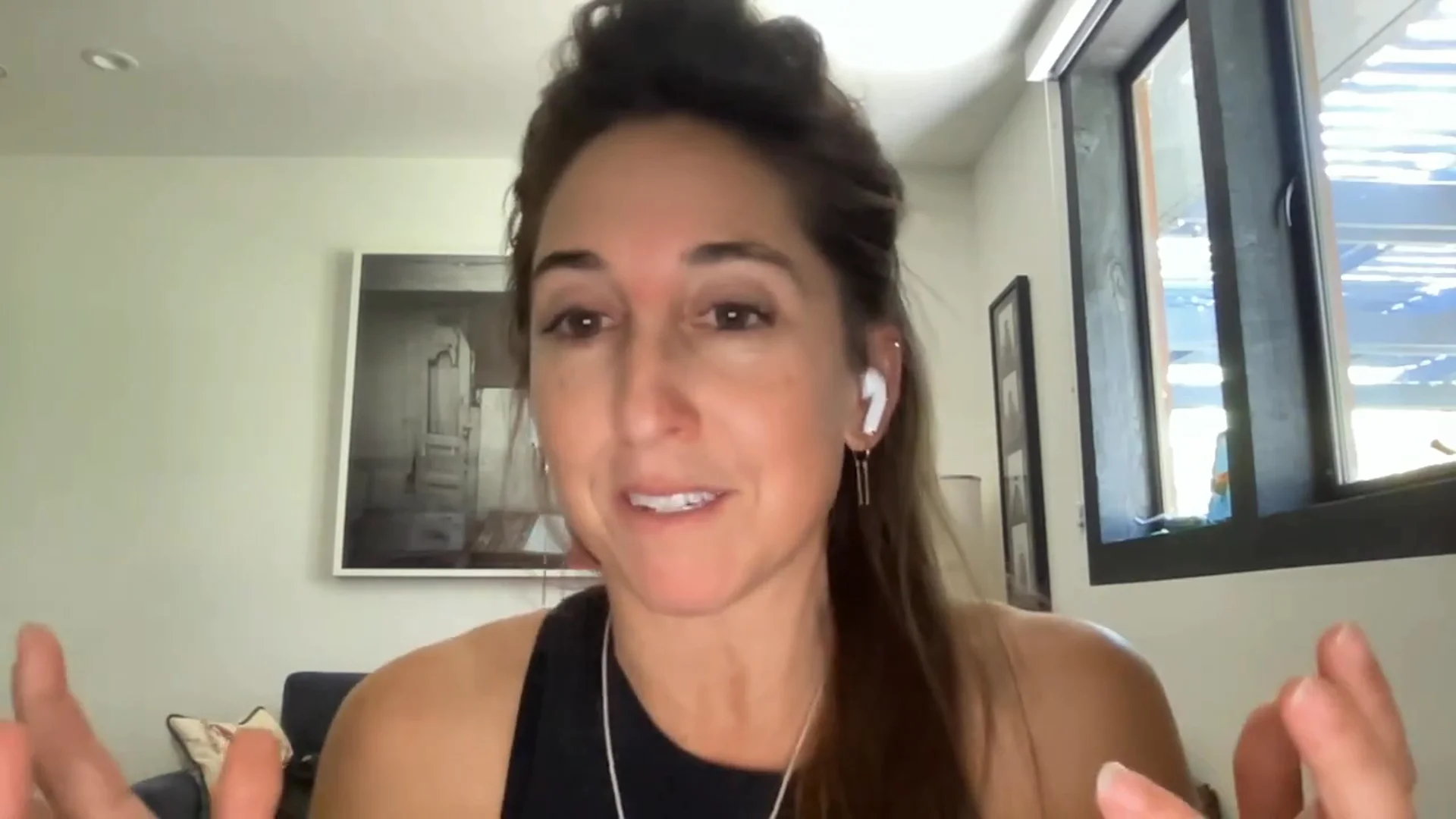
No. 4 of 44 · 16 January 2025 · 1 h 10 min Stephanie Lepp Transcending (and Including) Partisan Debate Watch the conversation On YouTube Everything said in it, in the order it was said: 107 turns, 56 of them Stephanie Lepp's. Press one to hear it from its second. 0:00 Stephanie Lepp All of the wisdom traditions have some kind of like map is not the territory, no false idols. The Tao that can be named is not the it's do not confuse this little thing for the whole. We must stay tethered to the whole. That is honestly what I understand Shabbat is for. Six days, focus on the part, one day, zoom out to the whole. Always stay tethered to the whole. So therefore, could AI help us in some way to change the very economic context in which AI is developed? I don't know, but that is part of a question that I would ask.0:52 Michael Garfield I'm your host, Michael Garfield. Thank you for joining me on an exploration into wisdom in the age of magical technologies. This week I speak with my friend Stephanie Lepp, two-time Webby Award-winning producer and storyteller devoted to leaving no insight left behind with playful and provocative media experiments that challenge our limitations of perspective. Stephanie is the former executive director at the Institute for Cultural Evolution and former executive producer at the Center for Humane Technology. Her work has been covered by NPR, the MIT Tech Review, supported by Mozilla Foundation and Sundance Institute, and featured on the Future Fossils podcast twice, first in episode 154 for her project Deep Reckonings, and then in episode 205 with Greg Thomas on jazz leadership and antagonistic cooperation. She and I are members of what I think of as the Integral Diaspora, creative producers inspired in our youth by the integral philosophy of Ken Wilbur, who are now committed to fostering multi- and metaperspectivalism in public discourse and applying it in practice for social impact without the jargon of adult developmental and transpersonal psychology.2:11 Michael Garfield Her latest project, Faces of X, pits actors against themselves in scripted trialogues between the politically liberal and conservative positions on major social issues, with a third role swooping in to observe what each side gets right and what they have in common. I support this work wholeheartedly. In my endless efforts to distill the key themes of humans on the loop, one of them is surely how our increasing connectivity can, if used wisely, help each of us identify our blind spots, find new respect and compassion for others, and discover new things about our ever-evolving selves at every scale, from within the human body to the big we of the biosphere and beyond. Steph offers some of the most web-savvy, potentially viral, heartful, and humorous takes on this work I know, giving us a spoonful of sugar to help the medicine go down as she reminds us that we are bigger than we think we are and more capable of finding common ground. As we move into what will assuredly be a heavily politicized, deeply polarized year of pointless internecine conflict at precisely the moment we most need to find new ways to work together, I'm glad to weave her and her work into this project and include her DNA in the senius on tap small language model that this show will blossom into one day.3:44 Michael Garfield Before we start, I want to call attention to a few things I just dropped or am about to. One, my latest essay, Reflections on Technology and Eternity, about how to see the future and stay humble, is now up on Substack for my paid subscribers. Dig into that for comments on the failures of techno apocalyptic thinking, how I've learned to differentiate between prophecy and prediction, and how to serve becoming without misinterpreting your visions. Two, this Friday, I will share co-evolving selfhood and curating transformational perspectives with large language models, my lightning talk from Santa Fe's El Cylon series on the potential of computing to encourage precisely the kind of wisdom Stephanie and I discuss in this episode. In this 15-minute blitz through Media Theory, the history of simulation, Eastern philosophy, and pro-social implementations of generative AI, I lay out the foundations of what I consider the most promising consequence of the digital revolution, namely, that it might provoke us to let go of the destructive ideologies of separation and embrace a more capacious sense of our place within the cosmos.4:56 Michael Garfield And three, I hope you'll join me this Saturday, January 18th at 2 p.m. Mountain Time for the first monthly online hangout of the year. No schedule, no agenda, simply me and patrons meeting up in circle to discuss what is alive for us right now and how we're making sense of it. I find these very nourishing, and I hope you do too, and that I can help you find a place to process. I want to thank my new donors and subscribers from the last couple of months. Jason Glickman, Alec Honefeld, Bill Sender, Megan Pieski, Jeff Gerati, Dan Palmano, Roberta Vogel Leuting, Fury Bean, Tom Murray, Kurt, Matt Bristol, Scott Rose, Rand Dienstog, Sage, and Sophie Whalen. Thank you and the hundreds of others contributing small pieces to what this show needs to stay afloat. If you would like to throw your weight into a wiser future, please subscribe at humansontheop.com or make tax deductible donations at every dot org slash humans on the loop. Thank you and enjoy this conversation. Let's do this. Here we go.6:35 Michael Garfield Stephanie Lepp, you're on the loop. Thank you.6:39 Stephanie Lepp Thank you. I'm grateful. I'm honored. At least I'm still on the loop. May we continue to be on the loop, right?6:47 Michael Garfield Right. As opposed to in the loop. So just to be clear about this, because you and I know each other well enough, but let me do a little bit of context project framing here at the outset that I would normally put in a preliminary call for people that I'm just meeting. I think you may have read this in the thing I sent you. There's three ways of thinking about autonomous weapons, right? There's in the loop, on the loop, out of the loop. In the loop, as far as I'm concerned, presupposes a level of agency in human decision making that I find frankly fictional. You are never really completely in control. Amen. Out of the loop, same story. You're never completely out of control.7:34 Stephanie Lepp Out of control. On some level, this is a very synthesis position on loopness, right?7:40 Michael Garfield Right. Right.7:41 Stephanie Lepp That there's a lit. Yeah.7:43 Michael Garfield You're even if you're like blackout drunk, somehow you might still walk home. Some part of you is still making those choices, putting one foot in front of the other. So I think that the honest terrain for asking questions about our relationship to automation is what is going on between those two bounds? What is going on? Like, where do we have it? Simply even asking that question, simply saying, Well, I'm choosing to buy a large hazelnut latte today. Are you though? Are you really sober if you're making that decision? Are you? Or are you intoxicated by your office productivity agregore?8:26 Stephanie Lepp Right. And we'll get into this later, but you know me well enough that yes, we don't turn black and white into gray. We want black, white, and gray. Sometimes you really have hardly any control. Sometimes you really actually have a lie. And sometimes you're somewhere in the middle. So yeah, under what circumstances do we and do we want to to the extent that we can have a conscious decision about that?8:50 Michael Garfield Right. The other piece I'll add, just because both of us come from the school of disenfranchised Ken Wilbur diaspora, like whatever.9:00 Stephanie Lepp I don't feel super disenfranchised, but yeah. You know what I mean?9:03 Michael Garfield It's almost am I gonna get canceled talking about the fact that I learned so much from his work 20 years ago?9:09 Stephanie Lepp I feel good about it.9:10 Michael Garfield I am grateful. I personally am grateful.9:12 Stephanie Lepp Me too.9:13 Michael Garfield But everything is cancelable now. It's insane.9:15 Stephanie Lepp So and yeah, and we will get the tagline is like something like least disliked by most people who cannot agree on anything else. So that's what I'm going for. Yeah, it's not not canceled, it's just least disliked by most people who can't agree on anything else.9:34 Michael Garfield In my day, only celebrities got canceled. Everyone gets canceled now. But anyway, so this is all setting the stage. So the other thing, because I come from that, we're talking about multi-scale regulatory mechanisms, right? To the degree that you're not making decisions, it might be because you live in a society, it might be because you're a particular species of organism that is only capable of seeing a certain band of the electromagnetic spectrum and therefore is unaware of all this other stuff going on that you might you could decide to interact with. There's all of these different ways, historically, that you look at where you are situated in the evolution of information across cosmic time, and you can say, where is the decision happening in this structure? That's a multi-scale selection thing that comes out of evolutionary biology where it's like, well, natural selection is not simply happening at the level of the gene, it's happening at the level of the organism, it's happening at the level of populations of organisms, of ecosystems, etc. Planets, the great filter.10:44 Michael Garfield So that is the decision-making matrix rudiments that I want to lead with through this conversation. But first, I want you to tell people who you are. I want you to give us your story, I want you to address us in the matrix of decisions that created you and led to you making the decisions that you made that resulted in you taking on the work that we're going to be talking about today.11:16 Stephanie Lepp Yeah. Honestly, these days, every time I start a sentence with I am, there's a little bit of me that just laughs. Am I anything other than a total and unbelievable mystery to myself? What am I? So just with that as the preface to whatever I'm about to say, yeah, just that's really that's yeah. I actually have no, I yeah, I'm just a an unfolding mystery as we all are. With that said, maybe I'll I'll give us the address within the context of a story that very much does lead to one piece of work that we're gonna talk about together. And that is the first real activism experience I ever had uh was completely alienating. I was a freshman in college and I went with the Redwood Action Team at Stanford, acronym RA, to a city council meeting in Mendocino to protest the logging of the Northern California Redwoods. And at the time, an activist named Julia Butterfly Hill, some of you might remember her, was living in one of those Redwoods. And we called her on speakerphone from a mobile phone to her tree from the protest, and she gave us a pet shock from her tree.12:36 Stephanie Lepp Okay, so this is all very exciting, but I noticed something strange. I noticed that the people who we were protesting against, the loggers and their families, looked like really humble people, right? They look mostly like migrant workers, and I just remember thinking to myself, I don't really want to be on the opposite side from these people. I want to be on the same side as the trees and the people, right? The way these lines are drawn just does not make sense to me. And I that that that confusion ultimately marked the end of my involvement with rats and honestly, the end of my involvement with politics for a while, until I could find a way to put people and trees on the same side, until I I used to call myself a promiscuous pragmatic pluralist until I discovered integral. And I was like, ah, so much easier. One word than three, so much less of a mouthful. But that really that that kind of did mark the beginning of my fascination with integrating different perspectives.13:44 Stephanie Lepp How do we redraw the lines to get more of us on the same side of things? And that ultimately led to the creation of Faces of X, which is a video series that we can talk about.13:58 Michael Garfield Let's talk about it.14:00 Stephanie Lepp Let's talk about it. Should I just introduce it?14:03 Michael Garfield Please. Yeah. I will just say out of uh as a matter of journalistic integrity, I may or may not eventually have music in the bed of one of these videos at some point. You and I have been working in.14:17 Stephanie Lepp Oh my gosh, totally. Yeah.14:19 Michael Garfield I've seen these things in progress. I've seen you working them out with other people and asking for input. And so I have a bias. I have a special I I cherish this project, not as merely an academic curiosity, but as something that I think has real legs and succeed. And not just because I might get some sort of mention in passing.14:47 Stephanie Lepp Yeah, thank you. I appreciate that, Michael. And yes, you have been following along from the beginning. I feel like for this crew of listeners, like I can go a little more behind the curtain a little bit and just I mean, this is very much in the canon of previous work, which is introducing integral thinking without actually saying the word integral, right? It's how do we teach people, how do we teach the internet in an internet-friendly way? This aperspectival machine, right, has so many different perspectives that they're all seemingly in competition with each other. How do we teach them that perhaps those perspectives need not be in competition? Perhaps some of them in some ways are complementary, such that they could give us a bigger picture of reality. How do you do that, right? In a in five minutes. So the faces of X is a series of short videos that attempts to do that in five minutes or less, basically integrates different perspectives on divisive social issues like gender, abortion, and race, keeping it light.15:54 Stephanie Lepp But the format is very simple. So I'm going with the Hegelian triad of thesis, antithesis, synthesis. We're all played by the same person. So thesis and antithesis are having this debate, right, about abortion or gender or whatever it is, and steel manning the different side, and then synthesis walks in the door. Again, the same person, and the tense to articulate an integrated perspective on that issue. So the format is very simple, but I hope the synthesis can offer something by way of not one side, not the other side, also not both sides of them, right? I like to say it's not likely that one side is entirely right. It's also not likely that both sides are equally right. What's more likely is that most of us are partially right and some of us are more right than others, which doesn't make for a great tagline. But that's what's up when we're contending with the full complexity of reality. So yeah, ultimately, Faces of X is not really about any of these issues individually. It's ultimately about cultivating our capacity to integrate different perspectives and see reality in a more multi-dimensional way.17:08 Michael Garfield So I appreciate that in your article about this and what is emerging. And just now a moment ago, you make an effort to distinguish this from both sidesism. I want to give a what I think, based on what we were talking about earlier at the beginning, is a kind of a diagnosis of both sidesism. I think both sidesm is the other side of cancel culture in that both of them are an attempt to squeeze the breadth and complexity of the entire world into a situation with its own local constraints and considerations. Cancel culture, it's well, this thing that works for me over here within this sort of evolutionary moral light cone, this is bad, and over there, therefore, it must also be bad. And both sides are saying almost like structurally the same kind of thing, but reverse, which is flattening totally. Yeah, all of this exists, therefore, it must all be good all the time. And so I get that's why I felt like the need to introduce this issue of scale.18:28 Stephanie Lepp It's like it's it's a new dimension, right?18:31 Michael Garfield Yeah, I want to give you a riff on this, but I want to give a concrete example to people because I think that this has to the degree that we're talking about this in light of what this means for technology, the way we think about technology, the way we think about our relationship to it, the way we're embedded within it, the way we relate to our markets as technologies, and so on, what innovation means in this framing. I've been watching people lose their minds over. Well, you see this in any given fandom now, because basically, whatever people were into back in the 80s, those people are all grown and they all have kids and they all have different political positions, and their kids are at the age that their parents first interacted with this stuff. So let me give you the example of Disney Star Wars.19:22 Stephanie Lepp Excellent example.19:23 Michael Garfield On the one hand, you have Andor, which is as Damian Walter has noted on the science fiction podcast, Andor is clearly a version of Star Wars for like middle-aged men, basically, or like people who grew up with Star Wars and are now stuck in some sort of dehumanizing institutional infrastructure and are relating to it through the logic of what the rebellion must have been going through in terms of a class war and so on. And then you have stuff like the acolyte, which is Star Wars as packaged basically for teenage girls. And the people who loved Andor got all shitty over the fact that the acolyte exists because they wanted more Andor. They can't interface with this particular branch of this enormous thing, which is all being served in the same streaming platform, and it's all served under the same franchise umbrella. And there's something going on like this everywhere you look, where Star Trek is going through its own kind of thing, right? Where like people who like Stranger Worlds hate Discovery, people who like Discovery don't like lower decks, but what they what's happening is the maximum entropy production algorithm of capitalist extraction is seeking to find affordances on the attention of every possible version of someone who likes Star Wars or someone who likes Star Trek.21:00 Michael Garfield And so you're gonna end up with something like a religious sectarianism, the way that many different scholars have noted that fandom is sort of a modern secular replacement for what religion is doing for people in a different kind of culture. There's the critics that are hating on any one of these different spin offs, and then there are the countercritics who are saying. Everyone gets a piece. And yeah, I just felt like I needed to inject that concrete example because this issue of preference and localization, because like the way that people find themselves within a large sort of possibility space of identification and moral value and so on, this isn't just about what shows you stream. This is about what beliefs you cleave to. And that's where I will pass it back to you.22:05 Stephanie Lepp Well, I can say that as a parent with young children, and Disney is a great example if we're thinking about both sides or the evolution of culture, right? Because Disney is evolving. We've watched the stories evolve, we've watched the plots evolve. It's not only male heroes and a love story between a man and you know, we've not the love stories between two sisters, or it's not about good versus evil at all. It's about the relationship with your family. Moana, you got the plots are getting a little thicker. Does that mean that I don't want my daughter watching the old Disney movies that are just about good versus evil? No, right? This again, it's I don't want to just collapse all black and white into gray, because then we've literally gone from two shades to one. I want black, white, and gray. I want it all. I want more. Because then my daughter and I, we get to have a conversation about the evolution of these stories. When she used to talk about bad guys, like I wouldn't, you know, I wasn't gonna, it's like, well, hurt people, hurt people.23:10 Stephanie Lepp Like, she can think that there are such things. We start with black and white, and then recently she actually asked me about Hitler's mom. Yeah, I was like, exactly. So now we're starting to like, how did they become a bad guy in the first? Like, what's going on, you know? So the the plot is getting thicker. So I'm not gonna just be like, you know what, jungle book and like Cinderella, we've moved on. It's no, I want the evolution, I want her to experience the evolution, and I want to be able to talk about the evolution. So uh you you said there's the critics who say, like, everyone gets to have their peace. Sure, everyone has their peace, but the pieces are different. And let's acknowledge the difference between them.23:53 Michael Garfield And there is one fundamental way in which your project touches on something that's not immediately obvious from that, which is when we're talking about everyone getting their own little corner of an expanding fandom. The reason that this is so controversial for people is because we are treating matters of the individual allocation of attention and resources as the kind of scarcities in like cultural space to which we are accustomed in geographic space, when it's like we're all worried that they're only going to fund one more Star Wars, and so the next one has to be this way, and so we're seeing this thing that's happening in massive parallel in more like a linear logic. Okay, so William Erwin Thompson talks about noetic polities versus geographical polities, and we see this going on with you know, there's the network state. We have this new idea of network states that are like service providers, irrespective of your physical location, like an insurance company or something. And the question that we're tangling with as a society is how does that kind of think superimpose in any kind of reasonable way on top of the fact that I still live in a particular place?25:23 Michael Garfield I don't live online. John Perry Barlow's Declaration for the Independence of Cyberspace that's nice. It didn't play out that way. Like the internet didn't win in the sense that space and time have been remixed in weird ways, but we all still have bodies and live in some kind of shelter if we are so lucky, and so on. We all have a location, and so that's the problem of politics into which the faces of X has dropped. There is a there's an idea space in which we can train people to hold all of these things together, and then there's a basically, in my opinion, an imperative that we must train people to hold seemingly contradictory ideas or to find the Hegelian synthesis between these different positions, or we end up treating the complex regulation of entire nation states as the arena in which matters of local concern must compete for global domination. That where the rubber really hits the road with the work that you're doing is that this is helping people come together and talk in a reasonable way about policy decisions, about a decision that has to be made, about a way that make the world one way and not another.26:59 Stephanie Lepp I see it as honestly more like training wheels. Like for me, it's like success would be if these videos get boring. I hope someday they're super boring because it's like, why would we ever leave an insight off the table because it came from someone that we didn't see eye to eye? It's like you just take the insights no matter where they come. Do you or do you not want to be as tethered to reality as possible? Right? So yeah, the topic happens to be our most divisive political issues, but it could be anything. Like I would love to make one about Michael Jackson. Obviously, that is also in some way political, but yeah, it's like spectacular entertainer, likely perpetrator of child sex abuse, victim of abuse. They don't cancel each other out. And not only do they not, maybe they actually maybe it's partly because he was the victim of that he became such an amazing entertainer and kind of a creep. Like maybe these things actually go together. So this just happens to be the stage that it's playing itself out on, but it's I'm like trying to cultivate a capacity that I think we already do in other domains of our lives.28:10 Stephanie Lepp Like my favorite example is probably just parenthood. I love the shit out of you and go the fuck to sleep. And those things coexist so deeply. I feel those both so that's part of what grows my heart, right? And grows my mind. So I think we do this in other domains of our maybe we forget it on our on some of our most divisive issues. And granted, we have the cards stacked against us, but I see it as almost like training wheels in order to cultivate a capacity that, yes, ultimately I think is like a survival skill at the level of our species, the capacity to perceive reality more fully. Which, yeah, obviously has its implications in polarization, but it also has its bigger picture, has its implications in just our capacity to even understand what the hell is going on. Right?29:01 Michael Garfield Yeah. As a way of working through this process for people, I want to do let's cook on stage. Because for the purposes of this show, when we're asking questions like, if I can do anything, what should I be doing? If technology allows me to do anything I want, supposedly, there will always be inequity of some kind or another, constraint of some kind. But we're getting very close to dream something and then wake up and it's in your 3D printer because of your brain-reading headband. So what do we dream about? And then the question becomes what I was saying a moment ago about how we have traditionally treated the world of ideas as non-rivalrous. I can have my ideas, you can have your ideas. But then we also act as ideologues. We act like the world's not big enough for one idea or another. This town's not big enough for the both of us. It's getting interesting right now in a way that the easier it becomes for someone to act on their desires and to make real what they want to see in the world, the more crucial it becomes for us to interrogate our ideologies.30:21 Michael Garfield So there's this question: why do I want something? Your toolkit here, I see as like a fundamental piece of how to teach people how to be wizards in the age of generative AI. Because if you can't sit there and ask yourself what you're doing with that power, you're gonna end up doing horrible things. You are guaranteed to create consequences you weren't really thinking through. And frankly, none of us can think through all the consequences, and we need each other, and that's where being able to model other people and their perspectives and so on is just honest in the way that that you're presenting it here. So, what I want to talk about is innovation. But you live in California, made it, but you you've got these two things, right? You've got we'll just innovate our way out of it. Yeah, but in order to innovate, in order to create, you must also destroy maybe the degrowth thing and the accelerationist thing.31:30 Stephanie Lepp Oh, I can't wait to make faces of artificial intelligence.31:34 Michael Garfield Let's do it. Yeah, yes. This is where we can workshop that because I see a race to the stars on the one hand. Yeah, and then on the other hand, I see the well, we've overshot the carrying capacity of this planet, and capitalism is the problem as the two things that desperately need a faces of x everywhere I look.32:00 Stephanie Lepp Well, capitalism, I did, and I can share where that one lands if that's helpful. And by the way, for everyone who is following along and would like to check these out, you can find them at facesofx.org. Hopefully, it's an ongoing series. Once you see one, you can imagine how the pipeline is potentially infinite. Faces of free speech, faces of guns, faces of artificial intelligence. I think next up is probably gonna be faces of feminism.32:27 Michael Garfield Are you gonna create a generative interface for people to produce their own?32:32 Stephanie Lepp I I would love to do that. Right now, it's right now it's very analyzed. It's me just saying, make your own. But yeah, I could definitely imagine that's not that is one beauty of AI is uh once you have enough of the example, the series can continue more easily. But cat, yes, I thank you for the invitation to cook in public. I can tell you where my thoughts are as far as where phases of AI would land. Maybe it would be helpful to start with where phases of capitalism landed because that is very much related. So, phases of capitalism, and it's a nice way of distinguishing between both sides and synthesis. So, both sides would be something like capitalism has its upsides and it has its downsides. It's so obvious to the point of not being particularly helpful, right? Where the synthesis lands is something more like capitalism's downsides have brought us to the potential point of civilizational self-destruction, but its upsides are precisely what is enabling us to evolve beyond it. It is partially because of capitalism that we were even able to create such things as closed loop production systems and platforms for decentralized coordination.33:56 Stephanie Lepp So you have brought us to the brink of self-destruction and enabled us to move beyond that point. That's where capitalism lands. Do you want to respond or should I just try to just riff on what I'm thinking for AI?34:11 Michael Garfield All I will say as a bridge between the two is that if it's not as obvious to someone listening what that bridge is, as I pretty much always bring up Cosma Schelezi's argument that AI is generalizable to the same thing that markets and bureaucracies and institutions are, and that there's a sense in which we can understand large language models as the child of, for instance, the limited liability corporation.34:51 Stephanie Lepp I I will say I don't I have I this is very like cooking in public. So maybe it's helpful if we just first articulate and again this is very simplified thesis, antithesis, synthesis. Granted, that you could say there are an infinity of perspectives about artificial intelligence and super simplifying and trying to just like cluster the main ones into loop general camps so that those camps can make love and we can have this beautiful baby. So how would we articulate the two camps? Right? The two camps would probably be something like and please jump in here too. Is I guess it's the acceleration camp and the deceleration camp. It's artificial intelligence is the pinnacle of human progress versus artificial intelligence is the pinnacle of human hubris. Okay. And actually, maybe after we do this, the thinking that is going into this, like a lot of it is coming from a guest that I would totally recommend to you. So maybe we can talk about him after this. But yeah, one main thing that the synthesis would do, obviously, is or I don't know if obviously, but is zoom out to the context in which this technology is being funded, developed, and used.36:09 Stephanie Lepp And have you talked about Moloch on this show? Not really.36:15 Michael Garfield Take it away. You had Liv in your series.36:18 Stephanie Lepp So this is Yeah, so Liv is holding the mantle of introducing the idea of Moloch into public consciousness.36:27 Michael Garfield Live.36:28 Stephanie Lepp Liv More, yeah. But initially it was Alan Ginsberg who wrote about Moloch in a poem, and then Scott Alexander wrote a beautiful essay called Meditations on Moloch. And now Liv has been like bringing it to the internet with beautiful video essays and actually talked about Moloch on the Ted stage. Bless her. Bless her. So Moloch is actually mythically in the Bible, some kind of demon to whom we sacrifice our children, basically to represent a sacrifice of long-term collective well-being for short-term individual gain, and has come to represent precisely that phenomenon where we sacrifice our long-term well-being in pursuit of short-term gain. And Moloch manifests itself all throughout human civilization. Capitalism happens to be like a very powerful instantiation, let's say, but that doesn't mean that other economic systems and just human systems in general don't manifest Molochian multipolar traps. So if we're going to do a synthesis on AI, the first thing to say yes is that AI is being developed within this like very Molochian context. So hence the race that we're seeing, where it's like, how many nonprofits have started to pursue AI safety and then like somehow or other, somehow or other have shifted to building AI as fast as they can.37:59 Stephanie Lepp And the logic is, oh, well, we have to build it first because we're the good guys. And if we don't build it, other people will build it. And we're the ones that you really want us to build it because we're going to protect you from it, except for the fact that what everyone's doing is just racing to build it. Okay. But these organizations, these entities exist within this context, right? Let's say just the context of Mola. In the meantime, AI is also almost like this manifestation of Moloch in the sense of its frame is optimization, right? The frame is like optimizing one thing at the expense of. And that is exactly what Moloch is about. It is said that the root cause of the metacrisis is our inability to see wholeness. Let's say part of what I'm trying to do, help us see a wholer picture. What Moloch does is it's just, I only want to focus on profit at the expense of everything else. Or you could make the same claim about socialism. Theoretically, socialism wants to focus on equality at the expense of right, but it's the focus on something at the expense of everything else that is in and of itself what we're up against.39:03 Stephanie Lepp And so not only is AI being developed within an economic context that is prioritizing short-term profit at the expense of everything else, but AI itself, and I don't know enough about how it's being designed, and perhaps it could be redesigned, but from what I understand, it is like amplifying that exact same dynamic of one thing at the expense of everything else. All of the wisdom traditions have some kind of like map is not the territory, no false idols. The Tao that can be named is not the it's do not confuse this little thing for the whole. We must stay tethered to the whole. That is honestly what I understand Shabbat is for. Six days, focus on the part, one day, zoom out to the whole. Always stay tethered to the whole. So therefore, could AI help us in some way to change the very economic context in which AI is developed? I don't know, but that is part of the question that I would ask. Let me just pause here.40:02 Michael Garfield This is excellent. Because I'm sure it will come as no surprise to you that I've been thinking a lot about this very thing. And in the context of AI specifically, which I may annoyingly to some people use interchangeably with technology generally as a leverage enhancing and world reducing instrument. It's especially obvious in communications technology. In order to communicate across distances Information must be transmitted from context to context. And so something is shaved off along the way. Like you you gave the example of socialism shaving off the issue of profit and capitalism shaving off the notion of fairness or whatever you want to call it. There is this balance that we can ask how can we strike this with our technologies that has to do with finding the appropriate level of context. And again, I'm just going to point to the fact that whenever you hear someone in 2024 talking about a new technology, you are almost guaranteed to hear them talk about how it's going to scale in that frame. And when they say that, typically what they mean is something like Singularity University.41:45 Michael Garfield Like, how can we make this a product that impacts the lives of over a billion people? And I guess what I would ask is something more like what I'm seeing in a countercurrent in the development of new AI tools, small language models, right? Like my buddy Android Jones and his friend Anson Fong and others, their friend group, they've been working on this project called Chimera. And Android was the first of many planned artists to train a generative AI on only his own art. There's no issue here. The consent has been granted. And the like you're not getting.43:40 Stephanie Lepp Yeah, totally.43:41 Michael Garfield Right. And that again, that looks like both siding. That looks like kids.43:46 Stephanie Lepp Yeah, totally. Sausage. Just sausage. I love sausage, but it's just like a little bit everything, and then there's no difference between anything anymore. No fun. We want different ingredients to play with.43:58 Michael Garfield So I'm really fascinated with this idea of technologies that don't scale.44:04 Stephanie Lepp I love that. It's like once upon a time, we wanted to make everything as big as possible, but now that we know how to do that, ask yourself what is the appropriate sign? Okay, you hit the limit, you beat it, you won, and now you can actually ask yourself, what is actually the thing that I want? Back to your question. What do we actually want to dream?44:24 Michael Garfield And I was just having a conversation with a friend. I won't name the organization involved. An immersive art experience corporation thing. And they went in there and they said, Oh, we've had to reduce our hours because we had to just lay off a bunch of people because this thing grew really fast. And then it had to right-size itself as an organization. And it's I'm seeing this like when people talk about infinite growth versus collapse, I think that the system is actually doing what you are talking about here in some way that we're seeing the institutions work out their own sort of faces of X calculus. And that right sizing is the like noxious corporate lingo version of finding the level at which this actually makes sense, the appropriate size for this corporation. It would be better not to overshoot it first.45:32 Stephanie Lepp I was it base camp. I can't remember which he, the founder, he stopped growing. He was like, We're done. And that was it. I think it was base camp, but I can't really remember. But either way, are you you're okay? You're familiar with panarchy. There's an element to which it's like when you're solving a problem that has not been solved, you need resources and you're growing and you're figuring out once you've solved it, you're coasting. You get to chill, you get to just be in maintenance mode. You don't need to grow anymore. If you want to find another problem to solve, great. But other than that, like so much of what the world needs is literally just maintenance of like cleaning the dishes, making more food, like changing a diverse. It's not that sexy, but so it's our so much is there, it's already worth marveling at. Like a lot of it just requires just some maintenance. So yeah, while you're solving a problem and you're on the whatever part of the adaptive cycle, but like at a certain point, you're coasting.46:34 Stephanie Lepp I do have a guest I would love to suggest for you. We talk about that.46:40 Michael Garfield We I will ask you at the very end of this all of the guests that you want. If it comes up naturally in the course of conversation, by all means.46:48 Stephanie Lepp Yeah, I feel like I want to talk about it because I have a theory about his theory that I would love to talk about with you. Maybe that'll feed your conversation with him. But yeah, but as like one last thing on this faces of artificial intelligence. First, have I told you who I want to be the star with Grimes?47:08 Michael Garfield Oh, perfect. Yeah.47:09 Stephanie Lepp Should be perfect. Okay, so that would be my dream. And as just one last thing on that, there's something like in terms of the poetic, like one-liner that's it's something like we know that we can't have the power of gods without the love, prudence, and wisdom of gods. But how can we develop the love of God if we're under the trance of a demon? So there that it'll be set something there. Okay, so but now, okay, so the guest, and this is very relevant to what we were just talking about. So he is the author of my favorite piece of philosophy and technology. His name is Langdon Winner. He is a professor at the Rensler Polytechnic Institute in New York, and he wrote a piece called Do Artifacts Have Politics? Can I actually just read the first like paragraph of this article? Okay. And then okay, so this article begins in controversies about technology and society, there is no idea more provocative than the notion that technical things have political qualities. At issue is the claim that the machine structures and systems of modern material culture can be accurately judged not only for their contributions of efficiency and productivity, not merely for their positive and negative environmental side effects, but also for the ways in which they can embody specific forms of power and authority.48:39 Stephanie Lepp Yeah. So and do artifacts have politics is this beautiful piece of writing and still so prescient, even though it was written in 1980. And it speaks to the fact that we are surrounded by claims that artifacts, the internet, artificial intelligence, Facebook inherently have politics, right? Facebook is destroying democracy. It's destroying our family, it's destroying our mental and emotional well-being. So that is called technological determinism, right? The idea that just like technology causes. The flip side, of course, is the notion that technology's impact is entirely driven by the social system that it inhabits, right? Facebook is just this neutral tool that's being exploited by bad actors, whether that's um venture capitalists or the Kremlin. So that's social determinism. And what Langdon Winner is doing is inviting us to see that in most cases, neither technological determinism nor social determinism are very helpful for understanding how artifacts, how technologies have politics. And so that begs the question: how do we understand then the politics of Facebook and the internet and artificial intelligence? And he actually proposes this really nice framework in the article.49:57 Stephanie Lepp And that's what I would love to talk about with you. But that that is the genius of language.50:04 Michael Garfield So, first of all, the next step of this project after interviewing someone is you and I pick guests and we host a live salon. If you're game.50:18 Stephanie Lepp Sounds like you're I'm game.50:20 Michael Garfield Cool.50:21 Stephanie Lepp That's okay.50:22 Michael Garfield But I want to, while it's still just the two of us and everyone in the future watching, I want to ask this question because there are domains or dimensions to this project that I think about as the kind of six consistent bins. And one of those bins is informed consent. And so, like when you are talking about Langdon Winter saying, Do artifacts have politics? Or a moment ago, when you were saying you're asking that question about can we choose gods while under the influence of a demon? There is this question about the nature of choice. And I think that your project gets to the heart of this in the way that the whole value of steel manning the other side of an argument is so that you actually understand your own position. Or that's one of the utilities of this. You can't know who you are unless you know the alternatives. When we talk about the way that this adult developmental psychology dimension of discovering that you live in a society and that the society is not just one culture, it's made out of multiple cultures and so on.51:52 Michael Garfield I think it's like going back to what I said, there isn't really a pure Platonic ideal of a human in the loop. There isn't really a pure Platonic ideal of informed consent. You can get like Cartesian with it and be like, no matter how good this looks, it could be a demon. And that's where people want to go with this. That's where the AI as shogoth has been erupting into the discourse because as the systems become more and more layered, they become more and more opaque. Something changes. There's a qualitative shift in the nature of our decision making that happens between I am operating within a sensible cosmos to what you and I talked about with Greg Thomas on Future Fossils episode 205. About we move out of like orchestral performance from a score and into the realm of jazz leadership. Jazz, totally, yeah, I'd love to hear you speak to this. And let's anchor it to faces of X. Like, how are we using this to help with this problem?53:16 Stephanie Lepp Um transitioning from orchestra to jazz.53:20 Michael Garfield Or to get us back on the page. Because I feel like that's what the project is. It's like there are instances where we can actually get back into an orchestra together, stop. Feeling our way through non-computable uncertainty, we can actually come to some sort of understanding about our values.53:41 Stephanie Lepp I don't have an immediate response. I hope that Faces of X can help with that. I guess if we're used to content that is maybe just like one instrument by itself, playing scripted music. And maybe when the spirit of training wheel, this is a little bit like scripted jazz, which I know is a little bit of an oxygen moron, but it's look at what happens, and we each bring our instrument to the table. And I do, I actually I think there are things right now that I would think of as training wheels that um maybe other people would think of as like terminant or something. Because at the end of the day, like ultimately, what do we need? We mean we need to all get skilled up on our own instruments. We also need to learn how to listen to each other, but it really doesn't end there. Then we gotta make something new together. Then we gotta make something maybe even that like just completely surprises us, something that's never been played, something that's never been heard.54:45 Stephanie Lepp So yeah, faces of X, I feel, is is very much in the training wheel modality of one side and the other side, one side and the other side, synthesis. Ultimately, I think we'll be able to give ourselves like a much longer leash, so to speak, when we're all skilled, when we all know how to listen to each other and trust ourselves as a group. Who even knows what we're capable of?55:10 Michael Garfield Let me come at this from a slightly different angle that I think might be easier for riffs. We're in an election year. Yeah. I don't know when this will go live, but it's being recorded on August 16th, 2024. And voting is a technology that one might argue most people do not know how to actually operate because you can't vote for something if you don't understand the different choices, and in a way, like I see the faces of X as a manual for learning how to vote or for learning how to exercise agency as a citizen in society, could be, but are you thinking literally?56:11 Stephanie Lepp Or how would you see that playing out? Because I would almost see it as manual for challenging the propositions that we are invited to vote on. Is this really the best proposition we could come up with? One about which we will be like almost equally divided on. Doesn't that mean it's almost as as shitty of a proposition as possible? So that's a good point.56:40 Michael Garfield So there are like two places in the stream, right, where this could be interpolated. One is lower in the hierarchy of legislation where it's like these are the choices you have. How can we think through because there is a synthesis, and I think you've always made this clear to me actually in the way that we've spoken about this project, it does more if it's upstream from that. It does more if this is a tool for the people that are actually writing the bills.57:20 Stephanie Lepp I would say both, but yeah, definitely, definitely, yes, it can do a lot at that level. And yeah, I think even like at just the conceptual level of just it's literally all this does is plant a seed that when I'm like arguing with someone or disagreeing with someone, that maybe our views are not entirely clashing, but in some ways complementary, or in some ways like we're holding different pieces of that. That's also very kind of mystical. I come from Judaism. So that this notion of the shattering of the pieces, and that part of our work is to put the pieces back together. That said, it is also worth noting, and that this idea of synthesis can be weaponized, right? Like anything. Some perspectives are inherently unintegratable, right? Abortion never and abortion always do not play well with other perspectives, right? Other perspectives are just morally not welcome. There are some things about which there is no gray, like a meaningful synthesis on race is not between anti-racism and racism, right? It's between the anti-racism proposed by Ibrahim McKenzie and the colorblindness proposed by Coleman Hughes.58:37 Stephanie Lepp At least that's how I framed it. But the point is we have to be discerning about which perspectives we're integrating, transcend and include, and how we're framing the sides of the debate. Because obviously anyone can come along and just frame it so that the thing that they want ends up being right in the synthesis. And how do we, how do we know we're doing that? How do we prevent ourselves from doing that? Well, that's not that it just goes back to the wisdom truth. It's stay connected to the whole. The math is not the there will be nothing I can even say. It's just like when it stops to be somewhat self-evident on some really gut level, that's when we're really in trouble. So yeah, just do Shabbat or just do whatever is your practice of staying tethered to the whole. And hopefully that will keep your heart beating and your mind intact, such that you will discern when you're like weaponizing something that is like theoretically helping us stay tethered to the whole.59:37 Michael Garfield So something you're saying here really excites me, which is if you think about legislation as code in society, then you have the coder and the end user. And there's this question of how do we get people from merely using technology to making technology? You have to be able to start thinking through the way that these different things are framed. You have to have like a fourth wall rupture or something. You have to see that there's something left out. You have to see that you're not just taking a multiple choice test and then it's A, B, or some admixture. Like you have to be able to interrogate the frame, as you were just saying a moment ago. So I guess the last question about this for you that I have is how could this project grow into what you have might be like, I don't know, the undergraduate version, and then the graduate version is like teaching people how to basically teaching people how to make weapons, right? Like teaching people how to structure the synthesis, but in order to achieve.1:00:52 Michael Garfield Uh, pro-social, pro-topian, generative outcomes that are not merely teaching people how to hide the externalities in pitting one supposed political extreme against another.1:01:10 Stephanie Lepp Right, right. I think the 201 version or whatever, or where we're headed, is you can drop the like little like putting the ingredients on the table in the beginning, right? But right now, part of the reason to do the thesis antithesis is to let everybody know you're being included. You know, it's hey, are you pro-life or pro like you're or are you pro-traits? Like your perspective is included here too. But eventually, when we don't need the training wheels anymore, we can just articulate because the different perspectives will be in there. Like we won't need to be like, hey, different sides. I got you, because maybe the sides will no longer exist or be meaningful, or they will have been reframed, or something else. So it's probably something like that. I I do think some version that's in between this and there, something needs to be done with the end. Right now, it just obviously it's just, and I think we've talked about this. It's so it's so cat. It's one side, other side, one side, the other side.1:02:10 Stephanie Lepp Synthesis, yay! And then everybody's smiling, and it's just so creatively unsatisfying. So I'm not sure it's not just like how to make it more entertaining. It's honestly the question is how to make it more true, how to make it more real. Like what's actually going on? And in some of them, for example, the gender one, it's funny, I didn't plan this, but in the gender one, probably that if you were gonna say like which side had more of a partial truth in the synthesis, it's the gender critical side. Like the synthesis says all transgender people deserve legal protections and medical care. But the right to make irreversible modifications should probably be reserved at least until the age of consent, maybe except in rare or evidence-based circumstances. So it's yeah, but most of the time, not really. So it's really giving it so, and at the very end of the video, when the synthesis is done and the right and left are looking at each other, the left that I didn't plan this. Like Buck Angel's gender inclusive side goes right on, dude.1:03:12 Stephanie Lepp And the gender critical side doesn't say anything. And it it is actually funny because the left was actually conceding, and that that is what it was, it's totally coincidental that ended up being what it is in the video. But it's it is what I want. Should the end be some kind of actual representation of which side who was the flower and who was the vanilla extract in that cake? Or I don't know, I'm not really sure how to end it in a way that is both creative and also true to the situation, or maybe I'm overthinking it.1:03:50 Michael Garfield Well, again, I mean, the problem that you might be running up against is something we've talked about a lot in this, which is the audience is presumably what all English speakers, everyone in America, that these are issues. They're not issues in Homer, Alaska, where there is something that needs to be worked out at the regulatory layer of that particular community of people that is going to fine-grain in a way that the coarse-grain synthesis doesn't capture. And so that's another one of the basic or primordial dimensions of this project is again like the question of multi-scale regulation and self-determination. And you and I talk to Jim Rutt a lot, Jim. The game B thing is that whole thing is working through this kind of thing. Like, how do we allow enough self-determination in these different experimental contexts without it being a sort of anarcho-libertarian fantasy land? That seems to be the axis where there might be an invitation to people to not just watch a thing and absorb a lesson, but to actually bring it to their council and say, like, how do we titrate this?1:05:24 Michael Garfield How do we negotiate this kind of dialogue here where Jim's kid is trans and such and such, and where there are people, it's not just issues, there are people attached to those issues.1:05:41 Stephanie Lepp Yeah. Yeah. Again, I think training wheels that if yeah, if that if just the seed can be planted, uh, integrating perspectives in order to see a bigger picture at the seed, I will be happy to plant.1:05:56 Michael Garfield I have one last question for you, and I this may seem at first like a dog leg, but it's not. And it has to do with you as a parent. Because in teaching people how to think through stuff like this, it's structurally very similar to teaching your own child how to make decisions about what is good for them. And as a way of ending this with a hurrah, I would love to hear you talk about how you think through and work through with your partner and your family, the issue of self-determination with respect to technology and like how to use tools, how to decide which tools to use. Are we gonna let you have a phone? Like these kinds of things. No.1:06:50 Stephanie Lepp I want to hear your my my like joking, not so joking idea that I actually may implement that I do want to do. Right now, my kids are seven and almost four, so there is very little green technology in their life deliberately. That might I be asked, is to take them through the evolution of the technology. We'll start with Morse code, we'll start with some flares, like eventually end not like at some point we'll install a payphone outside of the house, then maybe we'll have like a you know, then it'll be in the car. It'll be in the car, a phone in the car. And then maybe when they're like on their way to college, they can have it. No, and I'm like, I'm like, I'm not actually totally joking because there is something about we humanity had went through so much and had to learn and adapt at each step along the way. And to, and maybe if I can just give that experience in fast motion so you can appreciate and recognize and have some perspective on is this better?1:07:53 Stephanie Lepp What did I lose actually? So I would like to choreograph something like that.1:08:02 Michael Garfield And then the joke is at the end of the surprise the whole time you were in the open world.1:08:23 Stephanie Lepp Thank you. Thank you, Michael. It's always such a pleasure. Always such a pleasure to get to interact with your mind.1:08:39 Michael Garfield Thanks again for listening. Humans on the Loop is made possible thanks to small grants from Cosmos Institute and O'Shaughnessy Ventures, gifts from Imaginal Seeds and BitTensor, and paid subscriptions from hundreds of wonderful people who believe we can dream better together. Subscribe at humansonthloop.com for more podcasts, writing, art, music, and news, as well as our online community where you can meet new allies in the intersection of technology and wisdom. If you would like to partner with me or this project, I welcome you. Email humansonthloop at proton.me. Our next episode on January 22nd is going to be a banger of a conversation with science fiction author Robin Sloan on his amazing genre-bending novel Moonbound, narrative-obsessed AI dragons, long-term thinking, monastic mathematics, interspecies anti-debates, and being good ancestors. Until then, take care. Share the show if you're so inspired. And remember, attention is our greatest natural resource. Before · No. 3 Christina Bowen Mycopunk Community Coordination After · No. 5 AI-Assisted Transformations of Consciousness: Co-Evolving Selfhood with Computing A talk by Michael