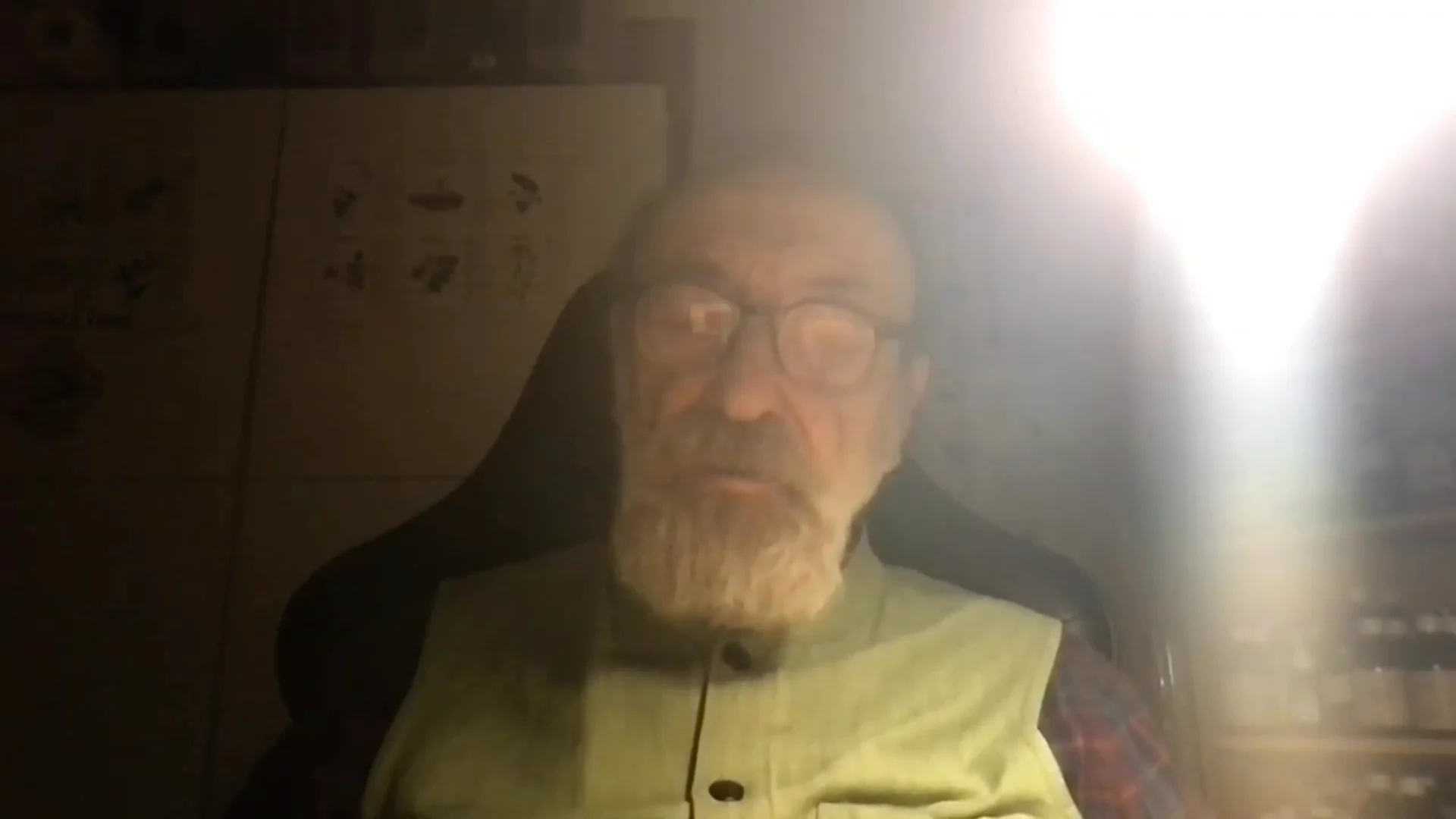
No. 23 of 44 · 1 July 2025 · 1 h 5 min George Pór Lessons from a Metamodern AI Shaman Watch the conversation On YouTube Everything said in it, in the order it was said: 51 turns, 26 of them George Pór's. Press one to hear it from its second. 0:00 George Pór A super organism or planetary superorganism is not necessarily a good thing. It can be the technocratic nightmare of the show is run by the super organism. So we clearly need a benevolent superorganism which can grow out only from the wisdom fostering AI. And when I say wisdom fostering AI, it's not an attribute of the AI systems. It is an attribute of the human and AI collaboration. So it is our responsibility whether the superorganism will be a toy for global governance with five or six mega corporations, or whether it would be a means of planetary weakening.1:14 Michael Garfield I'm your host, Michael Garfield, and this week I have a true legend in the hot seat. George has played vital roles in our emerging understanding of collective intelligence, knowledge gardening, and online community. In this episode, we explore his latest iteration as a metamodern AI shaman, what that means, why he's promoting this approach for the cultivation of hybrid human machine wisdom, and his theory of change for a reimagined human being in an age of collaborative planet scale intelligence. We had a delightful conversation. If you like it too, leave a comment and visit humansontheloop.com for nine years of additional episodes. Special thanks to new members Mike Kripe, Patrick Morensi, and Paul Dinard, and to everyone else supporting this work, of which the podcast is only one small part on Substack and Patreon, or with tax-deductible donations at every.org slash humans on the loop. Some of you, those at the founding member level, just got free access to all of the recordings and readings from my recent Weirdosphere course, How to Live in the Future. 20 hours of deep dives into the philosophy of technology, the evolution of culture and consciousness, the metadisciplinary study of time, and the changing nature of selfhood in our emerging age of planetization.3:19 Michael Garfield Plus, enough reading to inspire you for months. It's an honor and a privilege to devote so much of my time to synthesizing the big picture and exploring it with you, and I'm glad I get to share the amazing trip of that course. One more announcement: my first essay at Aeon Magazine, Homo Crustaceous, is now live on their website. It's an excerpt from my upcoming book and an extensive exploration of our troubled relationship with language, technology, and the biosphere, laced with riffs on sci-fi, meme culture, military history, and the evolution of crabs. Their editorial board called it the most audacious contribution that had ever passed their desk. Find the link to the show notes to read it, and hang tight as I'm taking the month of July off from regularly scheduled community calls to work on research and writing. But those of you subscribed will have plenty more to soak up in the interim. And that's all the news that's fit to print. Thank you for listening and enjoy this conversation with the insightful and delightful George Poor.5:00 Michael Garfield But it's worth it. It's worth it. That's incredible. How are you? I'm good, man.5:06 George Pór You will see at the end whether it was worth it. I have an article review by midnight about the way of the metal modern AI sharmen. But the problem is that my bedtime is at nine o'clock. So I will have to go beyond my bedtime.5:32 Michael Garfield Wait, what time is it there? Oh wow. Yeah, you will. Special thanks then to sticking around and making this work.5:41 George Pór Yeah.5:44 Michael Garfield So I've got a ton of notes here on random scraps of paper because I listened to pretty much every available interview of yours that I could find. And before we get into that, I would like to give people some context on you. I saw an older interview that you did with Ectic Spacewalk, which I'll link to in the show notes, which was more or less a biographical walkthrough. So I don't think we need to do that exactly. But it would be good to tell people. Kind of where you come from in terms of I liked you know the graphic that Lehman Pascal had made of you in the four seasons of your life. And you're just such a storied individual that I think it makes sense to take as much time as you feel is appropriate to lay out the path through hyperspace or the hyper trail, as you put it, that gets us to the person I'm speaking to now and why it is that you care about the things that you care about.6:52 George Pór Okay. Well, this is the kind of thing that I can talk about in five minutes or in five hours. So I guess I have to strike a balance somewhere somewhere between them. So I don't have a strong sense of who is your audience, but it seems to me that it's general intelligentsia, emergencia, tech people, and thinkers and doers. Yeah.7:24 Michael Garfield Wice. Okay. So yeah, what is your catalytic moment? Like what is your animating origin story?7:31 George Pór Well, that was something like how many sixty years ago, I guess. You know, I'm a guy from the 60s. I was an organizer of the anti-government student movement in Hungary. And we were very much inspired by the American, Western European, radical, leftist students. And so I got trouble with the government. They called it anti-state conspiracy. That was really what I organized some study circles of political philosophy. So that was really in my twenties, my awakening to social realities and also some kind of social commitment, engagement for standing up for stuff that I believed in. And then I was, after spending 20 months in jail, I was exiled from Hungary. I finished my academic degree in Paris. I started teaching sociology. I was a radical sociologist in the 70s. Then from there I moved to India, like many people of my generation went to India seeking after some deeper truth than the academic institutions could give us. So I spent half a year in ashram, became a meditation teacher, then moved to California. That was an important moment in my life.9:19 George Pór I felt that there is a bigger difference culturally between California and Paris, where I was at the university, than France and then socialist Hungary. So I loved California and I come out of money. And guess what? I became a computer salesman. Interestingly, my friends from my previous period of life, from the meditation feature life, they said that, George, I can't recognize you. You are in this trippy suit, and you lost your charisma. Where is the sparks? Well, the sparks were not flying when I was trying to sell Macintosh computers, but the good thing was that I had my own first my Apple II in 1982. That was my first computer, and then the first Macintosh in 84. Then I told my friends that you guys, you don't get there. There is a red thread going through, because what I was after in Paris in my psychedelic experimentations later with the meditation, and now the computer is the same thing. It's expanding our consciousness because what computers allowed me is not, I was not very excited about this and those early software, but with the computer, I also got a modem.11:00 George Pór And the modem 300-board modem, it allowed me to connect through the phone line with people in not only around the town, but around the continent and make friends and start talking with folks from all over the world about stuff that I was interested in. And that became so a major shift in my life when I connected people through computer networks in the early mid-80s. So I was one of the pioneers of virtual communities, and that was something that took me to management of big companies where I used basically the selling of the use of computer networks with the language that they understood, which was you save money and it will save time and all those good things. But my real agenda was to let people connect with each other and start conversations that matter to them on their intranets. So that led me back to Europe because INSEEAD, it's a big business school in Pontrebleau near Paris, invited me to do a stint as senior research fellow, and basically the research that I wanted to do about automating the functions of facilitating computer-based collaboration, automating to the extent that it's possible.12:49 George Pór So then that's basically from there I did more consulting work, but then it was more in the style of you must have heard of Frederick Lulu and the reinventing organization. So because I always like to support those people whom I feel that they are doing very good work with high impact. So in support of the film movement, I founded Enlivening Edge, which became the go-to place for a teal organization. It still exists. I started it in 2015. Yeah, that's in a nutshell. There were many stages of spiritual work, organizational work, technology work. I like to stay on the moving edge of how evolution is taking us to the next stage in technology, in organization, social evolution, spiritual development, and even naming these. Strands a little bit bizarre because they are not really separate strands in my life, they are all intertwined. Does it make sense for you?14:19 Michael Garfield Yeah, I think you say in some of your work that you associate wisdom with the ability to cultivate multiple perspectives, to inhabit multiple perspectives. As a kind of rudimentary example of this, I try to see things both instrumentally and intrinsically. You know, an action is just rewarding. That like the way that Timothy Morton talks about the sacred as the feeling of biology, you know, that like just being alive, even if you're ostensibly not having a good time, like that uh you can inhabit it in a way that makes it numinous and rewarding. So there's that's there's that sort of whistle while you work piece. And then the other piece being that there's a way to look back on anything that you've done and review it and make sense of it retroactively and assign or generate meaning. And so, like, the way that I've been doing this is that the play and the work of the show is to demonstrate and to evoke the play of perspectives. And so when you're saying like all of these things are related to you, like that is very resonant with the way that in my own life I've been saying people assign these categories that just don't hold up under scrutiny, art, science, religion, like I just mentioned work and play, or the idea of living in machinic, I think is also very suspect, right?16:07 Michael Garfield That's just me agreeing at length with the way that one of the things that I like about what comes forward in your work is how you rotate things and braid them, and the way that you emphasize being spacious enough to hold multiple different models and playful enough to try on different perspectives in your work.16:38 George Pór Yeah, playfulness is really a key ingredient in my life's work because part of my spiritual journey led through the Native American medicine will. So I used the medicine wheel for pattern my circle of life work on the eight directions of the medicine wheel. And I had this practice for something like 20 years now. Every year, just before my birthday, I cast the circle of my life work in a personal ceremony, which includes figuring out what are the main directions into which my creativity wants to flow. And you can also think of it as roles. What are my roles in the game of life or in holacracy language, the roles and accountabilities, but the playfulness comes in when I don't prescribe my activities in my calendar to those different functions? When I say functions, that's another way I relate to the different dimensions of my active life. Functions in the web of my relationships, in the ecosystem of my relationships, in the ecosystem of life, what is the function that I feel in? And then having a map, uh, these mental models, it's never static.18:34 George Pór First, it doesn't stay longer than a year, that's why every year I renew it, but even within the year, the map helps me to realize that oh no, it's the researcher part of me that wants to come out and play, or know if it's the mentor or the toolmaker or the basket weaver, and I just let them play. But I like to have this map, and it worked for me until two years ago, then I utterly became incapable to stick to name any roles because I just my life became more fluid. I dropped all the roles and became just a guy who is doing this and that. Whatever I receive the challenges and opportunities from life that calls me, I respond to those that call me the strongest. And now it is artificial intelligence, not the technology per se, but what we can do with it.19:55 Michael Garfield So I want to see if I can work into that transition in selfhood and unpack that a bit, but I want to do it through the statement that you made earlier that the sparks were not flying when I was trying to sell Macintosh computers, which is of course hilarious. Yeah, in some of your other conversations, you mentioned doing this corporate management consulting and subversive culture change work at huge organizations like HP and Greenpeace. And you said specifically that you were trying to create liberated zones within hierarchical structures. One of the things I'm most curious about is how this relates across levels of organization. You talk about enlivenment as a theory of change and how the relationship between the enlivenement of oneself and then one's relationships and one's society starting in the middle, but also working out from the structures in. And so, in thinking about all of this, everybody I talk to has in some way had to reckon with what James C. Scott wrote that book, seeing like a state, you know, that the states and markets make only certain things legible.21:16 Michael Garfield Like David J, formerly of Center for Humane Technology, wrote this book, Relationality, and that just came out. David has been working within organizations to make the work of the people who are already enlivening relationships within the organization, which is of benefit to the entire institution, more legible in a way that makes them more supported by the organization itself. But as soon as you make something legible, like suddenly you've created a new key performance indicator, and now you're chasing it. And the actual juicy generative action of what was going on underground has to retreat back underground in order to not be bent into service of some new variable in the revenue model or some new measurement of regulatory control. The last piece I'll stack on this before. Kicking it back to you for your riffs is in the Holistic Technology and Wise Innovation Discord server, you cited a few interviews with Kay Alato McDowell, whom I adore. When Kay and I spoke, we had this conversation about how the internet is like a living thing. It's enormous, and we're all participating in it.22:44 Michael Garfield And the idea that you're like selling these walled apps to an individual person who is actually part of this enormous coral reef of stuff, it just becomes increasingly absurd. Yeah. And so I'd love to hear you speak more about how that articulates with the way that you think across scales in your theory of change and what you think that means in terms of the unrealized potential of communications technologies.23:23 George Pór I have to step back one to look at the history of the relationship between technology and the evolution of human society. It's clearly co-evolution. I don't think that technology drives human and societal evolution. It's more like they are co-evolving human needs and the needs of commerce and production and governance make calls to technologies, which leads to new tools. And of course, technology also has its own line of development because academic papers in math and physics translates into new possibilities in this and that technology. So that also happening at the same time. But the interesting thing that I observed when I got involved with technology first time in the 80s, that it actually can contribute to cultural change. When I say contribute, I emphasize that it's not technology that drives it, but the combination of internal change champions, those people who are for enlightenment, enlightenment of the rigid relations of hierarchy and communication, those in all. So when technology enables that, then the response is that the new forms of organizing are calling for new technologies.25:23 George Pór So I see quadruple helix of co-evolution. There is the individual and collective intelligence is a double helix. That the smarter we become individually, the smarter the collective that we are part of can become. And the other double helix is of course the tour systems and the human systems. So when I put these two double helix inside each other, that creates a vortex of ironing of evolution. That's how I see in the broad picture. I am less obsessed with that question that who is using it and for what. Because the current dominant mode of production and commerce and organizing work cannot further itself without creating the conditions of transcending it. The whole AI revolution can be seen as a result of capital's unseizing appetite for more productivity, more efficiency, more profit, but unbeknownst to them in the process, they are creating possibilities for more freedom, for higher order coordination of complexity among three agents, which basically opens the door for a new social order. That's what I believe in my good days.27:27 Michael Garfield I appreciate this. I've got some friends that have been doing an amazing job. I know this guy, Ari Kushner, and my friend Stephanie Lepp, and both of them have been releasing these AI-generated videos of various complicated and contentious people like Elon Musk and Mark Zuckerberg and Donald Trump. My friend Stephanie Lepp calls them deep reckonings. And it's doing something that until I saw her work, I'd never seen anyone else attempt, which was not the deep fake for disinformation, but the deep fake for imagination, the ability to promote an opportunity for us to see a different way, to relate to one another in a different way, to find a narrative thread that has been until now invisible. But lately, watching Ari's series, which were written very beautifully by David Savage, who's like a professional empath, and does a fantastic job of communicating what it must be like for that person to have, like for Sam Altman to realize the ways that his decisions have complicated things for people and how it all roots in down into some childhood experience where he, you know, he just wanted to be special, he just wanted to connect with people and like you see that sort of psychoanalytic time dimension behind all of this stuff.29:04 Michael Garfield And in that sense, it's really cool. But I've been talking with Ari about how I'm concerned that this series places too much emphasis on these charismatic celebrity figures with enormous power already. This is something that we do very well in society. We do it very naturally, we defer to charismatic authority as social primates. We could be using these same tools to get a better grip on our own stories. There's a thread in this series on the notion that invention and innovation are like parenting in the respect that. The inventor does not actually know in advance all of the ways that a tool can be used. The thing that you end up patenting is inevitably taken up and repurposed in some other way. We live in a remix society now. And so what I would like to hear you talk about is this is our bridge to you talking about being an AI whisperer and an AI shaman. The fact of it is that you are already doing this work with ChatGPT and these other enormous corporate language models.30:25 Michael Garfield And I really appreciated the comments that you had made in some of your other conversations, that you are less concerned about having your attention hijacked and bent to the will of others than a lot of the people I know. That recentering of agency in this self, which is a transfigured self in the way we've been describing, but because of that transfiguration, we're no longer as obsessed with kings and popes and barons of industry and so on. The floor drops out from all of that and into something deeper and weirder. And I'd like to hear you talk about basically reclaiming agency.31:18 George Pór Yes, that's and I am thinking of the metamod AI shaman, which is a long journey to begun one and then to practice it. But as the Tao says, 10,000, a journey of 10,000 miles starts with begins with one step. Reclaiming agency is the first step, and the reclaiming agency starts with reclaiming our attention. That attention, intention, and energy, these are the basic human attributes that we need to use, we need to take responsibility for, starting with sensing, as accurate sensing of what is as we can. And by the I don't mean only the as individuals, but even more importantly, the as collectives, self-organizing collectives. And then once we improving of our sensing reality, then we need to engage in better sense making. So sensing and sense making are not the same. I'm using sense making synonymous as meaning making, but sensing is coupled with our sensory organs and what the signals or brain receive, then turn it into some meaning. So an agency is based on that we have more or less accurate sensing, good meaning making with proper relevance realization, and then we can have, as Schmartenberg has liked to say, on omnipositive choice making.33:21 George Pór So these three factors, sensing, meaning making, and choice making or action is the foundation of wisdom and agency, and it can be trained. So the three vectors of emergent qualities of wisdom can be educated. And the way of the AI Shaman is never solitary. I envision conveying in the near future, probably early next year, AI shaman communities of practice. Because when the whole social system is designed to deprive us from our sovereignty, from our agency, then we need each other. We need each other on the journey from collective intelligence, collective wisdom. Or as I started talking about it the last couple of months, not just wisdom guided collaborative hybrid intelligence, but wisdom fostering collaborative hybrid intelligence. That's really how I see the way to reclaim agency.34:55 Michael Garfield So let's talk about how this looks in practice. I would love to hear about the way that you have been exploring and experimenting with wisdom fostering hybrid intelligence. I tend to spend a lot of time up in the theoretical on this show, but I want to give people some ideas that they can actually take and explore. Because, like, one of the things that I like about You know, this idea of hypertrails, right? That's another thing that Kaolato McDowell and I talk a lot about is whether it's the riff on this show or whether it's the narrative that is embedded in high-dimensional semantic space that in the associative networks of our brains that we then kind of formalize into story. The idea of leaving a tangible trail behind, you know, showing our work, right? Making the process visible, making our own path to our own evolutionary journey open protocol. Doing that in tandem with these systems is something I'd like to hear you speak to. Like, what are your protocols? And how are you making those more operable by other people?36:23 George Pór Well, I don't want to give impression that I have well developed proven protocols, but I certainly had some interesting experiments, practices from which I started extracting some principles, and ultimately it will lead to the development of some protocols. So now I can tell you about the practices that I've been involved as facilitator of meetings and workshops where they invited Chad GPT to act as a co-facilitator. And I when I started doing that a year ago, that was rather unique, but notice it's quite widespread this kind of experiment when people in the workshop can ask ChatGPT or other eyes, or I was designing one of the workshops, then we inquiries in the master prom that ChatGPT asked provocative questions that correspond to the developmental journey that the group was in. So that was a step towards wisdom fostering AI because when the AI is making up its mind, so to speak, to provoke the humans with a challenging question that is specific to the situation where the humans are, and when we design those master prompt with a mind of foreign developmental stages, that's how I see that we can observe those practices and learn from it.38:32 George Pór I don't believe that we can or we should develop protocols in abstract, we can extract some principles from our observations of the practice, and those principles may add or may integrate into higher level, more complex protocols, but we are not yet at that stage. But given how rapidly we are moving, the team of people I am working with, I really believe that by the end of the year we'll have some quite interesting protocols for different situations, of course.39:18 Michael Garfield You talk about this with Ross Dawson a bit on amplifying cognition, but I would like to clarify for people when you talk about the difference between an AI whisperer and an AI shaman, what you mean, and then maybe we can use that to get into the way that you and Kay and I and many other people in this discussion are thinking about care. And I want to just peg into that that when you talk about the difference between knowledge management from like one of the earlier seasons, when you were you know preoccupied with growing into this concept of knowledge ecology and knowledge gardening, you made a distinction that I really appreciated between collective intelligence, the way that it is frequently used as a quantitative domain, a research domain in complexity science, and collective intelligence, which fundamentally comes from caring. And I think that to participate intentionally in collective intelligence means that one must be aware of the meta-individual, like the group or the collective within which one participates. Like a lot of evolutionary biology, the way that it's taught over the last century and a half actually departs rather profoundly from the way that Darwin himself was articulating it, in that Darwin was concerned with the interiority, with the life worlds of organisms that are participating in selection, you know, the whole rudiment of natural selection and sexual selection and the aesthetic domain.41:16 Michael Garfield And so, like you can tell me if I what I might be missing here, but it strikes me that the difference between knowledge management and knowledge ecology is like the difference between these two different perspectives on collective intelligence, and is like the difference between being an AI whisperer and an AI shaman in that there is a recognition of the, you know, if you want to talk about it like as the good and the true, or like the aesthetic and moral, the experience of you know, a transcendent concern, or just care, right? But yeah, am I we am I weaving this correctly?41:55 George Pór Yeah, well, let's step back to the dichotomy of knowledge management and knowledge ecology. I developed the concept of knowledge ecology in the 90s in response to the big wave of people who were dismissed from the job laid off, and then when the management realized that there's a lot of knowledge walking out on the door that they tried to retain, then they created the knowledge management, lotus notes capturing the knowledge, and that was not very successful. But anyway, I was just viscerally responding to that because I said in the funnily, I was a frequent speaker in the knowledge management conference circuit, and I always started my talk saying that knowledge management is an oxymoron because knowledge is not a thing that can be managed. It's not it's something that is between our two ears, and the ecosystem metaphor would be a more appropriate way of relating to knowledge, gardening, and so that's why I had the knowledge ecology fair in 1998, which was a virtual month long virtual fair on the internet. So that that was and at that stage, the polarity was between the Technocratic mechanistic view of knowledge and the holistic ecosystemic view of knowledge.43:43 George Pór Now, some 30 years later, and I looked at what is happening with prompt engineering. And there are the engineers who are the back-end guys of LLMs, but there is also the users who are just putting prompts together. They also sometimes call themselves AI whisperers. And of course, I like the term of AI whisperers because it is closer to a holistic mindset where if you think of the integral matrix, then an AI whisperer relates to both the right quadrants of the matrix and the left quadrants. In the upper right quadrants is the actual knowledge expressed, knowledge of the AI visperer expressed in creating prompts and master prompts and chain of talks and train of talks and more sophisticated prompting that creates results in the lower right, still in the objective visible part. There are all the courses, all the conferences, books, the software itself. And then what is the interesting thing is interesting for me, where more of my attention goes is the left quadrant. Of course, I do have to have some competence in the right quadrant, but in the left quadrant, the subjective, invisible part is where my values, my beliefs about the work that I am doing, why I am doing it, the self-observation, the subjective part of who I am as an AI disparator.45:52 George Pór And in the lower left, the collective is the lower of AI, the collective beliefs and norms about how do we do that. So that's what the communities of practice are tracking. So that's about the AI whisperer. But you asked me about the AI shaman. And so I would say that an AI shaman is an AI whisperer who is caring for the well-being and the well-becoming of communities at increasing scale. So the shaman of the premodern times was in charge to reestablish the balance of the community and the forces of the environment of life, healing not only the individuals, but healing the community. And the shaman does the same with the tools of their craft, building on their competences as AI whisperers, and coupling those competences with the axiological design, axiological use of AI, or as you said, the careering for the whole ultimately.47:33 Michael Garfield Can we just double-click and expand? Because I don't think when I had Steven Reed on Future Fossils, we had a nice long banter on axiological design, but I think if anyone jumping into this episode might need a bit of unpacking about what you specifically mean there.47:54 George Pór Yeah, there are different views about technology being value-laden or value neutral. Schwarzenberger and others say that it's value leaden, that technology has its own values. And I am more on the side of believing that technology can be designed for performing functions for the benefit of human emancipation or for the benefit of slaving people, squeezing more juices from employees. But that's not inherent in the technology, it's in the uses of it. So the axiological design would mean that we end the phase of evolution that can be described as blind evolution without intentional direction given by the human community. When we end blind evolution and when we start intentional evolution, then axiological design of technology can play a huge role because then we design technologies for maximizing its potential for human benefit, for social benefit. Well, all the big tech companies, starting with OpenAI, say that it's for the benefit of all humanity. And in a very abstract sense, well, I think that it is acceptable, but it goes parallel for the benefit of profit. One doesn't exclude the other, but when somebody is truly putting humanity and reaching the next stage, uh civilizational development, when we put that on the top of a priority, then we start designing AI systems and other systems with that priority in mind.50:14 Michael Garfield So that actually goes to the Nobel Prize in economics that was just awarded this year to two of the three authors, Asimoglu and Johnson. I'm getting this actually from a CNN piece that was shared by Turquoise Sound on her Patreon just to give a shout-out to turquoise. She quotes it that two of those authors published Power and Progress, a study of how technological innovations over the past thousand years have tended to benefit the elites rather than creating prosperity for all. And this goes to undergraduate SFI researcher Elisa Mora, who with Jeff West and Chris Kempis and a few other people a couple years ago decomposed the data on urban scaling and this argument that urbanization leads to super exponential wealth production, and found that when you actually look at it across economic strata, that the people in the lowest decile of city life are not actually any wealthier than if they were living out in rural areas, but most of the wealth is produced for the top 10%. And so, like again, Asim Moglu and Johnson said that the current path of AI is neither good for the economy nor for the democracy.51:40 Michael Garfield It strikes me that if open AI's about face to becoming a for-profit corporation were as smart as they think ChatGPT is itself, I feel like they would be whispering it in a way that would reveal to the corporation how to think of profit in new ways. I keep thinking about like Kate Rayworth and Donut Economics. And if you really want to optimize for profit, then wouldn't the most profitable thing be to figure out how to recycle literally all of our waste? That seems like the lowest hanging thing there is like, how can we make spent nuclear cores into money? How can we use them to regenerate the rainforest? And I guess I'm just ranting on this because one of the things that I I have appreciated you saying in all of this is that if you're using AI in team meetings to improve collective wisdom of your team, then you're asking AI what it is that you're not noticing. I'd like to wrap it with you on kind of a two-parter. One is what do you see as the road to making this particular application of not getting AI to do what you have already decided you want to do better, but utilizing the fact that it is in some regards foreign or exotic or alien intelligence?53:23 Michael Garfield And so it can show us to ourselves in a way that we don't already see, and that can generate an enormous amount of previously unimaginable opportunity. Like, what is your vision for a world in which we're actually doing this? Like, how do we get there? And then the second piece is just what questions have I not been asking in this conversation that I could be or that might generate the most valuable new insights.53:51 George Pór It's interesting the relationship between these two questions asking AI, what is that I didn't think of, and you asking me. So for the first, this is becoming the practice uh regular in our team. It was pioneered by a colleague of mine who kept asking AI with whom she developed a very intimate, almost soulful relationship, and she kept talking AI with the kind of passions that what is that I didn't think of in this conversation, challenge me, disrupt me, throw me a new perspective that is contradicting to the direction I've been going. So that's that's very interesting, and that's a huge step towards wisdom fostering AI. And I think that this will become a more widespread practice that my colleague is uh trailblaz uh of present. Now, regarding our conversation, the question that you didn't ask, or maybe you asked it, I just didn't pay enough attention. I don't know, you will decide. It is how my obsession, almost like obsession, about the AI whisperers becoming AI shamans as a part of personal development, on one hand, and On the other hand, my love affair with communities of practice, how these two relate with scaling the wisdom fostering collaborative hybrid intelligence of human and AI agent, scaling that into the kind of superorganism that is becoming a new branch on the tree of life, a new evolutionary phase that transcends and includes us as autonomous human beings.56:20 George Pór I'm not talking about Borg, I'm talking about the symbiont coming out from the symbiotic relationship of human and AI agents forming the superorganisms, planetary superorganisms in plural, together, becoming a new branch of the tree of life. And I'm happy that you didn't ask because I wouldn't have much more to say about this, because this is at the very edge of my knowing the frontier of between knowing and not knowing, but it's definitely the edge that makes me passionate.57:04 Michael Garfield Can I kind of twist that question for you as like a final button-up thing? Because I actually I talked about this with Matt Sagal a little bit, footnotes to Plato when we spoke for this, and you know, in the sort of zero episode of this show with Tim Morton back on future fossils, which is it's sort of like what evidence do we have that it hasn't already happened? Right? Like we have in some sense been taken up into and become reproductively dependent on our institutions for as long as we have existed as what we would recognize as human beings. So maybe the question that I would ask, riffing on that unasked question, is in what way is AI doing this in a qualitatively new, genuinely emergent way, rather than simply being a more kind of sophisticated or complex version? If we're gonna say it's a planetary superorganism, in what way is that different, say, from like the cybernetics-inspired 20th-century technocratic global economy?58:32 George Pór Yeah, I appreciate that question because that needs to be elucidated because uh superorganism or planetary superorganism is not necessarily a good thing, it can be the technocratic nightmare of the show is run by the superorganism, so we clearly need a benevolent superorganism which can grow out only from the wisdom fostering AI. And when I say wisdom fostering AI, it's not an attribute of the AI systems, it is an attribute of the human and AI collaboration. So it is our responsibility whether the superorganism will be a toy for global governance with five or six mega corporations, or whether it would be a means of planetary awakening.59:34 Michael Garfield So if I'm catching you, maybe it gets back to the that question of what Francesco Varella talked about as like the calculus of self-reference, and the way that you've talked about care, that the difference would be one in which we are more aware of it as a distinct and unified entity within which we emerge as individuals rather than as an abstraction. Yeah, I guess is like is the difference a figure ground reversal, right? Where it's like where rather than us thinking there's me and there's the economy, it's like there is the economy and I am of it, or something like that. Yeah, the visible hand.1:00:28 George Pór Yeah, right. I just have to share with you what came up as I was listening to you that a couple of years ago in my meditation, I discovered that I don't have a body, I am the body, and of course, I am many other things as well, but that background, foreground things. Similarly, when I look up the night sky and see the Milky Way and the zillions of stars, not as an outside object of my consciousness, but something that I am, so where the boundary between the whole and the self disappear, not as a concept, but as a lived experience. That first happened to me back in the 70s in my psychedelic explorations, but the world that I discovered there was not hallucination. I attribute as much reality to it as the ordinary realities. The way I perceive it now is that living in two universes. One is the one in which the I and the whole separation disappears because I am it and it is me. That's one universe, and the other is the ordinary consciousness universe, and I am oscillating between the two with increasing frequency.1:02:20 George Pór So then the challenge that I enjoy taking on is moving freely and by choice between these two universes, hanging all as much as long as I want in either of them. And I guess I don't have to tell you that I do have a personal preference of which universe I enjoy most, but I also exist in this physical body that connects me with the universe of distinct and separate forms. So that's why the best I can do is just keep oscillating.1:03:04 Michael Garfield That's a fine place to end this, George. Thank you. I think if people come away from this with only one thing, it would be your emphasis on the oscillation. I think that's I really appreciate that. Thank you so much for the care and the attention that you've paid to this conversation, by which I mean the broader discourse and to our personal interactions here and on the Discord server and elsewhere. I really admire and respect the way that you show up in community and keep moving the needle on these exchanges.1:03:50 George Pór Michael, this was my most enjoyable podcast. It always depends on the quality of the questions, the quality of the awareness of the horse that makes the conversation alive. And normally after being on the call that long, I feel exhausted and depressed, and no, I feel energized. So I just want to give shameless plug to my highest aspiration, which is to develop my talent for helping metal modern AI Shamans and others to move between the two universes freely by choice. That's what I want to do next time with my life. Thank you.1:04:47 Michael Garfield Thanks again for listening. If you liked this episode, dig into the archives and learn more about the myriad perks of membership at humansontheloop.com. And to find your people, join us in the Wisdom and Technology Discord server linked in the show notes. Our next episode is with Rufus Pollock of Life Itself and Second Renaissance, exploring the primacy of being and the shifts in consciousness and culture that we need to thread the needle of this era's many crises. Until then, take care. And remember, if you must think of nature as a resource, attention is our greatest natural resource. Before · No. 22 Evan Miyazono Design for Provably Safe AI After · No. 24 Rufus Pollock Culture, Consciousness, and the Second Renaissance