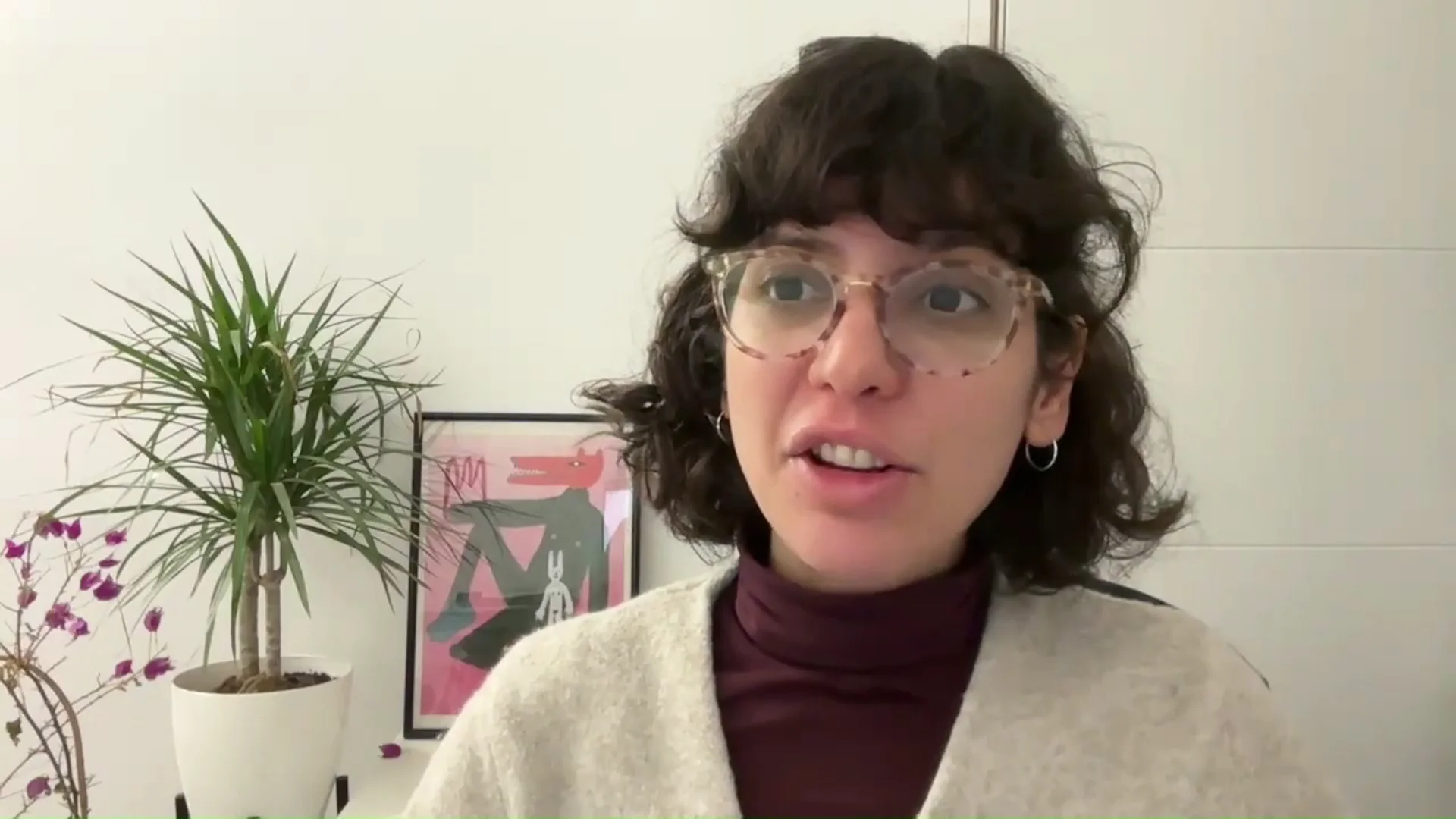
No. 39 of 44 · 16 June 2026 · 1 h 27 min Andrea Farias Bioregional Design for Life Online Watch the conversation On YouTube Everything said in it, in the order it was said: 79 turns, 40 of them Andrea Farias's. Press one to hear it from its second. 0:00 Andrea Farias It's a lot harder to think about what we do want than what we don't want. But that's the necessary step. I think it's about at the individual level, rather than saying, I don't need to look at my phone saying what are the things that I want to be paying attention to and why. And how can I replace this unhealthy habit with that healthier habit? How can I reconnect to the things that I value? Start by getting clear on the values and how those values translate into actions and actually replacing the action with an action that actually aligns with the values, even if it's on a small level. At the bigger scale, it's difficult. How do we actually get these ideas into places of power at this crucial moment? But it's also, I think, about not just imagining alternatives, but actually trying to demonstrate alternatives in the real world, even if it's on the small scale. So actually creating lived experiments of the things that we want that actually reflect our values, and growing those experiments and involving other people in those experiments, if people can see and experience different kinds of values in action.1:20 Andrea Farias I think for me it's about living it and being able to grow those experiments until they're able to showcase on a bigger scale what a different kind of system would look like.1:50 Michael Garfield I'm Michael Garfield, and this is a transdisciplinary investigation of wisdom and agency in an age of magical technologies. In the last episode, my conversation with C.T. Nguyen explored value capture, when our scoring systems define what we care about and ultimately our identities. In this episode, we push deeper into this inquiry with Andrea Farias, Barcelona-based researcher and builder whose guiding mission is to support the transition to a regenerative civilization, crafting information ecosystems that reimagine critical social systems like knowledge creation and resource allocation. But our path to this life required some serious unlearning. We invite you to ask the same questions she did, and we do in this conversation. When I decouple from the desires I've identified with, what is worth taking their place? How do we design and adopt technologies from this new, more spacious identity? How does the local determination of plural value help us restore necessary context to human-scale decision making? And how do we navigate the tensions between the placeful realm of community and the placeless realm of global coordination? Where do we need friction in our digital lives?2:58 Michael Garfield And how can ecology and bioregionalism inspire visions for a better web? What does it mean to be local to an idea or a narrative? And how does that cyber locality interface with geographic locality? Where do we want universal translation and where do we want to preserve plurality? Taking root in two of Andrea's essays, we riff on her journey out of healthcare product design and technology, and her growing disillusionment with the tech world's prevailing approach to solving real human problems by treating the body and the planet as if these are machines from which we can extract optimal performance. We talk about how to care for the processes that actually create life and what it means to enact regenerative principles to personal and collective health, technology and economy. One takeaway from this dialogue is that the bioregional movement and the best parts of Web3 are like yoga for entire societies, refocusing our collective attention on how we exist and move through space. Before we begin, I'd invite you to join me on June 23rd and 25th for Transcendence in the Age of AI at the Weirdosphere Online Learning Platform, where we'll host a watch party for Steven Spielberg's 2001 film AI and chase it with a deep-cut conversation between myself and two wonderful writers and filmmakers, Weird Studies co-host JF Martel and Joel Guns of MacGuffin Media.4:17 Michael Garfield If you've been around for a while, you know that every conversation I have with JF is solid gold, and Joel's roots in the work of Alfred Hitchcock and David Lynch will undoubtedly contribute the secret sauce for a tasty dish of a conversation on how to live in our age of accelerating weirdness. Founding members on Substack and Patreon can join for free, as always. Find registration info as well as an extensive rabbit hole for the resources Andrea and I mention in this episode in the show notes. And of course, for more, be sure to hit subscribe so you get all of the other marvelous conversations I have already recorded and essays I have in draft, including a series on the science of world models for the AI Capabilities and Alignment Consensus Project, a series on sovereign collective intelligence and the living web with my colleagues at Atlas Research, and a series on the new scientific and philosophical horizons of the UFO phenomenon. And with that, thanks for listening and enjoy this conversation with Andrea Farias. It was real nice.5:50 Michael Garfield They had an all-female speaking roster last night. You got three really different perspectives. The host, Kurt Dody, he made some claim in his news roundup at the beginning of the night that I forget who said it. This might have been like the World Economic Forum predicted 78 million jobs being created over the next several years. And isn't that great? And everybody's worried about technological unemployment. But look, and it's like, well, this is not an algebraic situation. This is a calculus situation. If 78 million jobs are being created and millions of jobs are being destroyed, and the people whose jobs are destroyed cannot retrain in the time that it takes to fill those jobs with qualified people or to save their livelihoods, then job creation is actually a problem. And looking at only one side of the equation of creative destruction is an issue. And then later Sarah Boivare got up from MIT and was talking about how she used to work in lasers and she's moved on to printing. And that you used to have one guy who knew how to use the CNC machine.7:08 Michael Garfield And now, whenever the new distributed manufacturing infrastructure makes it into the building, nobody knows how to use it except by going on to the internet, where if a lot of these instructions, if you follow them, will blow up your building. So I'm thinking a lot right now. Um, and I don't know how this connects to my conversation with you, but just about the like I told my wife this morning, that I expect the future just to get busier, and that if you're having trouble tracking things right now, you're not gonna be able to expect it to get better unless we change something inside of ourselves that increases our capacity to maintain necessary cohesion and focus within an increasingly busy environment. So anyway.8:04 Andrea Farias For me, I think that goes back to why do you even need jobs in the first place? Like the assumption that creating jobs is a good thing, surely automation is supposed to make us be able to do less things. So I think the fact that we're still talking about just creating jobs and not talking about like what do we want those jobs to do or the quality of what we're creating rather than the quantity, then we're still having the wrong conversation, especially as we're seeing that endless growth on a finite planet is not gonna work for very much longer. I think the question of automation and jobs is very much connected to that. And yeah, if we're gonna be automating things, let's think about how we're gonna make that have great outcomes for everyone, make people have be able to pay more attention to their kids or work less rather than just create more jobs or fill people's time with more stuff.9:05 Michael Garfield It's like the atom of this whole situation is at the heart of something I know I want to talk with you about today, which is this metaphysics of technology, which is if you specialize labor, okay, someone else is cooking the food, so I have more time to forage, then you end up with somebody who's really good at foraging and somebody who's really good at cooking. And then if the person who knows how to cook dies, you're back at square one, and you actually need two people to specialize. So there's this second-order thing that you're getting at, which is automation isn't necessarily even producing leisure, like it's just moving the work somewhere else, and then who's responsible for overseeing that work? And then is that even fun and what fills up the time that you've created, probably maintaining the outboarded structure for someone else? And the system gets less and less capable at the level of the individual, and like most people seem comfortable with that, but now we're in this situation where we are encouraged to know one thing very well and be effectively useless every other way, and collectively we have more knowledge than anyone else, like ever before, supposedly.10:37 Michael Garfield But each of us is this like helpless, domesticated animal, and we're like at that point where we don't even know how to prompt the collective for the insights that we need. Yeah, I don't know. Maybe we just snap it off here and start a fresh conversation.10:59 Andrea Farias Sure.11:00 Michael Garfield Yeah, Andrea, it's a pleasure. Thank you for being here.11:04 Andrea Farias The pleasure is mine. We're so glad we got to do this finally.11:07 Michael Garfield I want to start because you start diome.xyz by talking about your own journey and your process and the history that you've gone through personally. And because I want to anchor this in local story, that's where I'd like to start with you. So at great length, hopefully, we can talk about It Breaks My Heart, My Soul, My Body, this piece that you wrote, and what health and technology and balance, regenerative thinking, where all of this comes from for you and why you care about these conversations.11:52 Andrea Farias Yeah, I guess whenever I tell this story, I never really know where to start because I feel like it's been ongoing for such a long time, but it took me a while to actually see it. That I was looking for, I guess for a long time, I was looking for a way to actually make a difference in the world and just be helpful. How can what I do make a difference, or just I want to do something that feels meaningful? And my career started out in the startup world. I was really excited by technology, by startup culture, by building the new, by innovation. And so I got sucked into this world. And I wanted with all my heart to innovate, to create new kinds of products that would help people. And as a designer and as a product strategist, I worked for a long time trying to advise people and do research and create products that would help people. And the more I worked on different projects, the more I became disillusioned with what I saw.13:05 Andrea Farias Because no matter what I worked on, it seemed like it wasn't actually helpful. Like I was just putting a band-aid on a gushing wound. And it seemed every time I just lifted a lid, like there was some shit lying underneath. Nothing was ever felt like I was actually creating a real impact. And but I kept searching and I kept searching and I kept searching. And there were, I think, two real turning points for me. And they're both related to health, actually. Because close to the turning point, I was working in healthcare because I felt like creating products for healthcare would help people. What like what better way to help the world? And I was building a product to support people getting home care, so getting nurses and doctors to come to their house. And I was doing user research and I spoke to people. I spoke to many people who was using this medical service, and they all had really heartbreaking stories to tell about how their older parents have been left alone without care, or have been haven't been given the care they that they needed, including one man who was at the hospital with his father while his father was lying on his deathbed, and he took the time out to talk to me because he just wanted to speak to someone about the terrible care that his dying father had received our home.14:44 Andrea Farias And that was a real turning point because it really just made me feel on a very emotional level that what I said before, I was just putting a band-aid on a real big problem. And I wanted to address the problem. I didn't just want to do put a band-aid, and I realized no matter how much how amazing this app is that supports people with their home care, nothing is ever gonna fix the problem that this man has, that his father was sitting alone at home, sick, and the nurse didn't show up, or the nurse didn't know how to treat him. And that was one moment where I said, there must be a deeper level. How can I go deeper? Like I need to understand how I can really meaningfully address some of these problems. And for me, it all came back to money. It all comes back to money. Everyone's always trying to optimize for profit, or they just don't have the right amount of funding to do what they need to do. And so that just was a real realization for me that I was working on the wrong thing.15:56 Andrea Farias And around the same time, I was having a lot of issues with my own health. I had a back injury just from sitting in the wrong position or from nothing in particular. It's just that every time I made the wrong movement, I would just be in bed for days in pain because my back would just be so painful and it felt like. I just didn't know what to do. I went to doctors, I got scans, I went to therapy, I did osteopathy. And actually, it just got worse and worse over time. And through my whole process of research, actually for trying to figure out how do I go, how do I go deeper? How do I understand what the real problems are? I started researching about the regeneration and the regenerative economy and how we're treating our planet like it's some kind of machine, always trying to optimize for the maximum results. And I had this realization that I was doing the same thing to my body. Even throughout my work, I always pushed myself to the limit.17:13 Andrea Farias I always wanted to be the best at what I did. And my body was just a vehicle to do that. And even through the healing process, I was just saying to myself, how can I get the right therapy? If I do this, then will I be healthy? If I do this, then will I be healthy? And I wasn't really giving myself the care that I needed. And so I realized it all went back to this idea of care and caring, like caring for the processes that actually create life and not just trying to optimize for the maximum outcome. And the words felt the words made sense to me, but it wasn't until I felt it in my own body that I understood what it that actually meant deeply. And so that was the start of a transition for me of saying, okay, I need to dedicate my life to understanding how I can implement this these principles in the world, in how our economies work, in how our technology works. And that's what I've been doing ever since then.18:21 Michael Garfield So you talk about Martin Buber's I Thou thinking in this piece. And there's a moment where it's radical, you're relating to your body as a subject. What do you want? And you can actually listen rather than just command and manipulate. But then you talk about how at some point you realize that it got ridiculous because the thou in question, as you put it, was just me. And I think about this protocol for shadow work I learned back in 2005, the 3-2-1 process referencing third, second, and first person perspectives, and how you know, if something is triggering you, you can enter into a kind of gestalt psychotherapeutic dialogue with that thing after you take the time to describe it fully. You know, first you attend to it, then you converse with it. The case that we were given was you know a monster showing up in your dreams. And the of this process is where you realize that the monster is a part of you, it's like some manifestation of your own dreaming mind, and that you can claim this part of yourself in a way that allows you to recognize its value, which is funny, right?19:49 Michael Garfield Because you make the point also that the importance of keeping your body healthy, you say, my sense of self and self-worth, not to mention my economic prosperity, were deeply tied to the value it could produce. Elsewhere on Diome, you talk about value and values. So I want to make sure we get there. Where I tend to go with all of this, I feel like right now, people I'm seeing more and more people, like my friend Rubina Cohen at this AI salon last night, talking about relating to AI or technology broadly as thou, like entering into conversation with it, recognizing the consciousness of non-human entities on our planet. And also there's a step beyond that where the broadest sense, you know, like care takes us eventually all the way to care for other as self. And that seems really important. That something that seems to me fundamentally broken about the way that we relate to the planet, but also to technologies, is that not many people are doing that. Like at best, people are having this sense that interacting with a large language model is, if you give it the benefit of doubt, interacting with some kind of non-human intelligence.21:20 Michael Garfield Maybe I'm just hard to please here. It seems like we're still missing the turn that you made with your own body, where it's like, okay, well, what does it mean to really listen? What does it mean to really care? This involves a turn from the second person back to the deeper recognition that a lot of this drive to extract value is ultimately anchored in some kind of lack of self-worth. That's very clear, the not enoughness with which we see tech magnates. Oh, clearly, you're just doing this because you wanted approval that you never got from your dad or whatever. But it's not just them. It's I'm not gonna make this a class issue. This is something that I deal with too, this sense of having to accomplish more. And a lot of what motivates this particular show is my desire to model for people what arises when that is brought into the light, and we can start talking about values instead of value, and how those things are so often out of sync because we are not addressing some sort of deep-seated inadequacy.22:50 Michael Garfield And so I yeah, I would love to know what you feel is worth patching into and where you see it coming up in the various discourses that you monitor and participate in and just what it brings up.23:05 Andrea Farias Yeah, I think just this question of what is enough and how do we address limits? How do we handle limits as a human society is a really important one and one that I think is core to the question of how do we move forward. I guess there's two things in there. It's this idea of enoughness and how do we handle limits, and this idea of care and how do we center care rather than this kind of more, more, more. I think both are to do with quality over quantity, right? I think the idea of an enoughness is really important. I'm just thinking in my head now, it's bringing up of the ecological donor by Kate Randworth, I believe her name is. And how do we stay within the ecological limits? And I think it's the same story with technology, same story with ever anything that we're looking at of how do we actually handle staying within the necessary limitations where we're living within our means, but we're also doing the things that align with our values and are able to effectively.24:21 Andrea Farias Identify values as a collective and live by those values by saying, no, we shouldn't do this, or no, this is the limit. I don't think we've really figured out how to do that collectively. And I think that's exemplified by the fact that we our core process for decision making is through money, through profits. If it's profitable, then we do it. If it's not profitable, then we don't do it. What other mechanisms for making decisions that align with our values or that stay within limits can we have where we're not just making decisions based on what's profitable or what we can extract monetary value from, but what actually aligns with our values or stays within the limits of whether it's ecological boundaries or whatever else. And I think enoughness relates closely to care in that care is not sexy in a lot of ways. There's a lot of repetition, right? It's a lot of unseen work, it's a lot of repetitive work, it's a lot of just things that no one's gonna make history by doing.25:46 Andrea Farias And yeah, I guess what you're saying about these tech moguls centering or always driving this change towards a future that were promised that we want or that we will want is very related to this idea of innovation, of the new, of busyness, rather than this kind of intentional care that's often invisible or often not, let's say, impressive in some way, or not gonna get you into the history books.26:24 Michael Garfield I'm thinking of, in spite of his problematic legacy, I remember reading a book by Osho, I think it was like Tantra for Transformation back in college, and he said something to the effect of I'm not saying to be rid of your desires, I'm saying that you don't desire enough. Meaning you could create a product that helps a billion people, but that's only a material change in the world. You might become a billionaire, but those are still the desires of a small self. And why aren't more people asking, why am I satisfied? It's funny because it's not so much the amount of not enoughness as it is the distribution of not enoughness. Like we could be asking, I'm not wise enough, I'm not compassionate enough, I'm not capacious enough to enfold all of the world in my sense of care. And to your point, care doesn't get one in the history books. Why do you want to be a great person instead of a good person? And so I want to make a connection here between two of the quotes that you put in this piece.27:43 Michael Garfield You quote Jack D. Forbes in Indigenous Americans, Spirituality and Ecos. I can lose my hands and still live, I can lose my legs and still live, I can lose my eyes and still live, but if I lose the air, I die. If I lose the sun, I die. If I lose the earth, I die, etc. All of these things are more a part of me, more essential to my every breath than is my body. What is my real body? So again, it seems like primarily there's this dislocation of selfhood that leads to the acquisitive and extractive impulse, and that to expand one's desire to what my mom would call the treasures of heaven rather than the treasures of this life blinds us to other things that are of real value. You also quote Yancey Strickler in Post-Capitalism for Realists, makes the point that GDP tracks how much is spent but not why, and that an ideal citizen is someone who drives an SUV, has cancer, is getting divorced, and eats out every night. And yeah, again, because I just want to linger in this question of to really identity into the more than human, to accept technology and the biosphere and beyond into that eye, it becomes very clear that money is not actually registering everything of value.29:22 Michael Garfield And so I guess just moving forward in this conversation, I want to be clear that on the one hand, I think, and you give some really good examples of ways that we can design and adopt technologies from a more spacious identity, and that one of those technologies is the means by which we account for value, that we align value and values. And I also want to point to this notion that some of the things that you bring up are some of the things I talk on the show about a lot, which is about local currency and how one way that we can get a more accurate accounting of value is by knowing the natural limit beyond which the systems that we use to track value become decontextualized from what is valuable to us in our community or our region, that local currencies complicate in some ways the ability to exchange with the entire global economy, but like in other ways, bring accounting back to a human scale. So I've already gone on too long. I'd love to let you just take that.30:45 Andrea Farias Yeah, I guess the first thing that came up for me was just thinking about my own process of reconnecting with my body. And in another way, also reconnecting with the bigger whole. And on a physical level, I actually had this really amazing experience where at first I started doing a lot of yoga. Then I went to a place called the Movement School, where they essentially taught me how to move my body in different ways and reconnect, re-spark the connection with different parts of my body in a very physical way. And since then, I've felt the experience of living within my body very differently, a lot more vividly, just focusing on movement as I walk, as I sit even, as I experience my life, being physically present in my movement has changed a lot for me in just understanding what my body does and what my body is. And I feel a similar experience with reconnecting with the bigger whole of learning to connect with what's actually around us. I've been really involved with the bioregional movement, and something that really is very salient for me within those ideas is just understanding where your water comes from, where does your food come from?32:20 Andrea Farias What plants and more than human beings exist around you. And I think just that process of refocusing the attention on what's here and now, how are you moving through space? What kinds of relationships do you have on a daily basis with your community, that being the human community around you or the more-than-human community? I think that refocusing of attention is really important in this reconnection process of not just scratching the surface, but actually going deep into the movements, into the invisible processes that happen all around us. And I think that's core to what we're talking about in terms of connection or expanding the eye and in refocusing the values or understanding the values. So really being present within the processes of your body, of your community, of the things that sustain your life. And I think that takes us, you know, into community and community currencies, and how can that support this process? And I guess something that's really interesting for me is how currency can express values and value. And one thing that draws me to the Web3 movement in particular is this idea that you can create currencies around values.33:52 Andrea Farias You can create a currency around a meme or an idea, and that can create different types of value flows that can support that idea and bring something to life that wasn't there before. And so it just brings to the forefront for me the relationship between how we pay attention and what we pay attention to, the narratives that are formed from that, the social structures that emerge from those narratives, and how those narratives and those social structures can create essentially tokens that can act as financial mechanisms to those narratives forward, bring those narratives to life. And something that I'm really interested in is how human complex systems function. And there's this idea of humans, an individual human is in ourselves, we are a complex system. And when we interact with other humans, that system becomes even more complex. How do these mechanisms function for actually collaborating within these complex systems, whether it's a small group or the planetary community? And it goes back to this relationship between the narratives, the social structures, and the financial flows.35:22 Andrea Farias How those three things work together essentially determines how human groups are able to function. And so I'm really interested in those relationships and how by understanding these mechanisms, we can create new kinds of groups that have different narratives and that can cultivate these narratives into demonstrations of different ways to act within the world and live within the world.35:54 Michael Garfield So to embellish what we've been talking about so far, you quote technology is not values neutral, ending the reign of nihilistic design in your section on technology values, talking about how the scale increased the salience and visibility of body weight, changing the ways in which it could be valued, thought about, and otherwise related to psychologically. This had unforeseen outcomes. So this is the Michael constantly yellow teaming part of the show, because I too love the way that Web3 is giving us this proliferation, this efflorescence of new ways to think about the measurement of value and what can be measured becomes something that can be encouraged. It creates a channel through which information and energy and matter can flow, but much of current web three space is still, I think, suffering from a disjunction of the kind I talked about with Christina Bowen, thinking about there are safe, brave, and inclusive social spaces. And again, to go back to the local currency thing, there's a difference between a local currency that only works where you are, and then a local currency that started out coupled to matters of salience for that community, but becomes something that people can trade, finance, and speculate on in the global economy.37:37 Michael Garfield And I've been around the crypto space for long enough to see the way that the promise of Bitcoin hit that point in the tech adoption curve where suddenly states are considering it a reserve currency, and BlackRock owns countless billions of dollars in crypto, or like in what was it, December of 2017, when they opened the futures fund for Bitcoin. And then suddenly it is functioning in a completely different way. And I guess the question that I'm thinking about is akin to the question I asked Christina, which is if we're talking about enoughness, one of the things I think about a lot is how to keep Local attention, local accounting decoupled enough from the pressures of these larger systems so that it can continue to be functional in its original context. This may seem over here in the space, but like it's related to this thing about incubation and about the value of play and how hard it is to actually get your head into play if it's for something. And then it becomes a game, then it becomes something where you have something at stake.39:07 Michael Garfield One of the big pieces of the inquiry of this program right now is in knowing when to make something visible in a way that it becomes something that can be instrumentalized and operated on. But it's not just a binary question. It's a question of at what scale do we have that agency? To give an example, I think most people will understand reciprocity in social relationships and popularity in one's scene. But as soon as we like popped that with social media, basically the whole world got reshaped by this global popularity contest. And that had all kinds of devastating consequences where the scale at which something should operate is now open to connected with all of these other scales with all of the consequent opacity, rich get richer dynamics. And I just think about like carbon markets and how it seems like a good thing to make that trackable, but then it's become like another GDP. And so this conversation is as much about these two axes about what deserves to be tracked. I talked about this with Jim O'Shaughnessy, where he was saying, just because I can track my sleep quality with a Fitbit doesn't mean I want to.40:44 Michael Garfield There are things that we as individuals or as neighborhoods or societies or whatever may decide we're not going to make into affordances for optimization. So there's that, and then there's the other axis, which is that again, this is not just a binary concern of do I measure it or not, but a question of let's assume that everything can be tokenized. At what level of regulation does tokenizing it help? And at what level does it actually make things worse?41:23 Andrea Farias What that brings up for me is just thinking about how to me, one of the most important challenges of our time is how do we actually govern our common resources. And this relates closely to Web3 because in Web3, people are talking about governance, they're talking about new kinds of economic systems, new uh financial models. But a lot of the time it's all very abstract and it starts with the mechanisms. People in web 3 love to tell you about their funding mechanism for whatever it is, or their governance mechanism for DAOs. But to me, it all comes down to how do we govern our watersheds, how do we govern our common assets? So I think one one of the speaking of axes, one of the axes for me is this contextualization versus abstraction, and how really one of the problems with the globalized world and globalized currencies is this high levels of abstraction that where we're looking at these numbers of how much this value has gone up or down rather than the actual tangible value of the water that we need to drink or the air that we need to breathe.42:49 Andrea Farias And I think Web3, the majority of the Web3 space, is actually going further along that abstraction axis, it's further abstracting through tokenizing, through mechanisms rather than contextualizing. And I think what we need to do is contextualize. And so I think Web3 has given us a lot of insight and a lot of models, but now the work is to look at the world and look at the actual real tangible governance problems that we have, like how do we govern our watersheds and say how can our learnings apply to this? And I think it really starts with what we were saying around how do we expand this idea of I? How do we develop ourselves in conjunction with our communities and realize that the I is not just us. There is no such thing as I if we're not in relationship to others and in relationship to the ecosystems around us. And those relationships are governance. Governance starts with relationships and the mechanisms and the abstraction is useful, but it's especially useful when things go wrong or when things aren't working the way that it should be, or when you need to work at a level where you're not able to build this kind of trust at scale.44:26 Andrea Farias But really, the first thing is being in relationship and building trust, and the last thing is financial mechanisms or governance mechanisms. And yeah, I think I'll leave it there. You said a lot of things, but that's the main thing that came up for me.44:42 Michael Garfield So this is cool because this actually allows me to get into this idea of the diome as not opposed to, but expanding on the biome to include the virtual and the digital, and how another thing that comes up a lot on the show is that sort of dark forest theory of the internet. Because you know, you're talking about trust, and one of the consequences of coupling mechanisms that make sense at one scale to mechanisms that make sense at another scale is that we now operate in these enormous online social spaces that are subject to some of the same challenges that you get when you know a watershed becomes not just valuable for the dynamics of that area, but becomes the place that serves some sort of industrial function. You know, like I see what has happened with the global economy and social media akin to let me put it like this I'm very wary of the idea that this story of the automation of trust mechanisms is actually gonna operate as advertised because the story that most of us, I think, learned in public schooling is that was what money was in the first place, as a way to engage with people that you're not going to have that context, that long term relationship with.46:25 Michael Garfield And it it reduces everything to the transaction rather than the relationship. And this idea that you explore in rewilding social digital spaces, I think, you know, the fact that right now younger generations are less interested in Facebook and more interested in, for example, Discord, or the success of a platform like Mighty Networks is part and parcel with this recognition that the integrity of these things at their scale are crucial. That like being able to know the people that you're speaking to online is like knowing that your food and your water come from this place. When I talked to Lehman Pascal about this, one of his observations, you know, the deep trend of what we're living through right now is that we're pulling increasingly in both directions, that we are unifying processes at ever greater scales, but also in order to understand that we're diving deeper and deeper into the microworlds. And so I don't really see these things necessarily in opposition, but it no longer seems to make sense to talk about ecosystems without considering the fact that those ecosystems now are in context with human culture and the exchange of ideas, and that a lot of that is going on online, and that it's like irresponsible to regard these as from one another.48:12 Michael Garfield And yeah, I want to not pivot so much as bend your thinking on the diome and on what it means to care for the partially digital social environments in which we are making important decisions about how to relate to one another across all of these scales and in both physical world and virtual world, and why these are not like Yeah.48:41 Andrea Farias I guess it's absolutely important because our identities are formed through these conversations that we have online more and more, and conversations not just with other humans, but with algorithms, with AI, with advertisers, with businesses, with corporations. The way that we interact online essentially is a form of socializing. It shapes who we think we are, how we relate to others, and how we relate to the wider world. So these processes by which we're defining our identity and defining what we believe to be true, and the narratives that shape our perception of the world are crucial to how we act in the world, and therefore also crucial to any kind of change or transition we might want to make in how we act in the world. And we've been speaking a lot about watersheds, and I think this acts as a great metaphor for online spaces too. Often this metaphor of feeds, like in Facebook, Instagram, Twitter, are spoken about with the metaphor of a stream, but really it's a massive flowing river of information where we're all essentially drowning.50:09 Andrea Farias Or more than a river, more like a pipe where it's just pumping information all the time. Whereas rivers and watersheds follow a fractal structure. So speaking of scales, you have small streams that lead into rivers that lead into bigger waterways that eventually empty into the sea. So it's not for me just about breaking up into smaller groups and knowing everyone around you, but about what is the relationship between the small and the big. And I think learning from these kinds of fractal relationships is very powerful as we think about how are we creating online spaces? How are we creating spaces where we can form deep and meaningful relationships with the people around us where we know the names or the identities, the assumed identities of those people? And how are those relationships essentially being mirrored through fractal structures into bigger scales? So not just a pipe pumping information, but fractal relationships that build on each other. And we're seeing this more and more in this kind of dark forest theory of the internet, which you were mentioning, of people in part retreating to smaller, cosier spaces.51:38 Andrea Farias I tell people now that my main social media is Telegram and they look at me like I'm crazy. But it's true, most of my social networking happens on Telegram because I'm part of different sized groups that are talking about themes that I'm interested in. There are different kinds of scenes that are interested in different topics, and that is the backbone of my social interactions online. But these cozy spaces don't exist in isolation. There's people who participate in many spaces, so there's this cross-pollination, and the ideas or the outputs that are being created and being built in these smaller spaces then get channeled out into those bigger streams or rivers down the line. And so I hope we're gonna see more of these patterns where at the same time as we enter into more of these cozy spaces, we're creating spaces for these ideas to be born, for people to play around with different kinds of identity, essentially sense making spaces where we're processing information collectively with people that we trust. And then the question becomes what is that relationship?53:01 Andrea Farias How can we create this fractal relationship between the small and the cozy and the wider streams until we get to the C?53:10 Michael Garfield So this is exactly what I hoped you'd bring up. In your section on rewilding social digital spaces, you quote Rebecca Solnit talking about how as swathes of our countryside were repurposed for farming over the past century, our city streets have been optimized for one goal to move people around as quickly as possible, unhindered by anyone using public space for other purposes. And this is of a theme with what you were just saying about online communication, the fact that it's all just it's been consolidated into these gushing unified torrents and the rewilded internet, at least in part, is going to look like the fractal river that has not just tributaries but also oxpos, like that it's like structurally slowed down. And we know to link back into complex systems, the fractal growth of a watershed or of circulatory systems is about this distribution of strain through the topos or whatever, like through that space, but that in a straight channel, all of the friction that would be dissipated across an oxbow ends up creating these vortices because the water does not want to flow straight.54:41 Michael Garfield And I think we're just embellishing the point here. But I think a lot of the conflict online is coming from this kind of a dynamic. And so I want to tie this back to the conversation around the commons, the piece that you cite by Henry Zoo on the limits and good of public goods, which starts by asking: is language itself a public good? While language as a whole may not be excluded, we find ways in which it is flattened. And so this is where I want to initiate the question of again, maybe it is kind of mischievous, but if we're thinking about tech for good in a much more fundamental and rigorous way, rather than just myopic and superficial, then part of this is not just about the proliferation of biodiversity or of cultural diversity, it's about linguistic diversity. And you spend some time on rewilding our attention, which can include such things as online rabbit holes of information about non-trending topics, following niche blogs about small weird things, finding like-minded people in groups and writing on your own terms.55:55 Michael Garfield So, like when I spoke to Michael Dean on this show, he's working on AI not for writing, but for editing his unedited stream of thought essays into the form that will make them legible for other people. And the great hope that he and I see for AI as a translation layer is that it frees up each of us as the tributaries of this enormous sociocultural happening to worry less. In some sense, it sounds like I may be saying the opposite of what I was just saying about money and blockchain automated trust mechanisms and so on. But I want to play the other side with you for a minute here, that if we can find ways to use technology to worry less about making ourselves legible to other people, if you can get your philosophy degree and then be a philosopher and just follow what you decide is locally valuable and curate what seems salient in your life without having to worry about product market fit, then that seems like a light on how we can possibly start doing what you said a moment ago, which is finding ways to connect the system in healthier ways cross scales.57:53 Michael Garfield Is partially one of our capacity to translate, but largely one of privacy. And again, we've come back to this question of like placing blind faith in the ability of the AI editor to represent you does not get us there, but nor does merely constricting the sphere of concern to the health of one's watershed, because the watershed is connected through atmospheric and water currents to everything else. This is, I guess, kind of a biomimicry question, a technology design question. It's about the reconciliation of the local self-determination of value and self-governance with the interlinkage of everything. And how do we decide where to connect things across scales?58:46 Andrea Farias Yeah. I guess one of the things that came up for me is you were saying that, you know, what would it mean if I was able to be a philosopher and not worry about fitting myself into the world or this idea of product market fit. But I think there's always some sort of product market fit. We don't just exist as islands, we exist in relationship to the things around us. So there's always this idea of finding product market fit in terms of who I am in relationship to like the time that I live in in this world, the place that I live in, the people that are around me that I'm in communication with. And so the way that we formulate who we are, who I am as a philosopher should be in relationship to others. So there is this idea of how am I finding product market fit or like individual community fit. But I guess for me, it's what is that in service to generally it's around. Like being in service to capital, but how do we create individual community fit that's in service to our values?59:53 Andrea Farias And I think that's related to narratives and how do we process information and how do we sense mate around who we are in relationship to others or in relationship to the space and time that we live in. And that's what we do within these kinds of communities. And so for me, it's all about these relationships. It's not about the information per se. We often focusing on the information itself, but really the most important thing is the kind of structures that you're creating around that information. You're saying, how can we get this information out to people that it might be relevant to? But I think maybe at the core of that is how are we connecting people together in ways that create fruitful relationships, whether that's synchronously through actual conversations or asynchronously through I read something that you wrote and that gave me an idea. So I guess for me it comes down to that. I think that these communities for me are a breakaway from even the mass media and mass internet culture that we've been experiencing, a new way to create local cultures, whether it's local to a place or local to an idea or to a narrative.1:01:16 Andrea Farias And I guess as we create these kind of experimental spaces for narratives and for ideas and for processing information, I think that creates new kinds of relationships and builds trust because it's not just about the information, is how do we actually are how are we making sense of this information together? And that's key to me in moving forward out of the place that we're in and into a new kind of creative space in how do we communicate, how do we create, how do we govern the world differently, is how do we sense make together around our identities, around what's happening in the world. So for me, it's not so much about the translation, but it's about the kinds of relationships and the qualities of relationships and how are we building those, how are we connecting the mycelium together?1:02:12 Michael Garfield If we're gonna repeat this back to you in the language of the analogy I just offered, it's about less relying on automated translation to make one's weird, idiosyncratic, niche thing legibly inclusive than it is about finding how it matters in a way that can be understood by people who live closer to you in geographic or in semantic space. To go back to the thing about crypto, it's like I had a conversation with a beloved boomer friend of mine who was saying, yeah, all these things that you're saying are valuable about web 3 stuff. At the end of the day, you're still trading out into the dollar. And her point was that makes the dollar more trustworthy because she's still giving more trust to the institution. Whereas I think it's a problem in the opposite direction. It's like the dollar still matters in my community. And I think that's closer to the heart of what you're saying, right? Like if you're listening in Europe, then it's wow, wouldn't it be great if we could have participated in the euro without getting rid of national currency?1:03:31 Andrea Farias Yeah. Let's see, plurality is a very important thing. So, yeah, absolutely. I think the idea of currency also can follow this narrative of nested hierarchy. We can have the euro, we can have the country-level currencies, we can have the local currencies, and we can have currencies that represent our values in the communities that we live in, not just geographically but semantically, as you said. So we're talking about building trust in institutions. I think that our current perception of web three or of creating tradable tokens or tradable currencies is very much just a lot of the time, they're not new kinds of currencies, they are just representations of the dollar. I think the challenge is how do we think beyond just currency and consider maybe I need a second to think about that. I feel like okay, we're talking about the dark web in sense-making spaces, and then we're jumping into currencies. I guess I I want to make this more tangible somehow, and maybe I'll use the example of the bioregional movement. So I've been recently doing a lot of research on the bioregional movement because it's something that it's a space that to me is trying to create not just new narratives around how do we connect to place, but actual systems of governance and finance around resources.1:05:14 Andrea Farias So there's this tangible connection between developing new narratives and new kinds of relationships in niche, small spaces, but at the same time at a global level. And connecting these new kinds of ideas of the eye is not just me, but it's a planetary eye, and we need to govern our resources in a way that centers care and centers relationship and is regenerative and viable in the long term. And tying these ideas with real-life demonstrations of governance structures built on trust over time by people that have been working in place for a really long time. And using this trust and these new narratives that are very salient at the moment and very persuasive in thinking about how do we create systems change and turning it into tangible new ways of relating to our place and financing regeneration in a place. And the movement uses a lot of ideas from Web3. For example, in the most direct way, eco-credits are a mechanism for financing these new kinds of ways of relaying to place and working it in place and these institutions that are trying to create systemic change.1:06:43 Andrea Farias But more than that, I think is the idea that we can create new kinds of institutions. And often blockchain or web 3 can act as building blocks for how do we finance new projects or how do we track what's happening in this place or how do we govern a specific asset? But it's not the core of it. The core is about building the narrative within community, building trust, building new kinds of social structures and relationships to place. And the technologies are just there to support these narratives and new kinds of social structures. So I'm not sure if that answers your question, but that's what's coming up for me of how this becomes something more tangible. So it's not about just creating tokens that you can trade into dollars or not, but how is technology creating building blocks for making real these new kinds of social structures that we want to create in a place around governing water, around governing our agriculture or our soil? It's just a way that we're bringing these ideas to life, but it really has to start with a deeper relationship to place and community and an idea of how do we create social structures differently.1:08:13 Michael Garfield Yeah, I want to link what you've said and what we've been hinting at this whole time. This relationship between fast, global, abstract, and explicit on one end, and slow, local, tangible, and tacit on another. With you talk about the noetic pyramid, data, information, knowledge, wisdom. And we agree that a lot of people are looking for what rightly belongs at the level of information in data, or what rightly belongs at the level of knowledge in information, or what rightly belongs at the level of wisdom in knowledge, or worse, in data. Um, what I want to know is where you see healthy structures in place where these things are situated. I just want to say, like the whole website, I love the way that you have structured all of these entries as trunk leaves, flowers, fruits, with fruits being the tangible examples of places where people are these insights into practice. And your work with this project represents something of me banging my head against the wall with this question of yes, it's not all about making things legible.1:09:38 Michael Garfield Like you need direct mentor, mentee, master apprentice learning. And we can't just expect to learn everything online. We need to understand the context rather than just airdrop some kind of solution into somebody's problem. And we have an opportunity now that I think humankind is kind of fumbling again to make it easier to understand how to relate the wisdom, the relationality that emerges in one context to another. Biomimicry is a great example of this broadly. It's like obviously the flipper of a humpback whale is a very different context from the bumps on the wing of a jet liner that prevent turbulence. And yet somebody saw the analogy. And so what I'm most curious about is like, where do you have hope or where do you see good examples of this kind of structured understanding? Where what works in one context is not merely just subsumed, is held in its context, and yet still becomes a lesson in some other context that can be fit for its own bespoke purposes. Like, how are we doing that right?1:11:11 Michael Garfield Or how could we be doing that right? Yeah, I hope that makes sense.1:11:15 Andrea Farias Yeah. I guess one of the most interesting things for me that's also coming out of the Web3 world, not technology specifically, is just the idea of protocols and this move away from rules and into protocols. I guess what that means is we're so used to governing by rules. You can do this, you can't do this, but a a protocol is a more flexible structure for coordination. And we're seeing protocols being implemented through Web3 technology and a big conversation around protocols over platforms, and how do you free data and free information and free knowledge from the constraints of platforms like Facebook and Instagram, and be able to actually use that data and use that knowledge in different kinds of ways that fit the particular context or fit the needs of the person or don't have to be constrained in this digital gardens. But that lesson also applies far beyond that in how we govern spaces, how we govern the comments, or how we might think about what you're saying, translating learnings to other spaces. A useful kind of concept around protocols is not just a technological structure that allows us to speak the same language, even if we're not within the same organization or same container, and actually communicate things across containers, but also a protocol might be what's our approach to governing our watershed?1:13:02 Andrea Farias How do we govern our current commons? What are the protocols that we put in place to ensure conflict resolution or ensure that certain kinds of groups or certain kinds of people are using the watershed in a regenerative way according to the principles of how we govern our commons? And these kind of protocol structures can be shared and can be translated into other kinds of spaces, so replicated. I think it's really valuable this idea of how do we think about our technology and our social structures as protocols that don't just exist within a closed-off space or are really rigid, but as building blocks for technology, for institutions that can be used here and then translated to another kind of space and adapted for that space? This then allows us to think about those kinds of fractal structures that we were talking about. So whether it's on social media, how are we using those building blocks to actually connect to these bigger and bigger streams and rivers? But the same with local governance, how can we use protocols to create flexible structures where we can govern locally or at the community level, at the city level, at the country level or at the bioregional level without imposing rigid structures, but actually flexible structures that can allow for coordination and be adapted to other places without creating these rigid, singular kind of systems that we see now.1:14:44 Andrea Farias So that for me is a really interesting idea that is applicable to lots of different spaces and is very much growing now as a philosophy of how do we design technology and how do we design our social systems? And I think that's going to be really important as we develop our understanding of how we can transition to new kinds of systems.1:15:08 Michael Garfield So, what are your favorite protocols?1:15:11 Andrea Farias What are my favorite protocols? I'm just really interested in commons governance in particular. How do we collectively govern resources without imposing a hierarchy? I'm particularly interested in how commons governance protocols create structures that can be self-governed by the community. So if you have a forest, for example, defining how much can be taken from the forest or who can take what, and the whole community kind of being in charge of how those principles are being adhered to, and how that requires trust and belief from the whole community that the process will benefit them over time, and also commitment to actually enforce the rules and enforce the protocols between community members, or at phase exclusion from the protocol or from the community.1:16:12 Michael Garfield Yeah, I guess this is the last big chunk of this, which is the question of enforcement. Again, when I was talking with Christina Bowen off record about the protocols that she saw discussed last year at D Web for creating something like the benefits of a corporate structure for public goods projects, it had to be about access to being included in that collective effort. And so it always gets back to this question of if we think back to like in the first half of the 20th century, it was actually the conservatives in American politics who were behind the creation and support of the national parks system. That's an instance of where the people with the money to protect those spaces had the power to do so. The last piece of this that I want to explore with you is in Manda Scott's book, Any Human Power, she has this change makers movement, and their motto is power to wisdom, wisdom to power. And so it gets back to where we started in this conversation about the wisdom to power part, right?1:17:48 Michael Garfield Like I think we spent a lot of time on the opposite end of the Mobia strip about power to wisdom, in some sense, about how to create the support for right action. And in January of 2025, for me anyway, it's more a question of the incitement of that great desire how to take high-agency individuals and organizations and inspire an expanded sphere of care in the use of all of the power that has condensated into them. So, yeah, it's just it's like it's very easy for people at a local level to say we care about the forest, but we're not getting to set the rules because we have to eat. And so we have to make the choice. And there are few examples that of which I am aware of systems that have managed to square the circle with this. The one that I'm always coming back to is Regen Network and how their tokenization system allows people who are land stewards to determine what metrics actually matter to the health of that land, and then make that something that can be speculated on, can be invested in.1:19:14 Michael Garfield With the necessary partition that prevents it from getting captured in the way that carbon has been appropriated by the carbon market system. So without a revolution, we get back to this question that's kind of at the heart of this, which is like if you feel like your attention is scattered, that you're like doom scrolling all the time, what is that first step along the path to reclaiming the self-determination of your attention at even just the level of one person at a time? Is like the same question. How do we regenerate regulatory power? Well, it takes some amount of wisdom to do so at the level of the decision maker or like a recentering of decision-making authority into like, I don't have to look at my phone. I don't have to make this exchangeable with the dollar. I don't have to sell the forest off to become a plantation. Where do you see that process start?1:20:16 Andrea Farias I guess for me, it's a lot harder to think about what we do want than what we don't want. But that's the necessary step. It's I think it's about at the individual level, rather than saying I don't need to look at my phone saying what are the things that I want to be paying attention to and why. And how can I replace this unhealthy habit with that healthier habit? How can I reconnect to the things that I value? So actually on the individual level, I would say start by getting clear on the values and how those values translate into actions and actually replacing the action with an action that actually aligns with the values, even if it's on a small level. At the bigger scale, it's difficult. How do we actually get these ideas into places of power at this crucial moment? But it's also, I think, about creating alternatives and not just imagining alternatives, but actually trying to demonstrate alternatives in the real world, even if it's on the small scale. So actually creating lived experiments of the things that we want that actually reflect our values, and growing those experiments and involving other people in those experiments, so people can see and experience different kinds of values in action.1:21:48 Andrea Farias For me, that's the most important thing because I think right now it's really hard to see what a different kind of world would look like, and imagining it isn't not enough. I think for me it's about living it, even if it's on a small scale and a small level, and being able to grow those experiments until they're able to showcase on a bigger scale what a different kind of system would look like.1:22:15 Michael Garfield So, in closing, because you've already set the term, the parameter, that it's not enough to simply imagine. I like to ask people more or less the question that you're inviting, which is if you can do anything, if we start rather than from asking how can we do more, starting from the assumption, what if we could do anything? What will you do? What matters? What matters to you in terms of the most desirable future constrained by you have to see it working somewhere already, even at a small scale? What is the thing that you can venture to desire for the world that might be tiny and unobvious to other people now, but you can imagine becoming something that more and more people can stand behind and foster and encourage?1:23:15 Andrea Farias I think just building relationships, starting to build relationships with your neighbors, with the people around you, actually build these networks of relationships and not just with the people that are your friends, but people who you share a place with, and being able to communicate across boundaries by creating networks of place. Because it all starts without it starts with these relationships and building trust. Another important thing is learning with others. So not just learning, but how can you create new kinds of relationships through what you're learning and understand together what are small things that you can do in your place to actually address some small problem or just bring people together around an idea. And I think some of the most interesting experiments that actually bring these ideas to life that I've seen have just started with a community garden or a small group that's been kind of building momentum around how do we protect our watershed? So I think just getting involved with your communities with your place, or like I say, and rewilding digital social spaces, just diving deep into rabbit holes and following your intuition and trying to rebuild your information landscape in ways that come from you and not the platforms that you're on.1:24:53 Andrea Farias So I think all these are small things that can exponentially grow and become a lot more important in how we develop alternatives.1:25:03 Michael Garfield That would be more people have relationships with their neighbors, will understand where they live, more people work together in small and tendable spaces. I can get behind that. So anyway, Andrea, thank you for riffing at length with me. And thank you for putting together such a thorough and well-structured living document on all of this that I really encourage people to explore. It's a good rabbit hole.1:25:35 Andrea Farias Absolutely, it's been a great rabbit hole for me. I mean, for me, building that knowledge base has been my own way to rewild my attention and remake myself, remake my identity, and also the things that I bring into the world, my creativity, my work. So yeah, just building things is, I think, the best way to go, whether that's a digital garden or a real garden, bringing things into the world that actually reflect new kinds of values.1:26:10 Michael Garfield Thanks again.1:26:10 Andrea Farias Thank you.1:26:12 Michael Garfield Thanks again for listening. Humans on the Loop is a labor of love. If you want more of this in the world, consider becoming a member at michaelgarfield.substack.com. Or, much more intimate and fruitful, hire me to help you and your team reframe your work and make better sense of this age of intense transformation. You can send me an email or book a discovery call at michaelgarfield.net. And stay tuned, new essays are on the way, along with a total ripper of a yarn with William Morgan of Restless Egg on disrupting the world of tech ventures in service of a flourishing avant garde. Until then, remember the shape of reality is carved by the flows of our attention. So pay attention to where your attention is flowing. Before · No. 38 C. Thi Nguyen Games & Metrics: Agency as Art & Artifice After · No. 40 William Morgan Visionary Ventures & The AI-Native Avant-Garde